

Performing a roadside “gymnastics” routine is not a legal requirement, yet most Michigan drivers believe they must comply or face immediate arrest. The truth is far more high-stakes: these tests are designed for you to fail, and a field sobriety test refusal in Michigan is often the only way to deny the police the subjective evidence they need to convict you. When you’re standing on the shoulder of a dark highway, the pressure to “prove” your sobriety is overwhelming. You’re likely worried that refusing will make you look guilty to a jury or lead to an automatic license suspension.
We understand that fear. It’s a confusing, high-pressure situation where the line between a civil infraction and a criminal record is razor-thin. This article will help you discover the critical legal consequences of refusing roadside tests and how an aggressive defense can protect your driver’s license and your freedom. We’ll preview the vital differences between voluntary physical tests and mandatory chemical blood draws, the 14-day deadline you can’t afford to miss, and how a battle-ready advocate can dismantle the officer’s “probable cause” to win your case.
Key Takeaways
- Assert your rights immediately; physical field sobriety tests are voluntary in Michigan, and declining them is neither a crime nor a civil infraction.
- Secure your defense by realizing that a field sobriety test refusal in Michigan is often the most effective way to deny the police the subjective evidence they need for an OWI conviction.
- Distinguish between roadside exercises and the Preliminary Breath Test (PBT) so you don’t confuse a minor civil fine with the severe penalties of the Implied Consent Law.
- Recognize how environmental factors like uneven pavement and flashing lights are used to manufacture “failure” in tests that are rigged against you from the start.
- Deploy an aggressive legal shield to challenge the probable cause of your arrest and fight to keep your driver’s license intact.
The Roadside Trap: Understanding Michigan Field Sobriety Tests (SFSTs)
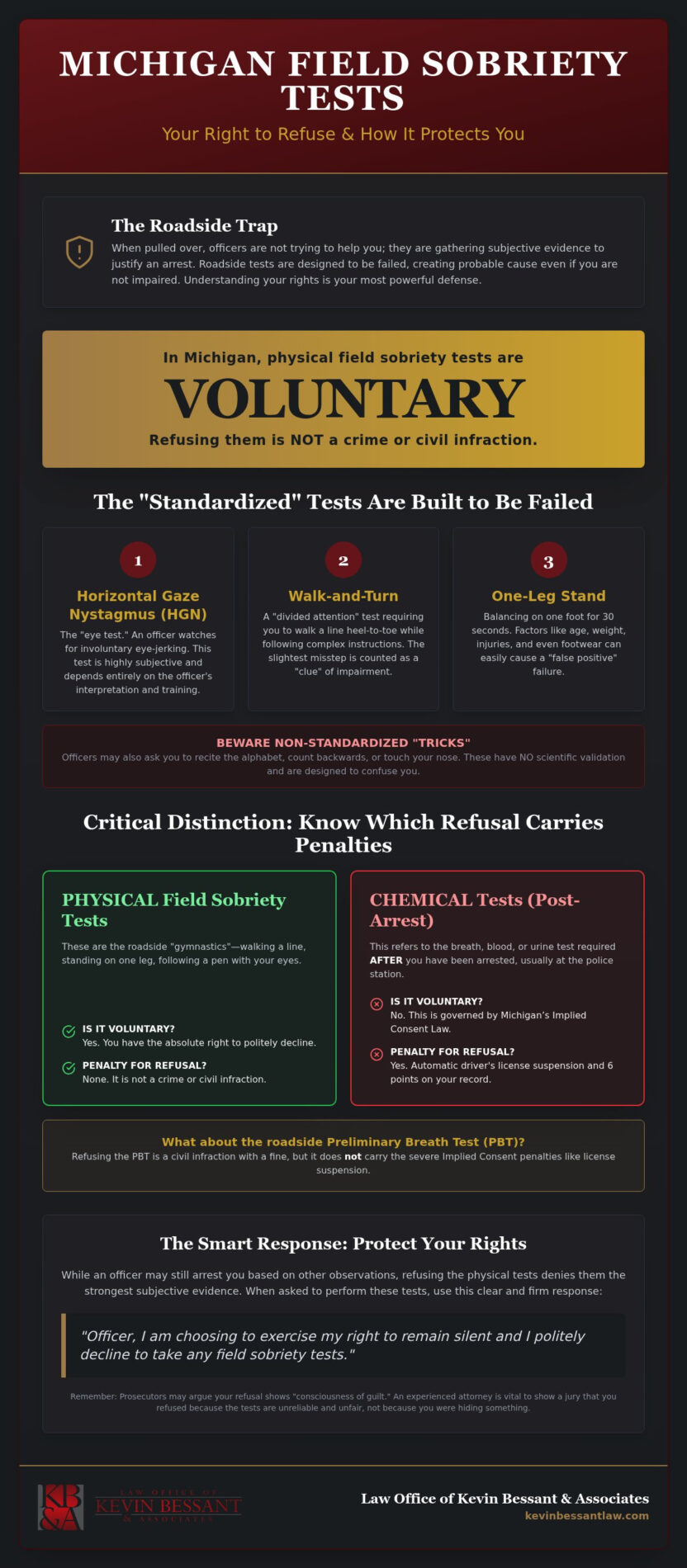
When an officer pulls you over in Southfield or Detroit, they aren’t looking for a reason to let you go. They are hunting for “clues.” Field Sobriety Tests (SFSTs) are roadside exercises designed to establish the probable cause necessary to put you in the back of a patrol car. Most drivers feel forced to comply, but the law is clear. These physical tests are voluntary. A field sobriety test refusal in Michigan is a powerful tool. It denies the prosecution the subjective evidence they desperately need to secure a conviction in a court of law.
The Three Standardized NHTSA Tests
The National Highway Traffic Safety Administration (NHTSA) recognizes three specific tests as “standardized.” However, these are often administered in less than ideal conditions, making them unreliable indicators of sobriety.
- Horizontal Gaze Nystagmus (HGN): This is the eye test. The officer watches for an involuntary jerking of the eyeball as it follows a pen or light. It is the most difficult test to challenge because it relies entirely on the officer’s interpretation of your pupil movement. Without a battle-ready expert on your side, this testimony often goes unchallenged.
- Walk-and-Turn: This “divided attention” test requires you to walk a straight line, heel-to-toe, while following complex instructions. Officers count even the slightest loss of balance or a missed heel-to-toe connection as a sign of impairment.
- One-Leg Stand: Balancing on one foot for thirty seconds sounds easy until you’re on a sloped shoulder with wind and flashing lights. Age, weight, or even a past knee injury can lead to a “false positive” failure.
Non-Standardized Tests: The ‘Tricks’ Police Use
Beyond the big three, officers often use “circus tricks” to gather more evidence. These include reciting the alphabet from a specific point, the finger-to-nose test, or the counting test. These exercises have no scientific validation from NHTSA. They are designed to confuse you and make you look impaired to a jury. Detroit’s uneven pavement and the high-pressure environment of a roadside stop make these tests even more unreliable. You should never feel obligated to perform these unvalidated stunts. If you are facing charges after a field sobriety test refusal in Michigan, your next step is critical. You need a shield. Kevin Bessant & Associates provides the aggressive advocacy required to fight back against subjective police testimony and protect your future. Don’t let a “trick” test lead to a life-altering conviction.
Can You Legally Refuse Field Sobriety Tests in Michigan?
You have the absolute right to say no. Don’t let a badge and a flashlight intimidate you into surrendering your constitutional protections. In Michigan, the law does not require you to perform roadside acrobatics. A field sobriety test refusal in Michigan is not a crime. It is not even a civil infraction. Unlike the chemical breath or blood test at the station, you face no automatic license suspension just for declining to walk a straight line or stand on one leg. You are in a high-stakes battle for your future the moment those sirens appear. Knowing when to stop talking and start asserting your rights is the only way to win.
The Legal Right to Say No
Michigan’s Implied Consent law applies to chemical tests like blood or breath samples taken after an arrest. It does not apply to physical agility exercises on the shoulder of the road. When an officer asks you to step out of the car, they are fishing for evidence to justify an arrest. You should decline politely but firmly. Use this exact phrase: “I am choosing to exercise my right to remain silent and decline these tests.” Silence is your shield. By refusing, you prevent the officer from documenting “clues” that are often just symptoms of nerves or fatigue. While the officer might still arrest you, they will do so without the “failed” test evidence that prosecutors use to crush your defense.
The Consciousness of Guilt Trade-Off
You must understand the tactical trade-off. Michigan courts generally allow prosecutors to tell a jury that you refused the tests. They will argue this shows a “consciousness of guilt.” They want the jury to believe you said no because you knew you would fail. This is where a battle-ready defense attorney becomes vital. We flow the script. We show the jury that you refused because the tests are rigged, unreliable, and fundamentally unscientific. According to NHTSA SFST Resources, these tests require strict adherence to specific protocols that officers rarely follow perfectly in the field.
A refusal is significantly easier to defend than a video of you stumbling because of Detroit’s cracked pavement or passing traffic. Without a “failed” test, the prosecution’s case is built on thin air and subjective officer opinion. If you are worried about how your refusal looks to a judge or jury, speak with a battle-ready advocate who knows how to dismantle the prosecution’s narrative and protect your freedom. We don’t back down from police testimony; we expose its flaws.
SFST vs. PBT Refusal: Clearing the Confusion
Drivers often panic when an officer pulls out a handheld breathalyzer. They confuse this roadside gadget with the massive machine at the police station. You must distinguish between the Preliminary Breath Test (PBT) and physical Field Sobriety Tests (SFSTs). A field sobriety test refusal in Michigan carries entirely different consequences than saying no to the handheld breathalyzer. The PBT is a roadside screening tool that is generally not admissible in court to prove your guilt, but it is used to justify your arrest. Knowing the difference between these two “requests” is the difference between keeping your freedom and handing the police the evidence they need to ruin your life.
The PBT Refusal Penalty
Refusing the PBT is a civil infraction, not a crime. If you say no to the handheld breathalyzer, you face a fine of up to $150 plus court costs. For most drivers, this refusal does not add points to your record or trigger an automatic license suspension. It is a minor penalty compared to the high-stakes consequences of an OWI conviction. Many battle-ready defense attorneys suggest that paying a small fine is a far better trade than handing the police a number they can use to justify an arrest. Do not confuse this roadside screening with the “Evidential” chemical test at the station. Refusing the station test triggers the Implied Consent Law, resulting in a mandatory one-year license suspension and six points on your record.
The SFST Refusal ‘Penalty’
Contrast the PBT fine with the consequences of declining physical exercises. There is zero fine, zero points, and zero license suspension for a field sobriety test refusal in Michigan. The law does not punish you for protecting your rights. The only “penalty” you face is tactical. Because of current court rulings, a prosecutor can tell a jury that you refused the tests to imply you were hiding your intoxication. We don’t fear this narrative. A jury hearing that you declined a rigged, subjective test is much easier to manage than a jury watching a dashcam video of you losing your balance on a dark, windy shoulder. The trade-off almost always favors the driver. By refusing, you force the officer to rely on their own biased observations rather than “data” from a flawed exercise. Kevin Bessant & Associates acts as your shield, ensuring that a tactical refusal doesn’t become a conviction. We specialize in dismantling the prosecution’s “consciousness of guilt” argument and exposing the unreliability of roadside testing.
Why Officers Want You to Fail: The Subjectivity of Roadside Testing
Standardized Field Sobriety Tests are not neutral evaluations. They are a trap. By the time an officer asks you to step out of your vehicle on a Detroit shoulder, they have often already decided you are impaired. They aren’t looking for proof of your sobriety; they are hunting for “clues” to justify an arrest. These “clues” are nothing more than subjective, biased observations. An officer might claim you “failed” because you started a test two seconds too early or moved your arms six inches away from your sides for balance. A field sobriety test refusal in Michigan is often the only way to stop an officer from manufacturing a one-sided narrative that a prosecutor will later use to crush you in court.
Medical and Physical Limitations
Many drivers fail these tests for reasons that have absolutely nothing to do with alcohol or drugs. If you suffer from back, leg, or inner ear injuries, maintaining the rigid balance required by police is physically impossible. Even the government’s own guidelines acknowledge that certain physical factors make these tests unreliable. For instance, being 50 pounds or more overweight or being 65 years of age or older can significantly skew results, leading to “false positive” failures. Beyond physical health, the sheer anxiety of a high-stakes police encounter can trigger tremors or “white coat syndrome.” An officer will gleefully label these natural stress responses as signs of intoxication rather than the human reactions they actually are.
Environmental Factors in Metro Michigan
The environment in Southeast Michigan is fundamentally hostile to physical testing. Detroit’s uneven, cracked pavement and crumbling shoulders make the idea of walking a “straight line” a legal fiction. If you are stopped in Warren or Eastpointe at night, you are likely battling poor lighting, blinding emergency strobes, and the buffeting wind from passing traffic. Michigan’s unpredictable weather—snow, black ice, and freezing rain—makes roadside acrobatics dangerous and invalidates the scientific basis of the exercises. Officers frequently ignore these variables in their reports to secure an arrest. They want a conviction, not the truth.
Don’t let a biased officer and a rigged test dictate the rest of your life. If you are facing OWI charges despite a field sobriety test refusal in Michigan, you need a shield between you and the system. We aren’t intimidated by police reports or subjective “clues.” Contact Kevin Bessant & Associates today to put a battle-ready advocate in your corner and fight for your freedom.
Arrested After Refusal? How Kevin Bessant & Associates Shields Your Future
An arrest is a crisis, but it is not a conviction. If you chose a field sobriety test refusal in Michigan, the police likely handcuffed you anyway, claiming “probable cause” based on their own biased perceptions. Don’t mistake this moment for a final judgment. It is the beginning of a high-stakes legal battle where your defense begins. Without a “failed” roadside test, the prosecution’s case is built on a foundation of sand. We immediately move to secure body cam and dash cam footage to expose the gap between the officer’s written report and the reality of the stop. If the officer cannot point to a failed physical test, they must rely on vague, subjective claims. We dismantle those claims one by one.
Aggressive Defense Strategies in Detroit Courts
We do not just wait for the court date; we go on the offensive. In Detroit, Southfield, and Warren courts, the success of your case often depends on attacking the officer’s initial observations. We file motions to suppress evidence, arguing that the stop was illegal or that the officer lacked the legal authority to arrest you. If you didn’t provide them with the “clues” from a roadside test, we force them to justify their actions under intense cross-examination. This aggressive approach often leads to reduced or dismissed charges during negotiations with prosecutors who realize their evidence is too weak to sustain a trial. We also move quickly to protect your driver’s license, ensuring that administrative deadlines do not result in an automatic suspension.
Why Kevin Bessant is Your Vital Shield
The legal system is a formidable opponent, but you should not stand alone. Kevin Bessant & Associates provides the battle-ready advocacy needed to navigate Michigan’s high-stakes drunk driving laws. We act as a dedicated protector for drivers facing life-altering outcomes. Early intervention is the most critical factor in saving your license and your freedom. You must Contact Us before your first court date to ensure your rights are protected from the moment you enter the system. We are not intimidated by police testimony or aggressive prosecutors; we are trained to win. Whether you are fighting a first-time OWI or a complex felony charge, our firm stands in the gap to secure the best possible outcome. Your future is worth the fight. Stand with a shield that knows how to win.
Legal Authority: Statute and Case Law
Michigan’s Implied Consent law governing chemical testing is codified at MCL 257.625a, and the standardized field sobriety test definition comes from MCL 257.62a, added by 2016 PA 242 and 243.
- People v Berger, 217 Mich App 213; 551 NW2d 421 (1996) — the Michigan Court of Appeals held that the only foundation required to admit HGN test evidence is proof that the test was properly performed and that the administering officer was qualified; no separate expert testimony is required to establish the test’s underlying scientific validity, which means challenging an officer’s specific training and technique is often the most direct way to attack this evidence.
For the current statutory text and published opinions, see the Michigan Legislature’s MCL database and the Michigan Courts case search.
Protect Your Freedom and Fight the System
The roadside stop was just the opening move in a high-stakes legal game. By choosing a field sobriety test refusal in Michigan, you denied the police the subjective evidence they need to secure a conviction. Now, you must act quickly to turn that tactical advantage into a winning defense. Your driver’s license and your future are on the line, and the prosecution is already building their case. You need a shield that won’t buckle under pressure. Kevin Bessant & Associates brings over 20 years of criminal defense experience to the fight, offering aggressive advocacy in Detroit, Southfield, and Warren courts.
We possess specialized knowledge of Michigan OWI and Implied Consent laws to dismantle the officer’s “probable cause” and expose the flaws in their investigation. Don’t let the system intimidate you into silence. An arrest is a crisis, but with the right advocate, it’s a crisis you can overcome. Don’t let a refusal ruin your future—contact Kevin Bessant & Associates for an aggressive DUI defense today. We are battle-ready and prepared to stand in the gap for you. Your future is worth the fight, and we are ready to lead it.
Frequently Asked Questions
Is it better to refuse or fail a field sobriety test in Michigan?
It is almost always better to refuse than to provide the police with a video of you failing. A failed test gives the prosecution a powerful visual “proof” of impairment that is difficult to challenge later. By opting for a field sobriety test refusal in Michigan, you force the officer to rely on their own biased observations rather than a recorded performance that a jury might find convincing. Denying them this evidence is your first step toward an acquittal.
Can the police force me to take a field sobriety test?
No, the police cannot physically force you to perform these tests. While an officer may use a commanding tone or imply that you have no choice, these exercises are entirely voluntary in Michigan. They are investigative tools used to build a criminal case against you. Stand your ground and politely decline. If you feel intimidated, remember that your refusal is a legal right that protects you from self-incrimination on the side of the road.
What happens to my license if I refuse the roadside tests?
Nothing happens to your driver’s license if you refuse physical field sobriety tests. Unlike the post-arrest chemical breath or blood test, physical exercises are not covered by Michigan’s Implied Consent law. You won’t receive points on your record or face an automatic suspension for saying no to the walk-and-turn or one-leg stand. This is a critical distinction that many drivers misunderstand during a high-pressure traffic stop. You keep your driving privileges while protecting your defense.
Will I go to jail if I refuse the field sobriety tests in Detroit?
You cannot be jailed simply for refusing to perform roadside exercises. Refusal is not a criminal offense or a civil infraction. However, the officer may still arrest you for OWI based on other observations like slurred speech or the smell of alcohol. While you might spend a night in custody following an arrest, refusing the tests ensures the prosecutor has less evidence to keep you behind bars long-term. A refusal protects your freedom by limiting the prosecution’s evidence.
Can a prosecutor use my refusal against me in a Michigan OWI trial?
Yes, a prosecutor can tell the jury about your field sobriety test refusal in Michigan to imply you were hiding your intoxication. This is known as “consciousness of guilt.” While this sounds damaging, a battle-ready defense attorney can counter this by explaining the tests are rigged and unreliable. It is much easier to explain why you refused a flawed test than to explain why you stumbled on camera. We turn their argument back against them.
What is the difference between a PBT and a field sobriety test?
A Preliminary Breath Test (PBT) is a handheld breathalyzer used at the roadside. Refusing it is a civil infraction carrying a fine of up to $150 but no points. Field sobriety tests are physical exercises like the “eye test” or balancing. There is no legal penalty for refusing physical tests. Both are screening tools used to establish probable cause for an arrest, but they carry different consequences for refusal. Knowing which is which helps you make the right choice.
Should I tell the officer why I am refusing the tests?
No, you should not provide a detailed explanation for your refusal. Anything you say can and will be used against you in court. If you mention a medical condition or an injury, the officer may use that to explain away your performance or twist your words into an admission of weakness. Simply state that you are exercising your right to remain silent and decline the tests. Keep your interaction brief, professional, and limited to necessary legal assertions.
Can I refuse the chemical test at the police station too?
You can refuse the station test, but the consequences are severe. Under Michigan’s Implied Consent law, refusing a chemical breath or blood test after a lawful arrest results in an automatic one-year license suspension and six points on your record. While you have the right to refuse, doing so triggers an administrative battle with the Secretary of State. You only have 14 days to appeal this suspension, making immediate legal intervention from a battle-ready advocate absolutely vital.
What does it take to challenge HGN eye-test evidence in court?
People v Berger, 217 Mich App 213 (1996), holds that HGN test results are admissible once the prosecution shows the test was properly performed by a qualified officer, without needing separate expert testimony on the science behind it, so challenging the officer’s specific training and technique is often the most direct line of attack.