

A single mistake at a checkout counter shouldn’t end your career, but in Michigan, it can trigger a life-altering felony conviction. If you’re facing a charge involving property valued at $1,000 or more, you’re staring down the barrel of first degree retail fraud Michigan penalties that include up to five years in a state prison. The system isn’t designed to be fair; it’s designed to prosecute, and without a fierce advocate, you’re standing alone against a machine that wants to label you a felon for life.
It’s natural to feel paralyzed by the fear of losing your employment or the crushing weight of a $10,000 fine. You deserve to understand how an aggressive, battle-ready defense can fight to get your charges reduced to a misdemeanor or even dismissed to protect your future. This guide breaks down the 2026 legal thresholds, the reality of potential prison time, and the tactical maneuvers used to shield your reputation from a permanent criminal record. You don’t have to let one moment of confusion dictate the rest of your life.
Key Takeaways
- Identify the specific legal thresholds under MCL 750.356c that elevate a retail incident to a high-stakes felony charge.
- Prepare for the reality of first degree retail fraud Michigan penalties, which can include up to five years in prison and $10,000 in fines.
- Recognize the long-term collateral damage of a felony record, including the loss of firearm rights and permanent damage to your career.
- Explore aggressive legal strategies used to challenge property valuation and prove a lack of intent to defraud the store.
- Understand why securing a battle-ready advocate is the most critical step in protecting your freedom and future from the legal system.
What is First Degree Retail Fraud in Michigan? (MCL 750.356c)
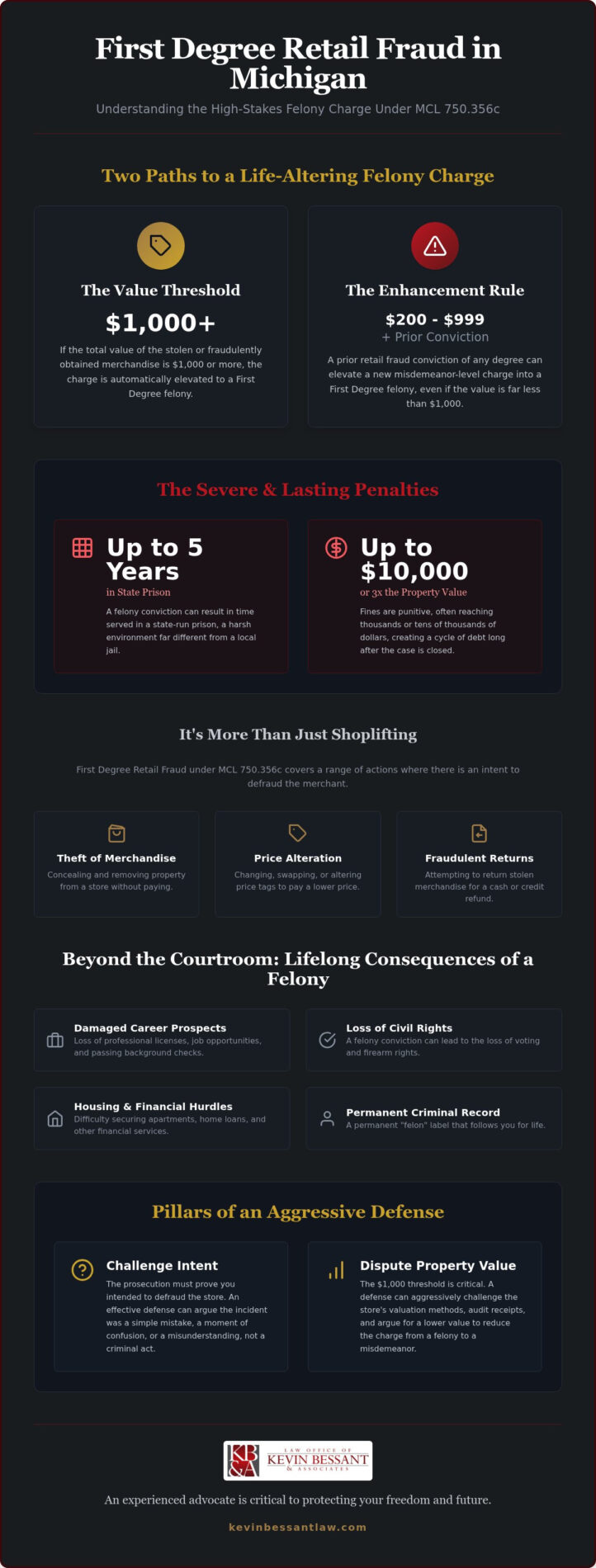
Michigan law doesn’t treat all theft the same. Under MCL 750.356c, First Degree Retail Fraud is the most severe level of shoplifting, categorized as a high-stakes felony. It’s not just about walking out of a store with an item. The statute covers altering price tags, switching packaging, or even attempting to get a refund for property you didn’t pay for. If the value of the merchandise is $1,000 or more, you’re no longer facing a simple ticket; you’re facing a life-altering legal crisis. Understanding What is Retail Fraud? helps frame the basics, but Michigan’s specific laws are designed to punish offenders with maximum force.
The Value Threshold and Intent
The $1,000 mark is the “magic number” for prosecutors. Once the value of the property crosses this line, the state upgrades the charge to a felony. Prosecutors don’t just look at what was taken; they look at your intent. If they can show you intended to defraud the store, the case moves forward. Even an “attempted” theft is prosecuted as a completed crime under this statute. Don’t assume that because you were stopped at the door, the charges will be lighter. The law views the act of concealment or price switching as the crime itself. You need a defense that aggressively challenges how the store calculated these values to protect your freedom.
Enhancement: The Hidden Danger of Prior Records
Your past can haunt your present. This is where many people find themselves blindsided by first degree retail fraud Michigan penalties. Under the enhancement rule, if you have a prior conviction for retail fraud in any degree, a new charge involving property worth between $200 and $1,000 is automatically elevated to a first-degree felony. The court looks back at your entire criminal history. They don’t care if your last mistake was years ago. This legal trap turns a misdemeanor-level incident into a five-year prison threat.
The prosecution will use your record as a weapon to paint you as a career criminal. You need a shield to stop them. At Kevin Bessant & Associates, we understand that a prior mistake shouldn’t define the rest of your life. We take a battle-ready approach to every case, ensuring that a single past incident doesn’t lead to a devastating felony conviction today. Don’t let the system use your history to crush your future; secure an advocate who knows how to fight back.
First Degree Retail Fraud Michigan Penalties: Prison and Fines
Facing a felony charge in Michigan is a high-stakes battle for your freedom. The state doesn’t view shoplifting as a minor lapse in judgment when the dollar amounts are high. Instead, the legal system prepares to use the full weight of the law against you. The first degree retail fraud Michigan penalties are designed to be punitive, expensive, and life-altering. You’re no longer dealing with a local ordinance; you’re facing a state-level prosecution that can dismantle your personal and professional life in an instant.
Incarceration and State Prison Time
A conviction for this offense carries a maximum sentence of five years in a Michigan state prison facility. It’s vital to understand the difference between jail and prison. While a misdemeanor might result in a few days in a local county jail, a felony conviction often leads to time in a state-run prison alongside violent offenders. Judges determine your actual time using the Michigan Sentencing Guidelines. These guidelines score your prior criminal record and the specific “offense variables” of your case. If your score is high, the judge is pressured to impose a harsher sentence. Don’t gamble with your future. An aggressive defense attorney fights to score these variables lower and advocates for alternative sentencing, such as the Holmes Youthful Trainee Act (HYTA) or specialized diversion programs, to keep you out of a cell.
The Financial Toll of a Felony Conviction
The state doesn’t just want your freedom; it wants your financial stability. Fines for a first-degree conviction can reach $10,000 or triple the value of the property involved, whichever is greater. If you’re accused of taking $5,000 worth of merchandise, you could be staring at a $15,000 fine before you even consider court costs or oversight fees. These first degree retail fraud Michigan penalties create a cycle of debt that’s difficult to escape. Beyond the immediate fines, you’ll face the collateral consequences of a felony, which often include the loss of high-paying job opportunities and housing denials. The economic impact of a permanent record far outweighs the initial cost of the items involved. If you’re feeling overwhelmed by the potential for financial ruin, it’s time to speak with a defense expert who can shield your assets and your reputation.
Felony probation is another reality many face. This isn’t “freedom.” It’s a period of intense state supervision that can last for years. You’ll likely face travel restrictions, mandatory drug testing, and regular check-ins with a probation officer. One small slip-up or technical violation can result in the judge revoking your probation and sending you directly to prison to serve your original five-year maximum. You need a battle-ready advocate to ensure the terms of your resolution are fair and manageable.
Beyond the Courtroom: Collateral Consequences of a Felony
The judge’s gavel is only the beginning of the struggle. While the immediate first degree retail fraud Michigan penalties like prison and fines are terrifying, the silent penalties that follow you for decades can be even more destructive. You’re no longer just a person who made a mistake; the state officially labels you a “felon.” This label acts as a permanent barrier to every basic necessity of a stable life. It’s a scarlet letter that tells the world you can’t be trusted, and it won’t go away once your sentence ends. You need a shield to prevent this label from defining your future.
Employment and Career Destruction
Retail fraud is legally classified as a “crime of moral turpitude.” This means it involves inherent dishonesty in the eyes of the law. Employers in Detroit and Southfield aren’t just looking for criminal records; they’re looking for signs of untrustworthiness. If you’re a nurse, a lawyer, or a real estate agent, a felony conviction can trigger an automatic suspension or revocation of your professional license. Background checks are brutal. Most corporate HR departments have “no-felon” policies that will stop your application before it even reaches a human being. You’ve worked too hard for your career to let it be dismantled by a single charge.
Loss of Constitutional Rights
Your freedom isn’t the only thing at risk. A felony conviction strips you of your Second Amendment rights. In Michigan, once you’re a convicted felon, you lose the right to possess, use, or carry a firearm. This is a permanent loss that affects your ability to protect your home and family. If you’re caught with a weapon later, you’ll face even more severe charges. You need a Gun Charge Lawyer Detroit to understand the gravity of these restrictions. Beyond firearms, you lose the right to serve on a jury and, in many cases, your ability to travel internationally. Countries like Canada often deny entry to anyone with a felony record, effectively locking you within the borders.
Housing is another battlefield. Landlords frequently use criminal records to deny applications, pushing individuals into less safe or more expensive living situations. The first degree retail fraud Michigan penalties extend into every corner of your existence. You need a fierce advocate who understands these high stakes and fights to prevent the “felon” label from ever sticking to your name. Protect your civil rights and your reputation before the damage becomes permanent. Don’t wait for the system to decide your fate; take a proactive step to secure your defense now.
Strategic Defenses: How to Fight Retail Fraud Charges
The prosecution wants you to believe your fate is sealed. They want you to think the evidence is ironclad and that the first degree retail fraud Michigan penalties are inevitable. They’re wrong. A felony charge is not a conviction. It’s a high-stakes legal battle, and like any battle, it requires a superior strategy to win. We don’t just wait for the court to decide; we take the fight to the prosecution by dismantling their case piece by piece. Your future depends on an advocate who knows how to find the cracks in the system.
Attacking the Evidence and Valuation
The $1,000 threshold is the foundation of a first-degree felony charge. If that foundation is shaky, the entire case collapses. Prosecutors often rely on the store’s “suggested retail price” (MSRP), but this isn’t always the legal standard for fair market value. We scrutinize how the store arrived at their numbers. Was the item on sale? Was it damaged or used? By successfully challenging the valuation, we can often force a reduction to a misdemeanor, saving you from the “felon” label. We also demand every second of surveillance footage and loss prevention reports. These documents frequently contain contradictions. When we cross-examine store security personnel, we expose these inconsistencies to create reasonable doubt in the minds of the jury.
Procedural and Constitutional Defenses
The police and store security must follow the law, even when they suspect you haven’t. If they violated your constitutional rights, the evidence they gathered might be inadmissible. We analyze the initial stop to see if there was actual “Probable Cause.” If security detained you without a valid legal reason, your rights were violated. We also look for Miranda violations. If you were interrogated while in custody without being read your rights, your statements can be suppressed. Securing your freedom starts early, often during the initial phases of your case. Utilizing the tactics of a Bond Hearing Lawyer Detroit ensures you aren’t fighting your case from behind bars. Freedom allows you to participate fully in your defense.
Negotiation is another powerful weapon. Sometimes the best path forward is a tactical retreat to a lesser charge. We aggressively negotiate with prosecutors to reduce felony charges to misdemeanors. This avoids the most severe first degree retail fraud Michigan penalties and protects your professional reputation. If you’re ready to stop feeling like a victim and start fighting back, you need to request a case evaluation today. Don’t let a single mistake or a false accusation destroy everything you’ve built. We are your shield, and we are ready to stand in the gap for you.
Why Kevin Bessant is Your Shield in Michigan Courts
Facing the legal system alone is a recipe for disaster. When the prosecution is pushing for maximum first degree retail fraud Michigan penalties, you need more than just a lawyer; you need a battle-ready advocate who stands in the gap for you. Kevin Bessant & Associates doesn’t view you as a case number on a docket. We see a person whose career, family, and freedom are under attack. Our firm acts as a vital shield, using over 20 years of legal experience to aggressively challenge the state’s narrative and protect your future from a devastating felony conviction.
Local Expertise in Detroit and Southfield
Michigan’s courtrooms aren’t uniform. The legal climate in Detroit differs significantly from the specific tendencies of judges and prosecutors in Southfield, Warren, or Troy. Navigating the 37th District Court in Warren or the 52-4 District Court in Troy requires specialized local knowledge that only a seasoned Retail Fraud Defense Attorney Michigan can provide. We understand how local benches score sentencing guidelines and what specific arguments resonate with regional prosecutors. This “home field” advantage allows us to anticipate the opposition’s moves and counter them before they can gain momentum against you.
Immediate Action for Your Freedom
Time is your greatest enemy in a felony case. The moment you’re arrested, the prosecution begins building their case to secure the harshest first degree retail fraud Michigan penalties possible. You can’t afford to wait. Early intervention is the most critical factor in achieving a favorable outcome. We prepare for trial from day one, scouring evidence for constitutional violations and procedural errors that others might miss. Our proactive approach forces the state to prove every single element of their charge, often leading to reduced counts or complete dismissals.
Don’t let the system intimidate you into silence. You deserve a defender who is formidable toward the opposition yet supportive and accessible to you. We’ve built a wall of credibility through decades of aggressive criminal defense litigation in high-stakes felony cases. Take the first step toward reclaiming your life and securing your reputation. Contact the Law Office of Kevin Bessant & Associates today to put a fierce advocate in your corner. Your freedom is worth the fight, and we’re ready to lead it.
Legal Authority: Statute and Case Law
Michigan’s first-degree retail fraud statute is codified at MCL 750.356c.
- People v Reddick, 187 Mich App 547, 551; 468 NW2d 278 (1991) — the Michigan Court of Appeals addressed the sufficiency of evidence needed to sustain a first-degree retail fraud conviction, confirming that concealment of merchandise combined with conduct suggesting intent to avoid payment can support a conviction, but the prosecution must still prove every statutory element, including the value of the property.
- People v Kenny, Mich App (2016) — relying on the pattern jury instruction M Crim JI 23.13(3), held that a person can “steal” property under the retail fraud statutes by concealing it with intent to keep it, even without ever leaving the store or reaching a register.
For the current statutory text and published opinions, see the Michigan Legislature’s MCL database and the Michigan Courts case search.
Take Command of Your Future Today
The state of Michigan is ready to use the full weight of the law to label you a felon. You cannot afford to wait for the system to show mercy. The first degree retail fraud Michigan penalties represent a catastrophic threat to your freedom, your right to possess firearms, and your professional license. You’ve seen how challenging property valuations and exposing procedural errors can dismantle the prosecution’s case. However, these tactics require a battle-ready advocate who understands the specific dynamics of local Detroit courtrooms.
Kevin Bessant & Associates brings over 20 years of criminal defense experience and aggressive trial tactics to your side. We don’t just manage cases; we fight for total victories. Whether we’re negotiating for a misdemeanor reduction or preparing for a high-stakes trial, our focus remains on shielding your reputation and securing your freedom. Do not stand alone against a felony charge; contact Kevin Bessant now for aggressive defense. You have the power to change the trajectory of this case. Let us stand in the gap and fight for the future you deserve.
Frequently Asked Questions
Is First Degree Retail Fraud a felony in Michigan?
Yes, First Degree Retail Fraud is a high-stakes felony charge under Michigan law. It is the most serious level of shoplifting and carries severe consequences that can dismantle your future. A conviction results in a permanent criminal record as a felon. This label triggers the loss of your right to possess firearms and can lead to up to five years in a state prison facility alongside violent offenders.
Can I go to prison for a first-time retail fraud offense?
You can absolutely be sentenced to prison for a first-time offense if the value of the property exceeds the $1,000 felony threshold. While some individuals may qualify for diversion programs, the prosecution often pushes for harsh first degree retail fraud Michigan penalties to set a public example. You need a battle-ready advocate to fight for alternative sentencing and ensure a single mistake doesn’t result in years behind bars.
What is the dollar amount for First Degree Retail Fraud in Michigan?
The primary threshold for a first-degree charge is $1,000 or more in stolen property or price-switching value. However, the law also includes a dangerous enhancement rule. If the value is between $200 and $1,000, but you have a prior conviction for retail fraud in any degree, the state automatically elevates the charge to a felony. Prosecutors also aggregate multiple smaller thefts occurring within a 12-month period to reach this limit.
Can a retail fraud charge be reduced to a misdemeanor?
Reducing a felony charge to a misdemeanor is a primary objective of our aggressive defense strategies. We achieve this by exposing flaws in the store’s valuation of the merchandise or by highlighting a lack of intent to defraud. If we can prove the fair market value of the items was actually under the $1,000 limit, the prosecution may be forced to offer a plea to a lower misdemeanor charge to avoid trial.
How long does a retail fraud felony stay on your record?
A felony conviction stays on your public criminal record permanently unless you successfully petition the court for an expungement. This record is visible to every employer and licensing board in cities like Troy or Royal Oak. Because retail fraud is legally viewed as a crime of dishonesty, it carries a heavy stigma. This “felon” label can prevent you from securing high-level employment or professional licenses for decades after your case ends.
What should I do if I am falsely accused of shoplifting?
If you are falsely accused, you must remain silent and immediately request an attorney. Do not attempt to explain the situation to store security or the police, as they will use your statements as evidence against you. We protect clients by securing surveillance footage, interviewing witnesses, and demanding the store produce proof of criminal intent. False accusations often stem from technical errors at self-checkout or misunderstandings by aggressive loss prevention officers.
Do I need a lawyer for a retail fraud charge in Detroit?
You need a fierce advocate to act as your shield against the aggressive tactics of Detroit prosecutors. A felony charge is a direct attack on your freedom and your reputation. Without a seasoned lawyer, you risk facing the maximum first degree retail fraud Michigan penalties. Attorney Kevin Bessant uses over 20 years of experience to navigate the 36th District Court and other local systems to ensure your rights are protected.
Can retail fraud be expunged under the Michigan Clean Slate law?
Many retail fraud convictions now qualify for expungement under Michigan’s Clean Slate laws. For most felonies, you must wait seven years after completing your entire sentence, including any probation or parole, before you are eligible to apply. This process is complex and requires precise legal filings to be successful. Clearing your record is a vital step in reclaiming your reputation and removing permanent barriers to employment and housing in Michigan.
Does the item have to leave the store for a felony retail fraud conviction?
No. People v Kenny confirms that concealing an item with intent to keep it can support a first-degree retail fraud conviction even if the item never made it past the registers or out the door.