
A 0.17% BAC reading on a breathalyzer isn’t a final verdict; it’s the start of a high-stakes battle for your freedom. You’re likely feeling the crushing weight of the Michigan super drunk law penalties, wondering if a single mistake will cost you your career and your right to drive. The anxiety is real. Between the threat of 180 days in jail and the mandatory ignition interlock requirements, the system is designed to feel overwhelming. You’re facing a legal machine that wants to label you as “Super Drunk,” but you don’t have to stand in that gap alone.
This guide reveals the severe consequences of a High BAC charge and, more importantly, how an aggressive defense can shield your future. You’ll learn the critical differences between a standard OWI and a High BAC offense, including the 45-day hard license suspension you must navigate. We’ll explore the strategic paths to getting charges reduced or dismissed so you can retain your driving privileges and stay out of a cell. The law is aggressive, but your defense must be even stronger. It’s time to stop worrying and start fighting back.
Key Takeaways
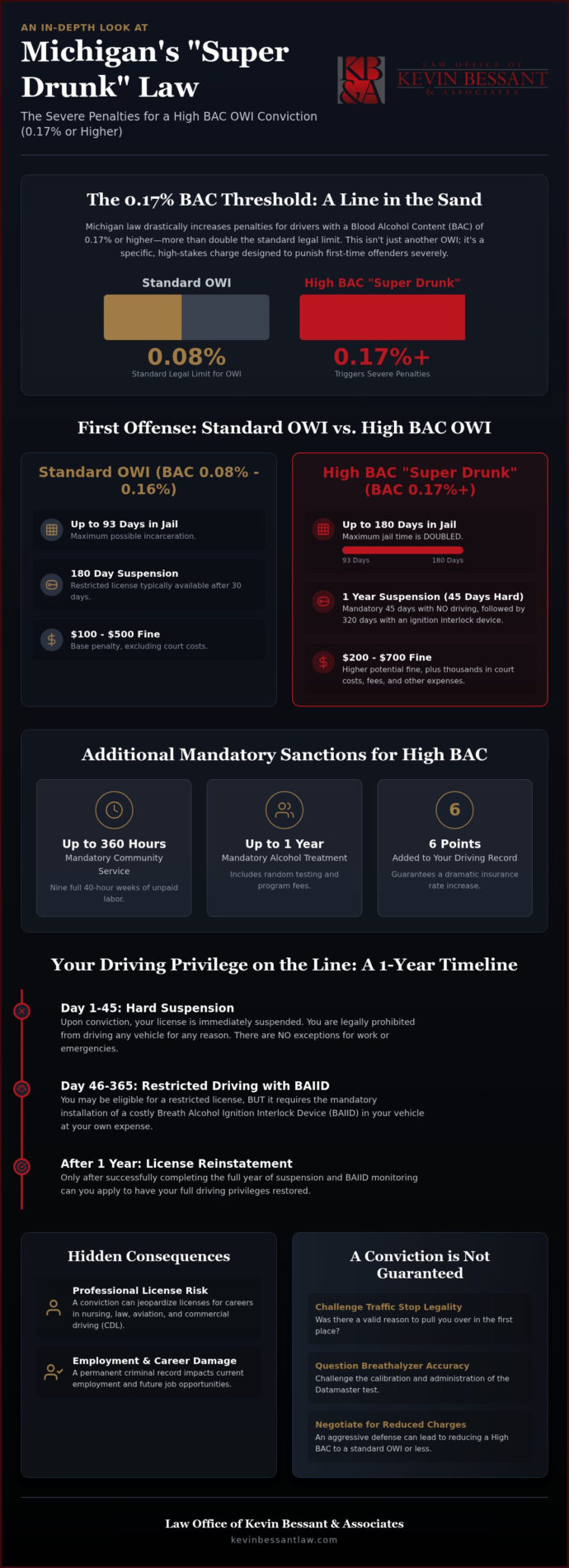
- Understand why a BAC of 0.17% or higher triggers the most severe Michigan super drunk law penalties, including up to 180 days in jail.
- Learn how to navigate the mandatory one-year license suspension and the 45-day hard no-driving period that follows a conviction.
- Recognize the hidden risks to your professional license or Metro Detroit career that extend far beyond the courtroom.
- Discover aggressive defense strategies to challenge Datamaster results and traffic stop legality to protect your future.
What is the Michigan Super Drunk Law (High BAC)?
In Michigan, a standard Driving under the influence (DUI) charge typically involves a Blood Alcohol Content (BAC) of 0.08. However, the state escalated the stakes in 2010 by introducing the “High BAC” law. While the public often calls it the “Super Drunk” law, the legal reality is much more clinical and dangerous. If your breath or blood test results show a BAC of 0.17 or higher, you are no longer facing a “standard” OWI. You have entered a category where the prosecution’s goal isn’t just a conviction; it’s an aggressive pursuit of the maximum Michigan super drunk law penalties. Michigan enacted this law specifically to punish drivers who are double the limit, viewing them as a unique threat to public safety.
The 0.17 Threshold: More Than Just a Number
The law draws a sharp, unforgiving line at 0.17. High BAC is a specific criminal classification under Michigan law that carries significantly harsher weight than a traditional OWI. For the prosecution, this number represents a “danger to the public” threshold. They argue that anyone operating a vehicle at double the legal limit is a high-level threat, which they use to justify more jail time and stricter oversight. This isn’t a suggestion; it’s a mandate for judges to treat you differently than someone who blew a 0.09. You aren’t just a driver who made a mistake; in their eyes, you’re a liability that needs to be controlled.
First Offense vs. Repeat Offender Status
A common misconception is that “Super Drunk” penalties only apply to people with a long history of drinking and driving. That’s a dangerous lie. This law was specifically designed to hammer first-time offenders who blow a high number. Even if you have no prior record, the system still ensures you face the full weight of Michigan super drunk law penalties. Don’t expect leniency from prosecutors in Metro Detroit. In Wayne, Oakland, and Macomb counties, the culture is one of zero tolerance. If you have a prior DUI on your record, the situation becomes even more precarious, as you may face felony-level scrutiny. You need a shield. You need to know why our firm is the right choice to stand between you and a system that wants to make an example out of you.
Michigan Super Drunk Law Penalties: The Cost of Conviction
A “Super Drunk” conviction is more than a legal stain; it’s a financial and personal wrecking ball. The state doesn’t just want you to pay a fine; it wants to fundamentally alter your lifestyle through a series of escalating sanctions. Understanding the full scope of the Michigan super drunk law penalties is the only way to prepare for the fight ahead. If you’re convicted, the court will strip away your autonomy, starting with your time and ending with your bank account. You’re facing a system designed to punish you, not just rehabilitate you.
Jail Time: Facing the 180-Day Threat
A standard OWI carries a maximum of 93 days in jail. Under the High BAC statute, that maximum doubles to 180 days. This isn’t just a theoretical number in a law book. In courtrooms across Southfield and Warren, judges often view a 0.17 BAC as a flagrant disregard for human life. They don’t hesitate to use jail time as a deterrent. Factors like a high-speed traffic stop or the presence of passengers can push a judge to lean closer to that 180-day limit. You aren’t just facing a few weekends in a cell; you’re facing half a year of your life behind bars.
Beyond the threat of incarceration, the financial burden is staggering. While the statute lists fines ranging from $200 to $700, the “hidden” court costs and fees often drive the total into the thousands of dollars. You’ll also be ordered to perform up to 360 hours of mandatory community service. That’s nine full weeks of unpaid labor that you must fit around your job and family life. On top of that, the Secretary of State will slap 6 points on your driving record, ensuring your insurance rates skyrocket for the foreseeable future.
Rehabilitation and Mandatory Treatment
The law requires mandatory alcohol treatment or education programs for up to one year. This isn’t a suggestion. Organizations like Mothers Against Drunk Driving (MADD) Michigan advocate for these strict measures to ensure high-BAC offenders are under constant surveillance. You’ll likely be subjected to “sober life” monitoring, which includes random testing and expensive program fees that you must pay out of pocket. If you miss a single session or fail a test, you’re looking at an immediate probation violation. The court’s patience is non-existent in these cases.
The system is rigged to keep you in its grip once you’re in the cycle of conviction. If you want to avoid these crushing sanctions, you must act before the court makes its move. Reach out to us to discuss your defense options and protect your future from these life-altering consequences.
License Sanctions and the Ignition Interlock (BAIID) Trap
Losing your license is the moment the weight of the Michigan super drunk law penalties truly hits home. It isn’t just a minor inconvenience; it’s a total shutdown of your independence. In Metro Detroit, where public transit is virtually non-existent, being unable to drive is a professional and personal crisis. The state doesn’t care about your mortgage or your family’s schedule. They want you off the road, and they use a complex administrative system to keep you there.
The 45-Day Hard Suspension
The law mandates a one-year license suspension, but the first 45 days are the most brutal. The 45-day suspension is a mandatory statutory requirement. There are zero exceptions for work, school, or medical emergencies during this window. You cannot drive to the grocery store. You cannot drive your children to school. If police catch you behind the wheel during this “hard” suspension, you face additional criminal charges and a permanent revocation of your driving privileges. You must plan for a total loss of mobility. It’s a non-negotiable reality of a High BAC conviction that forces you to rely on others for every basic necessity.
After you survive those 45 days, you don’t simply get your license back. You enter a “restricted” phase for the remaining 320 days of the year. This isn’t freedom; it’s a digital leash. You are strictly permitted to drive only to specific, court-approved locations:
- Your place of employment or to perform the duties of your job.
- Court-ordered alcohol treatment programs or support groups.
- Probation appointments and court hearings.
- Emergency medical facilities for you or a member of your household.
Living with the BAIID: Costs and Risks
Living with a BAIID is one of the most intrusive Michigan super drunk law penalties you’ll encounter. To access that restricted license, you must install a Breath Alcohol Ignition Interlock Device (BAIID) on every vehicle you own. This is where the administrative nightmare of the Secretary of State (SOS) begins. You’ll pay for the installation, the monthly rental fees, and the periodic data downloads. It’s a recurring financial drain that never lets you forget your charge.
Even worse, the technology is notoriously finicky. A single “false positive” caused by mouthwash or specific foods can trigger an immediate license revocation. You’ll be forced into an administrative hearing where the burden of proof is on you to prove you weren’t drinking. Beyond the technical risks, there’s a heavy social stigma. Every time you start your car in a parking lot, you’re broadcasting your legal status to the world. You need to know why our approach is designed to fight these outcomes before they become your reality.
Collateral Consequences: The Hidden Penalties
The judge’s gavel isn’t the final blow in a High BAC case. While jail and fines are immediate, the collateral damage of Michigan super drunk law penalties can haunt your personal and professional life for decades. In the competitive Metro Detroit job market, an OWI is a hurdle, but a “Super Drunk” conviction is often seen as a red flag that signals a deep-seated liability. Employers in the automotive, healthcare, and logistics sectors don’t just see a traffic offense; they see a risk they aren’t willing to take. You’re fighting for more than your freedom. You’re fighting to keep the life you’ve built.
Protecting Your Career and Professional License
If you hold a professional license, the stakes are astronomical. Nurses, doctors, lawyers, and CDL holders face mandatory reporting requirements to their respective licensing boards. A High BAC conviction often triggers an immediate “fitness to practice” review. The board may question your judgment and sobriety, potentially leading to the suspension or revocation of your livelihood. We don’t just focus on the courtroom; we act as a shield for your career. Kevin Bessant’s approach involves proactive litigation strategies designed to protect your professional standing and prevent a single night from ending your career. If you’re a CDL holder, a “Super Drunk” charge is a direct threat to your ability to provide for your family.
The reach of these penalties extends across the border as well. Canada views any alcohol-related driving offense with extreme severity. A “Super Drunk” label on your record can make you “criminally inadmissible,” meaning you’ll be turned away at the Windsor or Detroit crossings. Additionally, your auto insurance premiums will skyrocket. You’ll likely be forced into high-risk “SR-22” insurance, which can cost thousands of dollars extra each year. This is a long-term financial drain that never seems to end.
The Permanent Criminal Record
Many people believe they can just “clean up” their record later. While Michigan’s Clean Slate laws have expanded, expunging a High BAC conviction remains a complex and uphill battle. You might wonder, can a felony be expunged in Michigan? While the answer varies, a “Super Drunk” charge is a permanent scar that 2026 background check technology will find instantly. It won’t just say “DUI.” It will show a BAC of 0.17 or higher, highlighting the severity to every landlord or loan officer who sees it. Don’t let a conviction define your future. You need to contact our office today to build a defense that keeps your record clean.
Aggressive Defense: How Kevin Bessant Shields Your Freedom
A 0.17% BAC reading is a starting point for a fight, not a final verdict. Many people assume that once the breathalyzer machine spits out a number, the Michigan super drunk law penalties are inevitable. That’s exactly what the prosecution wants you to believe. We view that number as a challenge to be dismantled through rigorous forensic analysis and aggressive litigation. If the police violated your constitutional rights during the initial traffic stop or if the machine wasn’t calibrated correctly, that evidence shouldn’t stand in court. You aren’t just a case file; you’re a person whose future depends on a defense that doesn’t blink.
Trial readiness is the most powerful tool in our arsenal. When the prosecution knows your lawyer is battle-ready and willing to go to trial, their willingness to negotiate better plea offers increases. We fight to move your charge from a High BAC offense down to a standard OWI. This shift can save you months of jail time and protect your driving record from the most damaging sanctions. We don’t just wait for a plea deal; we force the system to prove every inch of its case against you. If they can’t prove the legality of the stop or the accuracy of the test, we push for a dismissal.
Technical and Scientific Defenses
The machines used by Detroit precincts aren’t infallible. We review maintenance records for Datamaster breathalyzers to ensure they were operating within legal tolerances at the time of your arrest. We also challenge the “rising blood alcohol” theory. This theory argues your BAC was actually lower while you were driving than it was when you were tested later at the station. Our firm is committed to scrutinizing every piece of forensic evidence to find the cracks in the prosecution’s case. If the blood draw procedure was flawed or the samples were mishandled, we move to suppress those results immediately.
Why You Need an Aggressive Detroit DUI Lawyer
There’s a massive difference between a “plea lawyer” who just wants to process your case and a “trial lawyer” who wants to win it. You need a dedicated advocate who understands the inner workings of the courts in Wayne, Oakland, and Macomb counties. Kevin Bessant has spent over 20 years standing in the gap for the accused, protecting clients from an overwhelming legal system. You shouldn’t settle for a lawyer who is intimidated by the prosecution or the high stakes of a High BAC charge. Learn more about why our firm is the shield you need in this crisis. Don’t wait for the system to steamroll your future. Contact Kevin Bessant now to build your shield and start fighting back against these life-altering Michigan super drunk law penalties.
Legal Authority: Statute and Case Law
Michigan’s High BAC (“Super Drunk”) statute is codified at MCL 257.625(1)(c), with implied consent and testing procedures at MCL 257.625a.
- People v Hammerlund, 504 Mich 442, 451; 939 NW2d 129 (2019) — the Michigan Supreme Court held that a warrantless OWI arrest made without probable cause requires suppression of the resulting breath-test results and statements, which applies equally to a High BAC arrest built on a weak stop.
For the current statutory text and published opinions, see the Michigan Legislature’s MCL database and the Michigan Courts case search.
Take Control of Your Future Today
The Michigan super drunk law penalties are designed to be crushing, but they don’t have to be your final story. You’ve seen how a High BAC charge threatens your license, your career, and your freedom through mandatory jail time and the intrusive BAIID requirements. These are high-stakes challenges that demand a proactive, vigorous response. A 0.17 reading is an invitation to fight, not a reason to surrender. By scrutinizing forensic evidence and challenging constitutional violations, you can push back against a system that wants to make an example of you.
Don’t let the prosecution dictate your outcome. Kevin Bessant offers over 20 years of high-stakes criminal defense experience and aggressive, trial-ready advocacy. He understands the inner workings of Metro Detroit court systems and knows exactly how to stand in the gap for the accused. You deserve a protector who isn’t intimidated by the system. Don’t Face a Super Drunk Charge Alone; Contact Kevin Bessant for an Aggressive Defense Today. Your future is worth the fight, and you can start protecting it right now.
Frequently Asked Questions
Is a Michigan Super Drunk charge a felony or a misdemeanor?
A first-offense High BAC charge is a misdemeanor under Michigan law, but don’t let that label fool you into thinking it’s minor. It carries significantly harsher Michigan super drunk law penalties than a standard OWI, including double the potential jail time. In courts from Warren to Southfield, prosecutors treat these cases with extreme severity. You are facing a criminal record that can disrupt your life just as much as many felony convictions would.
Can I get a restricted license immediately after a High BAC arrest?
No, you cannot obtain a restricted license immediately following a High BAC conviction. Michigan law mandates a 45-day “hard” suspension where all driving privileges are revoked. There are zero exceptions for work, school, or medical needs during this window. Only after this period ends can you apply for a restricted license, provided you install a Breath Alcohol Ignition Interlock Device (BAIID) in your vehicle and pay the required administrative fees.
What happens if I refuse the breathalyzer test in a High BAC case?
Refusing a breathalyzer test triggers Michigan’s implied consent law, leading to an automatic one-year license suspension and 6 points on your record. This administrative penalty is separate from your criminal case. Even if your High BAC charge is eventually dismissed in a Detroit court, you may still lose your license for the refusal. The police will likely obtain a search warrant for a blood draw anyway, leaving you with both the evidence and the refusal penalty.
How much does a Super Drunk lawyer cost in Detroit?
The cost of hiring a specialized DUI defense attorney in Metro Detroit varies based on the complexity of your case and the lawyer’s trial experience. Investing in an aggressive defense is about protecting your future income and freedom from the long-term Michigan super drunk law penalties. You should look for a firm that prioritizes trial readiness over quick pleas. While high-quality representation is an investment, the cost of a conviction often far exceeds any legal fees.
Will I lose my job if I am convicted of a High BAC offense?
A High BAC conviction can lead to termination, especially for those in healthcare, transportation, or positions requiring a professional license. Detroit area employers often view a 0.17 BAC as a major liability risk. If you are a nurse, lawyer, or CDL holder, you’re also subject to mandatory reporting requirements that could end your career. We fight to reduce these charges specifically to help you avoid the “Super Drunk” label that scares off most human resource departments.
Can a Super Drunk charge be reduced to a regular OWI in Michigan?
Yes, it’s possible to get a Super Drunk charge reduced to a standard OWI through aggressive legal negotiation and by challenging the evidence. We look for technical flaws in the Datamaster results or constitutional violations during your traffic stop in Royal Oak or Troy. A reduction significantly lowers the Michigan super drunk law penalties you face, eliminating the 45-day hard suspension and reducing potential jail time. This is a primary goal in our defense strategy.
What is the “hard suspension” period for a High BAC conviction?
The “hard suspension” for a High BAC conviction is a mandatory 45-day period where you are strictly prohibited from driving any vehicle. No judge in Eastpointe or Roseville has the authority to grant you a work permit or hardship license during these 45 days. This period is a statutory requirement that precedes the one-year restricted license phase. You must prepare for a total loss of mobility during this time, as any violation could lead to permanent revocation.
How does an ignition interlock device (BAIID) work?
A Breath Alcohol Ignition Interlock Device (BAIID) requires you to provide a clean breath sample before your vehicle’s engine will start. Once you’re on the road, the device will prompt you for “rolling re-tests” at random intervals to ensure continued sobriety. All data, including any failed tests or tampering attempts, is recorded and sent directly to the Secretary of State. A single false positive can lead to an immediate revocation of your restricted driving privileges.
Can the whole case be thrown out if the initial traffic stop was illegal?
Yes. People v Hammerlund, 504 Mich 442 (2019), holds that a warrantless OWI arrest made without probable cause requires suppression of the breath-test results and statements that followed, which applies with equal force to a High BAC charge built on a questionable stop.