

A Michigan identity theft charge is a felony the moment it's filed, and Wayne, Oakland, and Macomb County prosecutors treat intent as a formality rather than something they have to actually prove. It usually isn't a formality. The right defense depends on how the state built its case, not on a generic denial.
- Lack of intent to defraud is the strongest starting defense against most Michigan identity theft charges filed in 2026.
- Michigan identity theft is a felony under the Identity Theft Protection Act, carrying up to 5 years in prison and fines up to $25,000 for a first offense.
- Mistaken identity, authorized use, and unlawful search challenges each fit different fact patterns better than a one-size defense.
- A Detroit-area criminal defense lawyer can flag which identity theft charge defense fits your case during a free evaluation before your first court date.
Why this matters
Michigan charges identity theft as a felony from the first filing, not after conviction. That means bond conditions, employment questions, and professional license reviews start hitting your life before a jury ever hears the case.
Most of these charges get built the same way: a bank flags a transaction, a detective pulls records or a phone, and a name gets attached to the activity. That process has weak points, and a case that overlaps with a computer crime charge often has even more of them, because digital evidence has to survive a legal chain before it means anything in court.
If you've been arrested or you know charges are coming, say nothing further to police and get a lawyer who works Detroit-area courts on the phone today.
What makes the best defense against an identity theft charge
- Attacks an element the prosecutor must prove — not just your story, but a fact the state actually has to establish
- Matches how the identity information was actually obtained and used — a defense built on the wrong fact pattern collapses fast
- Survives the preliminary exam — Wayne and Oakland County judges bind cases over on thin showings; the defense has to hold up early
- Doesn't require you to testify — the strongest defenses work through motions and cross-examination, not your word alone
- Accounts for how the evidence was collected — warrant defects and chain-of-custody gaps matter as much as the facts themselves
- Keeps a felony off your record if it works — dismissal or reduction, not just a lighter sentence
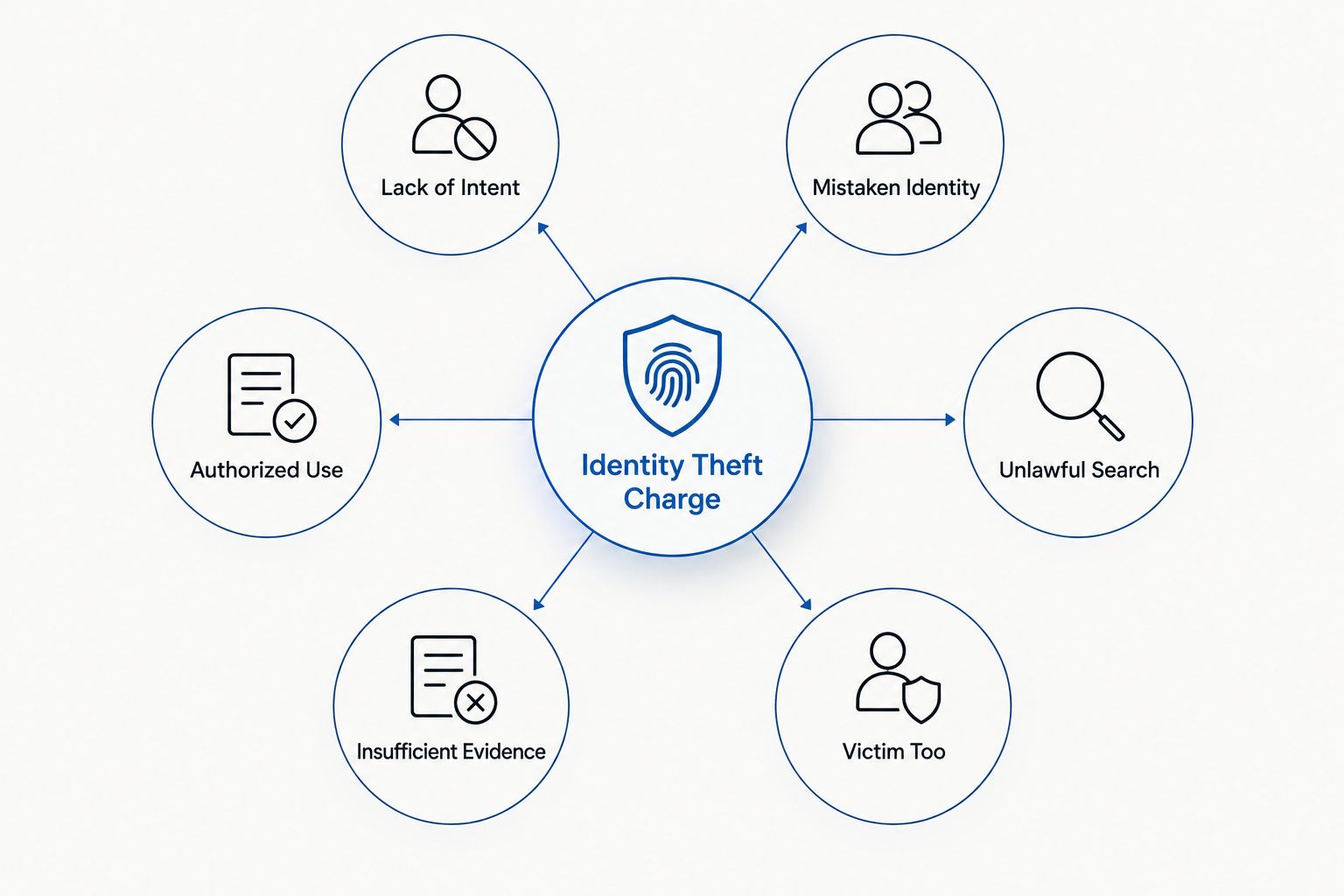
Identity theft defenses at a glance
| Defense | Best for | Standout feature | Key limitation |
|---|---|---|---|
| Lack of Intent to Defraud | Accidental or misunderstood use | Attacks the hardest element to prove | Weak against a signed confession |
| Mistaken Identity | Shared devices or accounts | Exploits weak digital attribution | Needs a named alternative user |
| Consent or Authorized Use | Family and employee account cases | Full defense if consent is confirmed | Falls apart if the "victim" denies it |
| Unlawful Search and Seizure Challenge | Cases built on phone or bank data | Can exclude the entire digital case | Needs an actual warrant defect |
| Insufficient Evidence / Chain of Custody | Cases resting on financial records | Forces the state to prove authenticity | Slow, rarely wins alone |
| Someone Else Used Your Identity | Defendants who are also victims | Reframes you as the victim | Needs proof you reported it early |
1. Lack of Intent to Defraud: best defense for accidental or misunderstood use
Michigan prosecutors have to prove you intended to use someone else's identifying information to fraudulently obtain money, property, credit, or services. If there's a legitimate explanation — a business arrangement, a misunderstanding about whose account it was — intent is the weakest link in the state's case.
Lack of intent pros:
- Attacks the element prosecutors struggle hardest to prove
- Doesn't require conceding the underlying facts
- Works well with a corroborated business or family explanation
- Often the fastest route to a dismissed count
Lack of intent cons:
- Harder to argue once financial gain is obvious
- Needs a believable explanation backed by something other than your word
- Doesn't survive a signed confession
Best for: defendants whose actions look bad on paper but had a legitimate purpose. Verdict: use it as your primary defense in most cases — it's the strongest starting point in 2026.
A charge built on intent alone is a charge built on the weakest fact the state has to prove.
2. Mistaken Identity: best defense for shared devices or accounts
An IP address, a shared Wi-Fi network, or a household device doesn't prove who actually typed the information in. Detroit-area investigators frequently charge the account holder, not the person who did the typing.
Mistaken identity pros:
- Strong when multiple people had access to the device or account
- Digital forensics is genuinely ambiguous in shared-household cases
- Easy to explain to a judge or jury
Mistaken identity cons:
- Needs actual evidence of other users — roommates, family, employees
- Weak on its own without a plausible alternative suspect
Best for: cases where a shared laptop, phone, or family account is the entire basis of the charge. Verdict: use it when access was shared, skip it if you were the only person who could have done it.
3. Consent or Authorized Use: best defense for family and employee account cases
Using someone else's card, login, or identifying information with their actual permission isn't identity theft under Michigan's Identity Theft Protection Act — the statute targets unauthorized use.
Authorized use pros:
- Complete defense when consent is real and provable
- Common outcome in family and small-business disputes
- Can end the case if the alleged victim confirms consent to police or in a statement
Authorized use cons:
- The alleged victim has to actually back your account
- Collapses if they deny giving permission
- Doesn't help if you went beyond the scope of what was authorized
Best for: cases involving a spouse, family member, or employer's account you had permission to use. Verdict: use it only when the other person will confirm consent — otherwise it's not viable.
4. Unlawful Search and Seizure Challenge: best defense for cases built on phone or bank data
A large share of Michigan identity theft cases run entirely on a phone dump, a cloud account, or a bank pull. If that evidence came from a search that exceeded or lacked a valid warrant, a Fourth Amendment motion can keep it out of trial entirely.
Search challenge pros:
- Can gut the prosecutor's entire digital case in one motion
- Doesn't require you to explain anything
- Judges take warrant defects seriously in felony proceedings
Search challenge cons:
- Requires an actual procedural error, not a hunch
- Adds a motion hearing and time to the case
- Doesn't touch non-digital evidence
Best for: cases where phone or financial records were pulled without proper authorization. Verdict: have counsel check the warrant on every case involving seized devices — this defense wins cases outright when it applies.
5. Insufficient Evidence / Broken Chain of Custody: best defense for cases resting on financial records
Identity theft cases lean on bank statements, surveillance stills, and data logs that pass through multiple hands and systems before reaching the prosecutor. Gaps in that chain can make the records unreliable or inadmissible.
Chain of custody pros:
- Works even when the underlying facts are hard to explain away
- Forces the state to prove authenticity, not just relevance
- Effective at preliminary exam stage in Wayne and Oakland County courts
Chain of custody cons:
- Technical and slow to develop
- Needs a lawyer who knows how to request and audit the actual records
- Rarely wins the whole case standing alone
Best for: cases where the state's evidence is entirely paper and digital records. Verdict: pair this with another defense — it weakens the case rather than ending it.
6. Someone Else Used Your Identity: best defense when you're also a victim
A growing number of Michigan identity theft defendants are victims themselves — their own login, account, or name got compromised and used by someone else to commit the underlying fraud.
Victim-too pros:
- Reframes you from suspect to victim in the eyes of the court
- Supported by fraud alerts, disputed charges, or a police report you filed
- Can lead to charges being dropped rather than reduced
Victim-too cons:
- Requires proof you reported the compromise before or shortly after the charge
- Weaker if you waited months to flag anything unusual
Best for: defendants who reported fraud on their own accounts before or around the time charges were filed. Verdict: use it immediately if you have any documentation of reporting fraud — it's the difference between suspect and victim on paper.
Talk to a Detroit defense lawyer now
Free case evaluation before your first court date.
How we ranked these defenses
Each defense above is ranked by how directly it attacks an element the prosecutor must actually prove, how it holds up at the preliminary exam stage in Wayne, Oakland, Macomb, and Washtenaw County courts, and whether it can end a case without putting you on the stand. Lack of intent ranks first because it targets the element every Michigan identity theft charge depends on; chain-of-custody arguments rank lower because they usually support another defense rather than winning alone.
Identity theft charges frequently travel with related counts — an embezzlement charge when the fraud involved an employer's funds, or additional computer-related counts when the evidence is entirely digital. The defense strategy has to account for every count filed, not just the identity theft charge in isolation.
Which defense should you use?
Start with lack of intent to defraud — it attacks the element every Michigan identity theft charge depends on, and it doesn't require you to explain away the facts. If your case turns on a shared device, phone data pulled without a warrant, or an account you had actual permission to use, one of the other five defenses may fit your specific facts better than a default explanation.
What matters right now isn't guessing which defense sounds best — it's getting a lawyer to look at the actual charging documents and evidence before your first court date. Kevin Bessant has spent 20+ years defending felony charges in Detroit-area courts, and an identity theft charge built on weak intent or bad digital evidence often falls apart once a defense attorney examines it closely.
FAQ
What is the penalty for identity theft in Michigan?
A first-offense identity theft conviction under Michigan’s Identity Theft Protection Act carries up to 5 years in prison and fines up to $25,000. Repeat or aggravated offenses involving multiple victims can carry harsher penalties.
Can identity theft charges be dismissed in Michigan?
Yes, identity theft charges get dismissed when the prosecutor can’t prove intent, the evidence was obtained unlawfully, or the alleged victim confirms consent. Timing matters, and challenging the case early gives more options than waiting until trial.
Is intent required for an identity theft conviction in Michigan?
Yes, Michigan prosecutors must prove you intended to use another person’s identifying information to fraudulently obtain money, credit, property, or services. Without provable intent, the charge doesn’t hold up.
What’s the difference between identity theft and fraud charges in Michigan?
Identity theft specifically involves using another person’s identifying information without authorization; fraud charges cover a broader range of deceptive financial conduct. The two often get charged together when a case involves both a stolen identity and a financial scheme.
Can I be charged with identity theft for using a family member’s card?
Only if you used it without their authorization. If the family member gave actual consent, Michigan’s Identity Theft Protection Act doesn’t apply, though the consent has to be provable, not just assumed.
How long does an identity theft case take in Michigan?
Timelines vary by county and by how much digital evidence the case involves, since forensic review and chain-of-custody challenges add time. Cases resolved through early motions typically move faster than ones that go to trial.
Does an identity theft charge show up on a background check?
An arrest or charge can appear on a background check even before conviction, and a felony conviction stays visible unless it’s later expunged. That’s why challenging the charge early matters more than waiting to see what happens at trial.
Should I hire a lawyer for an identity theft charge in Michigan?
Yes, because the charge is a felony from the moment it’s filed and the defense that works depends entirely on how the evidence was collected and what the prosecutor can actually prove. A lawyer familiar with Detroit-area courts can spot warrant and evidence problems you won’t see on your own.
One last thing
The defense that ends most identity theft cases early isn't a clever argument — it's a warrant that was pulled too broadly or a chain-of-custody gap nobody checked. If your case involves a phone, a cloud account, or bank records, that paperwork gets reviewed before anything else, because it's often the fastest way to a dismissed felony in 2026.
Related guides
- Best ways to get a Michigan criminal charge dismissed
- Best defenses against a Michigan home invasion charge