

A single moment of poor judgment at a suburban mall shouldn’t derail your child’s entire future, but the Michigan legal system is rarely that forgiving. You’re likely feeling a paralyzing mix of anxiety and fear, worried that a “thief” label will follow your teenager into every college application and job interview they ever face. It’s a high-stakes reality where the juvenile shoplifting consequences Michigan courts impose can include heavy fines, restitution, and a permanent scar on a criminal record before they even reach adulthood.
You’re right to be concerned, but you don’t have to let the system steamroll your family. This article will pull back the curtain on Michigan’s “Retail Fraud” laws, revealing how an aggressive, battle-ready defense can move the needle toward a case dismissal or a life-saving diversion program. We’ll explore the specific court processes for minors, the impact of “Clean Slate” legislation, and the strategic legal maneuvers that can protect your child’s reputation and give you back your peace of mind. The system is formidable, but with the right shield, your child’s future remains secure.
Key Takeaways
- Michigan law classifies shoplifting as “Retail Fraud” under MCL 750.356d, a formal criminal charge that carries far more weight than a simple store policy violation.
- The severity of juvenile shoplifting consequences Michigan imposes is dictated by specific value thresholds, where theft exceeding $1,000 can escalate into a life-altering felony.
- A retail fraud record can trigger “moral turpitude” clauses, creating permanent barriers to college admissions, FAFSA eligibility, and future professional licensing.
- Exercise your child’s right to remain silent immediately; statements made to police or store security are often weaponized to secure a conviction.
- Securing an aggressive defense with localized Metro Detroit court expertise is the most effective way to pursue case dismissals or clean-record diversion programs.
Retail Fraud vs. Shoplifting: The Legal Reality for Michigan Minors
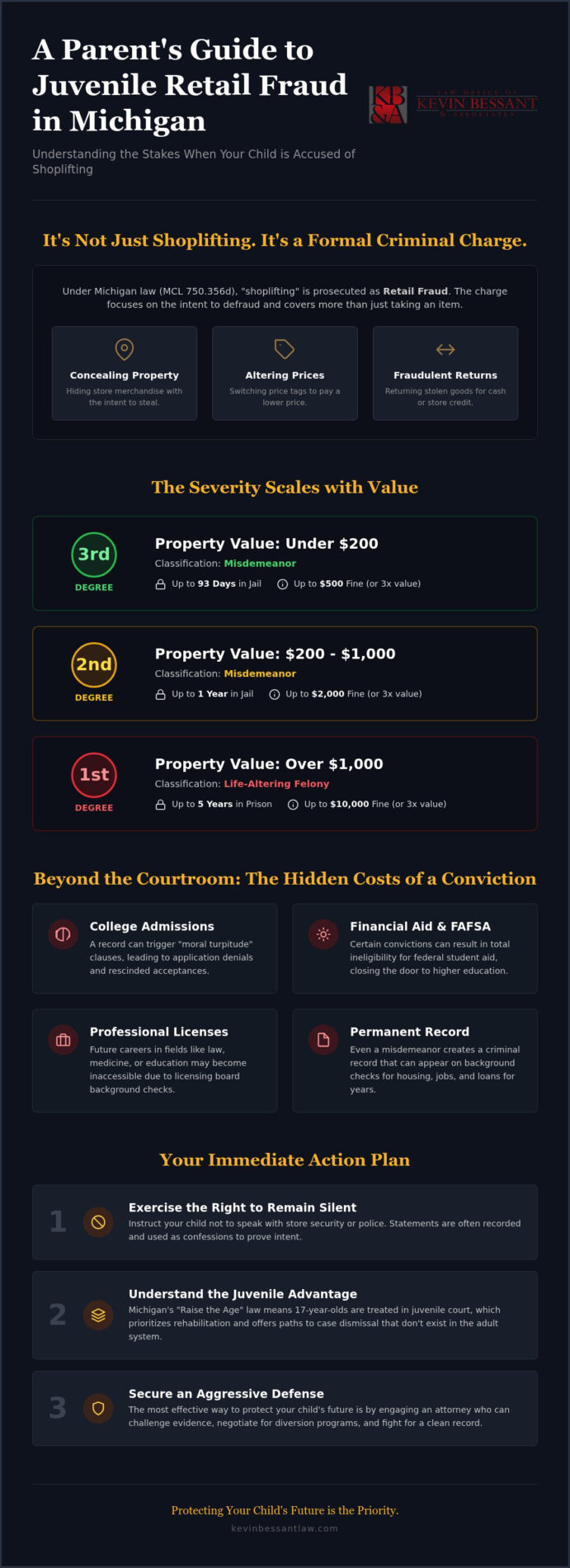
Under Michigan Compiled Laws (MCL 750.356d), what most people call “shoplifting” is formally charged as Retail Fraud. Don’t be fooled by the common name; the state treats these incidents with extreme severity. While a Shoplifting Overview might describe the act as a simple theft, Michigan law expands this definition significantly. Michigan Retail Fraud is the intentional misrepresentation of price or theft of store property. This includes switching price tags, fraudulent returns, or concealing items to bypass the register. Understanding these distinctions is vital because the juvenile shoplifting consequences Michigan courts impose depend entirely on how the prosecutor frames the intent behind the act. You aren’t just fighting a simple mistake; you’re fighting a statutory violation that can haunt your child for years.
The “Raise the Age” Legislation in Michigan
The legal landscape shifted dramatically with the “Raise the Age” legislation, which reached full implementation in 2024. Before this change, 17-year-olds were automatically funneled into the adult criminal justice system, facing the same harsh environment and permanent records as seasoned criminals. Now, 17-year-olds are legally recognized as juveniles in Michigan. This change provides a massive strategic advantage for your family. Juvenile court operates under a different philosophy, prioritizing rehabilitation and support over purely punitive jail time. It offers unique opportunities for diversion programs that can lead to a case dismissal, but these outcomes aren’t guaranteed. You need a battle-ready advocate who understands the nuances of Metro Detroit juvenile courts to secure these rehabilitative paths. Learn more about why our firm stands as a shield for families in crisis.
Intent and Evidence in Juvenile Cases
Prosecutors don’t just need to prove your child took an item; they must prove a specific “intent to defraud” the store. They build this case using high-definition surveillance footage and aggressive testimony from loss prevention officers who are trained to document every move a shopper makes. Most juveniles make a fatal mistake during this process. They try to explain their way out of the situation to store security or police. These statements are almost always recorded and weaponized as confessions in court. Don’t let your child become their own worst witness. The juvenile shoplifting consequences Michigan law allows for can be mitigated if we can prove a lack of criminal intent. We act as a shield to challenge the validity of the evidence and question the tactics used by store staff during the initial detention. If the evidence is shaky or the “intent” is actually a misunderstanding, we move to dismantle the prosecution’s case immediately. The stakes are too high to leave your child’s future to chance; contact us today to start building a defense.
Degrees of Retail Fraud: Penalties and Value Thresholds
The Michigan legal system categorizes retail fraud into three distinct degrees based on the dollar value of the items involved and the defendant’s prior criminal history. The state doesn’t care if the act was a dare or a momentary lapse in judgment; they use these tiers to determine how aggressively to prosecute your child. The juvenile shoplifting consequences Michigan courts enforce scale rapidly, moving from misdemeanors to life-altering felonies as the price tag increases. You aren’t just fighting a fine; you’re fighting a classification system designed to penalize. We stand in the gap to ensure a single mistake doesn’t define your child’s entire life.
Third-Degree Retail Fraud (Misdemeanor)
If the property is valued at less than $200, the charge is Third-Degree Retail Fraud. While this is the least severe tier, it still carries a penalty of up to 93 days in jail and a $500 fine, or three times the value of the stolen property. In Metro Detroit juvenile courts, judges may focus on rehabilitation, but the “thief” label remains a permanent threat. While you are Navigating Juvenile Probation or the initial court hearings, remember that even a misdemeanor can trigger “moral turpitude” clauses in future applications. We treat every 3rd-degree charge with the same urgency as a felony because your child’s reputation is on the line.
Second and First-Degree Retail Fraud (Felony Potential)
The stakes skyrocket once the value exceeds $200. Second-Degree Retail Fraud covers items between $200 and $1,000 and is punishable by up to one year in jail and a $2,000 fine. Once the value hits $1,000 or more, it becomes First-Degree Retail Fraud, a felony that carries up to five years in prison and a $10,000 fine. The juvenile shoplifting consequences Michigan law dictates for these higher-tier offenses are designed to be punitive, not helpful. The most dangerous trap is the “enhancement” rule. If your child has a prior retail fraud conviction, a new charge for a $50 item can be elevated to a Second-Degree misdemeanor. A new charge for a $250 item can be pushed into a First-Degree felony. This is where the system becomes predatory. A felony conviction can permanently derail college admissions and career paths in healthcare, law, or finance. If your child is staring down these high-stakes charges, securing an aggressive defense is the only way to shield their future from a predatory system. We don’t wait for the prosecution to move; we strike first to protect your family.
Life-Altering Consequences: The “Hidden” Costs of a Shoplifting Charge
A retail fraud conviction isn’t just a court record; it’s a character assassination that background check software will flag for decades. In the digital age, the “thief” label is a scarlet letter that follows your child into every adulthood milestone. Employers in the retail, financial, and pharmaceutical sectors often have zero-tolerance policies for crimes of dishonesty. If your child wants to work at a bank, manage a store, or handle sensitive inventory, this charge can lead to an automatic rejection. College admissions officers also look for “moral turpitude” during the application process. A conviction can jeopardize scholarship opportunities and FAFSA eligibility, effectively pricing your child out of a future before they even start. Even your child’s driving privileges are at risk. In Michigan, judges have the discretion to impose driver’s license sanctions as a condition of probation, even if the offense didn’t involve a vehicle.
Professional Licensing and Career Barriers
Many parents mistakenly assume that juvenile records are completely invisible once the child turns 18. This is a dangerous misconception. Professional licensing boards for nursing, law, and medicine in Michigan require full disclosure of all criminal history. Even if a record is “set aside” under the 2026 Clean Slate for Kids standards, it remains visible to state licensing agencies and federal government entities performing security clearances. The juvenile shoplifting consequences Michigan families face include being barred from high-level government roles or sensitive healthcare positions. Expungement is a powerful tool, but it shouldn’t be your primary strategy. You need to prevent the conviction from being entered in the first place. This requires an aggressive defense that challenges the prosecution’s evidence before it becomes a permanent part of your child’s history.
The Emotional and Social Toll on the Family
The trauma of the legal system extends far beyond the courtroom walls. Dragging your child through repeated hearings in Southfield or Detroit is an exhausting experience for the entire family. It creates immense stress at home and can lead to disciplinary actions or social isolation at school. The financial burden is also significant. Beyond legal fees, Michigan merchants can sue for civil damages up to 10 times the retail price of the stolen goods, with a minimum of $50 and a maximum of $200. This is why we position ourselves as a shield. We handle the heavy lifting of the legal system so you can focus on your family’s recovery. An assertive advocate doesn’t just fight the charge; they protect your child’s reputation from system-induced trauma. Learn more about how we protect families from these life-altering outcomes. The juvenile shoplifting consequences Michigan courts impose are designed to be heavy, but they don’t have to be permanent if you act now.
Immediate Action Plan: What to Do After a Juvenile Arrest
The moments immediately following an arrest are the most dangerous for your child’s future. Police officers and store security are not your friends during this process; they are gathering evidence to ensure the juvenile shoplifting consequences Michigan prosecutors seek are as severe as possible. You must take command of the situation immediately. Follow these steps to protect your family:
- Exercise the right to remain silent. Do not let your child explain, apologize, or “tell their side of the story” to anyone. These statements are almost always treated as recorded confessions in court.
- Secure your child’s release. Carefully review the “Notice to Appear” provided by the police. This document is a legal mandate that outlines the initial court date and the specific retail fraud allegations.
- Document the encounter. Write down every detail while the memory is fresh. Note the names of officers, the store’s specific location, and any aggressive or coercive tactics used by loss prevention staff.
- Contact a battle-ready attorney. Do not wait for the court to assign a public defender. You need an aggressive shield to begin dismantling the prosecution’s case before the first hearing.
The system moves fast, and any delay in your response gives the prosecution a head start. If you are facing this crisis, securing an aggressive defense immediately is the only way to ensure your child’s rights are protected from the start.
Navigating the Wayne and Oakland County Juvenile Courts
In Metro Detroit, the process usually begins with a preliminary inquiry or an intake meeting. This is a high-pressure environment where a court officer determines if the case should proceed on the “formal” or “informal” calendar. A formal calendar means a public record and a standard trial process. An informal calendar often allows for more lenient, private outcomes. Local nuances in Detroit and Southfield courts matter deeply. Each judge has a different threshold for retail fraud, and knowing these local preferences can be the difference between a harsh sentence and a second chance. We leverage our deep local knowledge to navigate these treacherous waters for you.
The Power of Diversion Programs
A skilled lawyer doesn’t just wait for a trial; we negotiate for the “Consent Calendar” or a specialized diversion program. These are paths that prioritize rehabilitation over punishment. If your child qualifies, they may be required to complete community service, attend counseling, or pay restitution. The ultimate goal of this strategy is a dismissed case. Upon successful completion, the charge is removed, leaving no permanent criminal record. This is how we save careers and reputations. We fight to ensure the juvenile shoplifting consequences Michigan law allows for do not become a permanent anchor on your child’s potential.
Aggressive Defense: Why Kevin Bessant is Your Child’s Best Shield
The Michigan legal system is a cold, bureaucratic machine that doesn’t care about your child’s potential. It only cares about securing convictions and moving through the docket. At the Law Office of Kevin Bessant & Associates, we don’t just “handle” cases; we wage war against a system that attempts to label minors as criminals before they’ve even graduated high school. Kevin Bessant operates with a fierce “Advocate-vs-System” philosophy, standing as a vital shield for families in Detroit, Southfield, and Royal Oak. With over 20 years of legal experience, he understands that the juvenile shoplifting consequences Michigan courts impose are a direct threat to your child’s livelihood. We don’t settle for “standard” outcomes or passive negotiations. We push for case dismissals and clean records because we know that a single mistake shouldn’t define a lifetime.
Custom Defense Strategies for Retail Fraud
We don’t take the prosecution’s evidence at face value. Store surveillance footage is often grainy, incomplete, or misinterpreted by loss prevention staff who are more concerned with store quotas than the truth. Our firm aggressively challenges these procedures, identifying gaps in the chain of evidence that can lead to a case being tossed out entirely. As a seasoned Retail Fraud Defense Attorney Michigan, Kevin Bessant negotiates from a position of strength. We don’t ask for mercy; we demand justice by exposing the flaws in the state’s case.
- We scrutinize store detention logs for potential civil rights violations.
- We challenge the “intent” behind the incident to dismantle the prosecution’s narrative.
- We leverage our deep relationships within the Metro Detroit court system to find alternative paths.
Whether it’s negotiating for a reduced charge or fighting for an alternative sentence that keeps your child’s record clean, we fight with a vigor that the public defense system simply cannot match. We understand the specific regional nuances of judges in Wayne and Oakland counties, and we use that knowledge to your child’s advantage.
Secure Your Child’s Immediate Future Today
Waiting to see “how things play out” is a recipe for disaster. The prosecution is already building their case, and store lawyers are looking for restitution. Early intervention is the only way to steer the narrative away from a permanent conviction. We have a proven track record of securing dismissals for first-time juvenile offenders by intervening before the court process gains momentum. The juvenile shoplifting consequences Michigan law allows can be devastating, but they aren’t inevitable if you have a battle-ready advocate by your side. You need a dedicated Juvenile Crime Attorney Detroit who treats your child’s future with the same urgency you do. Stop the anxiety and take control of the situation. Contact the Law Office of Kevin Bessant & Associates today for a consultation. Let us stand in the gap and protect what matters most.
Legal Authority: Statute and Case Law
Michigan’s retail fraud statutes are codified at MCL 750.356c (first degree) and MCL 750.356d (second and third degree).
- People v Kenny, Mich App (2016) — the Michigan Court of Appeals, relying on the pattern jury instruction M Crim JI 23.13(3), held that a person can “steal” property under the retail fraud statutes by concealing it with intent to keep it, even without ever leaving the store; whether the item ever left the premises is irrelevant to guilt.
- People v Reddick, 187 Mich App 547, 551; 468 NW2d 278 (1991) — addressed the sufficiency of evidence needed to sustain a first-degree retail fraud conviction, confirming that concealment of merchandise in the sales area, combined with conduct suggesting intent to avoid payment, can support a conviction.
For the current statutory text and published opinions, see the Michigan Legislature’s MCL database and the Michigan Courts case search.
Secure Your Child’s Reputation and Restore Your Peace of Mind
Michigan’s legal system won’t wait for your child to learn from their mistakes. As we’ve detailed, a simple retail fraud charge can quickly escalate into a life-altering felony based on value thresholds or prior records. You now know that the “thief” label isn’t just an insult; it’s a permanent barrier to professional licensing and college admissions. The juvenile shoplifting consequences Michigan courts enforce are severe, but your family doesn’t have to face this predatory system alone.
You need a battle-ready advocate who understands the specific nuances of Detroit and Southfield courts. With 20+ years of criminal defense expertise, Kevin Bessant stands as an aggressive shield against Michigan prosecutors, fighting to secure case dismissals and protect your child’s reputation. Do not let a mistake define your child’s life. Contact Kevin Bessant today for an aggressive defense. Your child’s future is still within reach, and with the right representation, you can put this crisis behind you once and for all.
Frequently Asked Questions
Will my child go to a juvenile detention center for shoplifting?
It is possible, but not guaranteed. Most first-time offenders in Metro Detroit won’t face immediate detention, but the court has the authority to order it for high-value thefts or repeat offenses. Judges in Wayne and Oakland counties often prioritize rehabilitation through probation or community service. However, if the incident involved violence or a significant breach of public safety, the risk of a juvenile detention center stay increases. You need an aggressive shield to fight for alternative sentencing.
Can a juvenile shoplifting charge be expunged in Michigan?
Yes, Michigan’s “Clean Slate for Kids” legislation, which reached full implementation in 2026, allows for the automatic setting aside of certain juvenile records. This process is designed to help young people move forward without a permanent criminal mark. However, some high-level felonies or specific repeat offenses may require a formal petition to the court. Don’t rely on automatic processes alone; ensure your child’s record is truly clear before they apply for their first career role.
What is the difference between shoplifting and retail fraud?
Shoplifting is the common term people use, but Michigan law formally classifies these acts as “Retail Fraud” under MCL 750.356d. This legal definition is broader than just taking an item. It includes switching price tags, fraudulent returns, or concealing merchandise while still in the store. Whether the incident happened in Royal Oak or Troy, the prosecutor will charge it as retail fraud based on the dollar value of the items involved and the specific intent.
Does a parent have to pay for the stolen items (restitution)?
Yes, parents in Michigan can be held financially responsible for their child’s actions. Beyond criminal restitution ordered by a judge, merchants in cities like Southfield or Warren often pursue civil damages. Michigan law allows retailers to sue for the retail price of unrecovered goods plus civil penalties of ten times the item’s value. These fines range from a $50 minimum to a $200 maximum. We fight to minimize these financial burdens on your family.
How much does a juvenile defense lawyer cost in Detroit?
Legal fees for a juvenile defense lawyer in Detroit vary based on the complexity of the case and the specific degree of the retail fraud charge. Factors like the number of court appearances, the need for expert testimony, and the intensity of negotiations with prosecutors influence the total cost. While we don’t provide a flat estimate here, investing in an aggressive defense now is significantly cheaper than the lifelong cost of a lost career or a permanent criminal record.
Will this shoplifting charge show up on my child’s college applications?
A retail fraud conviction can appear on background checks used by college admissions officers and financial aid departments. Many applications ask about “moral turpitude” or crimes involving dishonesty. If the juvenile shoplifting consequences Michigan courts impose aren’t mitigated through a diversion program or dismissal, your child’s FAFSA eligibility and scholarship opportunities are at risk. We work to ensure your child’s application remains clean and their academic future stays secure from these damaging marks.
Can my child be charged as an adult for shoplifting in Michigan?
Most minors are handled in juvenile court, but Michigan law allows juveniles as young as 14 to be waived to adult court for serious felonies. Since the “Raise the Age” law took effect, 17-year-olds are now treated as juveniles by default. However, if your child is 18 or older, they’ll face adult criminal court in Detroit or Southfield. The stakes in adult court are much higher and require a fierce, battle-ready advocate to prevent a prison sentence.
What happens if this is my child’s second shoplifting offense?
A second offense triggers “enhancement” penalties that can turn a minor misdemeanor into a serious felony. Michigan law allows prosecutors to use a prior conviction to increase the severity of a new charge, regardless of the stolen item’s value. For example, a second offense for property under $200 can be elevated to a Second-Degree misdemeanor. This pattern makes the legal system predatory for repeat offenders. You need immediate intervention to break this cycle and protect your child.
Does my child have to actually leave the store to be convicted of retail fraud?
No. People v Kenny confirms that concealing an item with intent to keep it, such as placing it inside a coat, can support a conviction even if the person never walked past the registers or left the building.