

In Michigan, a second OWI isn’t just a legal hurdle; it’s a direct assault on your freedom that the state treats with zero tolerance. If you’re facing DUI second offense Michigan penalties, you already feel the crushing weight of a system designed to break you. You’re likely staring down the terrifying reality of mandatory jail time, which ranges from 5 to 365 days under MCL 257.625. It’s natural to feel like the deck is stacked against you. The stigma of being labeled a repeat offender is heavy, and the anxiety of losing your driver’s license for at least a full year can feel like a life sentence.
You don’t have to stand alone against a prosecutor who wants to make an example of you in the 36th District Court. You deserve a battle-ready defense that acts as a shield between you and these life-altering consequences. This guide provides a strategic roadmap to navigate this high-pressure crisis. We’ll explore how to aggressively challenge the state’s evidence, fight for a restricted license, and employ tactics designed to keep you out of a jail cell. It’s time to stop the spiral and start building a defense that protects your future and your family.
Key Takeaways
- Understand why a second OWI conviction is a life-altering crisis and how the state’s legal system is built to prioritize your conviction over your future.
- Grasp the full extent of DUI second offense Michigan penalties to prepare for the aggressive prosecution tactics used to enforce mandatory jail sentences.
- Gain a tactical advantage in Detroit’s 36th District Court by leveraging local legal knowledge that can influence plea negotiations and sentencing.
- Identify the strategic shields used to dismantle the prosecution’s case by challenging the reasonable suspicion of your traffic stop and the reliability of sobriety tests.
- Discover how a battle-ready advocate acts as your definitive shield to protect your freedom and secure a path toward a restricted license.
The High Stakes of a Michigan DUI Second Offense (2026)
Michigan law doesn’t view a second OWI as a simple mistake. It treats it as a full-blown crisis. If you’ve been arrested for a second time within seven years, the state’s focus shifts from rehabilitation to strict, punitive measures. Under MCL 257.625, the DUI second offense Michigan penalties are designed to be life-altering. You’re no longer just a driver who made an error; you’re labeled a repeat offender. This triggers an immediate threat to your freedom. The legal system in Detroit and Southfield is built to move fast and hit hard. While Drunk Driving Laws in the U.S. vary by state, Michigan’s “habitual offender” framework is particularly brutal. You need a shield that can stand in the gap before the system crushes your future.
The danger isn’t just in the courtroom. It starts at the Secretary of State. A second conviction within seven years leads to an automatic, mandatory driver’s license revocation for at least one year. This isn’t a suspension you can wait out. It’s a total loss of driving privileges. In a region like Metro Detroit, where a car is your lifeline to work in Warren or Troy, this is a professional death sentence. The reality of DUI second offense Michigan penalties means you face a system that’s no longer on your side. The Detroit legal system is especially unforgiving to those who don’t fight back with vigor.
The 24-Hour Rule: Why Immediate Action is Critical
Don’t wait for your first court date to find an advocate. The first 24 hours after an arrest are the most critical for your defense. Evidence like dashcam footage or body-worn camera video from the Detroit Police Department can disappear or be overwritten if it’s not preserved immediately. Your bond hearing is your first real battle. It’s where a judge decides if you’ll walk out the front door or sit in a cell while your case proceeds. We use People v. Mezydlo to scrutinize the initial stop. We ensure the police actually had the reasonable suspicion required to pull you over. If they didn’t, the entire case could crumble.
Professional and Personal Fallout in Metro Detroit
A second conviction creates a permanent criminal label that follows you into every job interview and professional licensing board. Whether you’re a nurse in Southfield or a CDL holder in Warren, the fallout is devastating. Assertive representation is the only way to mitigate this damage. You aren’t just fighting a ticket; you’re fighting for your right to earn a living. We stand as your dedicated protector, ensuring the 36th District Court sees you as a human being, not just a case number on a docket. Don’t let a repeat offense define the rest of your life.
Mandatory DUI Second Offense Michigan Penalties: A 2026 Breakdown
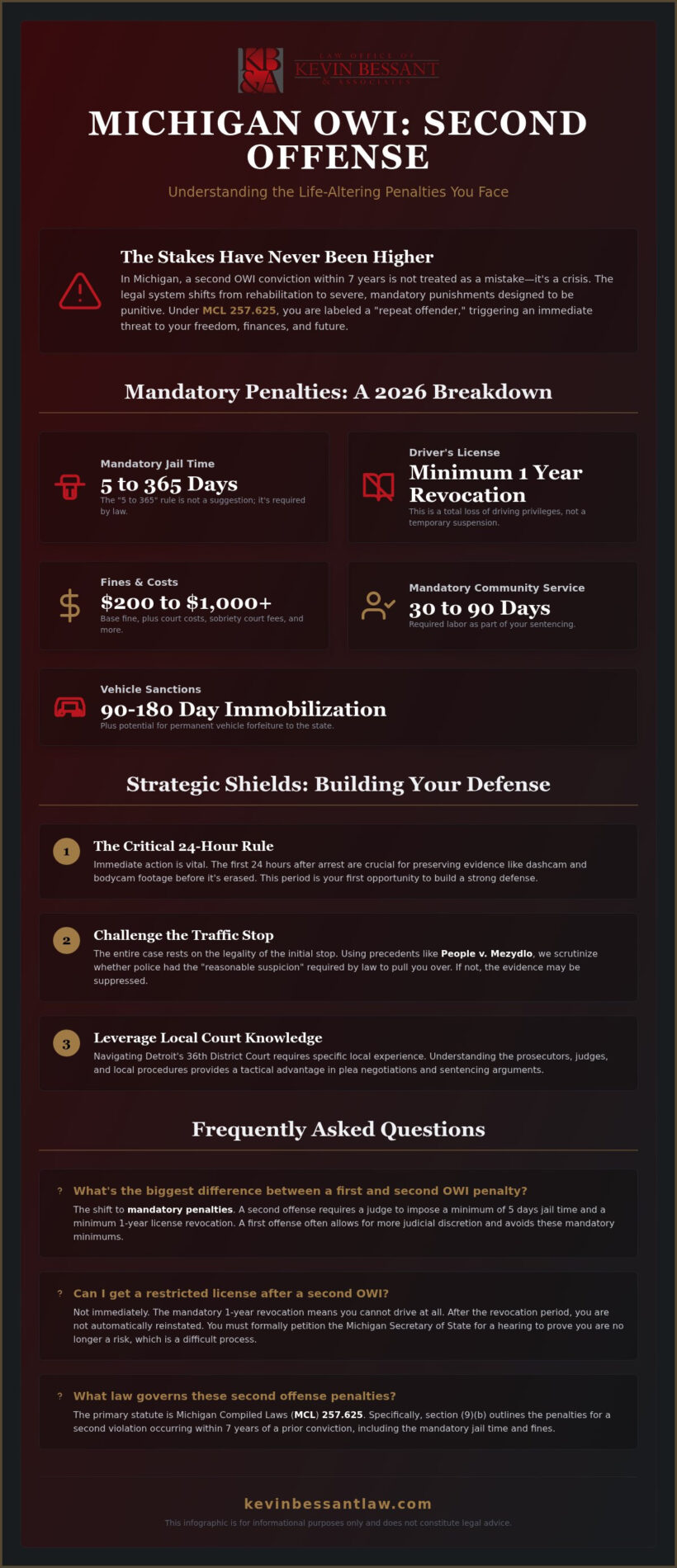
The jump from a first OWI to a second isn’t just a step; it’s a cliff. Michigan law removes almost all judicial discretion when you’re a repeat offender. Under MCL 257.625(9)(b), the court is required to sentence you to what we call the “5 to 365” rule. This means you’ll face a minimum of 5 days in a county jail, and a judge can legally keep you there for up to one year. This isn’t a suggestion; it’s the law. Beyond the cell, the financial impact is devastating. You’ll be hit with fines between $200 and $1,000, but that’s just the start. Once you add court costs, sobriety court fees, and oversight expenses, the price of your freedom skyrockets.
The state also demands your labor and targets your property through the following mandatory measures:
- Mandatory Community Service: You must perform 30 to 90 days of labor.
- Vehicle Immobilization: Your car will be locked down for 90 to 180 days.
- Potential Forfeiture: The state may attempt to permanently seize your vehicle.
This aggressive stance is part of Michigan’s Repeat Offender Laws, which are designed to remove “habitual” drivers from the road entirely. If you want to avoid the worst of these DUI second offense Michigan penalties, you need a defense that attacks the prosecution’s narrative from day one.
License Revocation vs. Suspension
Don’t confuse a suspension with a revocation. A first offense might result in a temporary suspension, but a second OWI within seven years triggers a mandatory license revocation for at least one year. Revocation means your driving privileges are destroyed. You don’t get them back automatically. You’ll have to fight through the grueling Secretary of State Driver Assessment and Appeal Division (DAAD) process. This involves proving your sobriety through substance abuse evaluations and multiple witness letters. We act as your shield during this administrative nightmare, helping you prepare the evidence needed to eventually petition for your driving rights.
The Super Drunk Factor in Repeat Offenses
If your Blood Alcohol Content (BAC) was 0.17 or higher, you’re facing the “Super Drunk” designation. For a repeat offender, this compounds the pressure. Judges in Detroit and Southfield often use high BAC levels as justification for the upper end of sentencing guidelines. We use People v. Krueger (2022) to ensure the police gave you proper warnings before the chemical test was administered. If they failed to follow procedure, that high BAC reading might not be as solid as the prosecutor thinks. In 2026, a second OWI conviction within seven years carries a mandatory minimum of 5 days in jail and a maximum of one year.
Navigating Detroit’s 36th District Court: Why Local Advocacy Matters
The 36th District Court in Detroit is a high-volume, high-pressure arena where your future is decided in minutes. If you’re facing DUI second offense Michigan penalties, you can’t afford to be represented by a generalist who only “dabbles” in criminal defense. Detroit prosecutors are seasoned and often cynical; they see a repeat OWI as a direct threat to public safety rather than a personal struggle. In 2026, the push for stricter enforcement remains high, as reflected in the evolving Drunk Driving Policy in Michigan. You need an advocate who’s a household name in the courtrooms of Detroit, Southfield, and Warren to ensure your voice isn’t drowned out by the machine of the state.
Judge and Prosecutor Tendencies in Metro Detroit
Local knowledge is the difference between going home or going to jail. Every judge in the 36th District Court or the 46th District Court in Southfield has specific tendencies regarding bond conditions and travel restrictions. Some judges view a second offense as an automatic reason to impose a high cash bond or mandatory daily breath testing before your case even starts. We understand these nuances. With 20+ years of trial-ready representation, the Law Office of Kevin Bessant & Associates knows how to present your case in a way that resonates with specific local benches. We navigate Chapter 6 of the Michigan Court Rules (MCR) with precision, ensuring every procedural safeguard is used to your advantage. Our local presence allows us to negotiate from a position of strength, often securing bond conditions that allow you to keep working while your case is pending.
The Advantage of a Battle-Ready Detroit Advocate
Prosecutors treat “plea-mill” lawyers with indifference. If they know your attorney never goes to trial, they have no incentive to offer a favorable deal. Being trial-ready changes the entire landscape of your case. When we challenge the prosecution’s evidence based on People v. Mezydlo, they know we’re prepared to take that argument to a jury if necessary. This assertive stance is what makes us a definitive shield. We don’t just “process” cases; we dismantle them. By strategically positioning your defense, we make the system work for you. This proactive approach is a core part of why our firm is chosen by those facing the most serious repeat OWI charges in Metro Detroit. We don’t just stand in the gap; we push back against the relentless pressure of the prosecution.
Strategic Shields: How to Fight Evidence in a Second-Offense Case
The prosecution wants you to believe their evidence is an impenetrable wall. It isn’t. Just because a Detroit police officer claims you failed a sobriety test doesn’t mean the case is closed. To beat DUI second offense Michigan penalties, we must aggressively dismantle the prosecution’s narrative from the ground up. We start by challenging the reasonable suspicion for your initial traffic stop. If the officer didn’t have a valid, articulable reason to pull you over, the entire case is built on a broken foundation. A proven Fourth Amendment violation regarding an illegal stop or seizure forces the court to suppress the evidence, often leading to a complete case dismissal.
We also employ a relentless three-prong attack on the reliability of Field Sobriety Tests (FSTs):
- Officer Compliance: Did the officer follow the strict NHTSA guidelines during the walk-and-turn or one-leg stand?
- Environmental Factors: Were you asked to perform these tests on uneven Detroit pavement, in high winds, or under the blinding lights of a patrol car?
- Physical Limitations: Do you have underlying medical conditions or injuries that make these “tests” biologically impossible to pass?
Don’t assume the DataMaster breathalyzer or a blood draw is infallible. These machines require precise calibration and strict adherence to administrative rules. If the 15-minute observation period was ignored or the blood draw protocol was botched, that evidence shouldn’t stand in court.
Dismantling the Prosecution’s Scientific Claims
Science in the courtroom is only as good as the people handling it. We look for common errors in Michigan blood-alcohol testing, specifically focusing on the chain of custody and potential fermentation in the vials. Under People v. Anstey, you have a statutory right to an independent chemical test. If the police denied you this right, Michigan’s Supreme Court has held that the remedy is a jury instruction on the point, not automatic suppression or dismissal of the case. We don’t just take the state’s lab results at face value. We use expert testimony to counter machine evidence, exposing the margins of error that prosecutors try to hide. It’s about creating reasonable doubt where the state wants certainty.
Procedural Errors and Constitutional Violations
Your rights don’t vanish because you have a prior conviction. We scrutinize every second of dashcam and bodycam footage to identify officer misconduct or Miranda violations. If you were interrogated while in custody without being read your rights, those statements must be suppressed. We use aggressive motion practice under MCR 6.110 to challenge the evidence before it ever reaches a jury. This proactive stance forces the prosecution to defend their shaky evidence or risk losing the case entirely. To start building your shield against these high-stakes charges, contact our Detroit defense team today for a strategic evaluation of your arrest.
Securing Your Future: The Clean Slate Law and Your Defense
A second OWI arrest is a direct threat to your legacy and your livelihood. You aren’t just fighting for your driver’s license; you’re fighting to keep a permanent mark off your criminal record that could follow you for the rest of your life. At the Law Office of Kevin Bessant & Associates, we serve as the definitive shield for those facing the overwhelming weight of the state’s power. We’ve spent over two decades in the legal trenches of Detroit, Southfield, Troy, and Eastpointe. We understand that the only way to bridge the gap between a high-stakes arrest and a restored future is through a relentless, trial-ready defense. Our Why Us factor is simple: we don’t back down when the consequences are life-altering.
The 2026 Clean Slate Law and Your OWI Record
Many drivers mistakenly believe that a mistake today can always be cleaned up tomorrow. However, under Michigan’s Clean Slate Law, specifically MCL 780.621, the rules for repeat offenders are incredibly rigid. While first-time OWI offenses became eligible for expungement under certain conditions starting in 2021, a second conviction remains ineligible for set-aside. This means that if you’re convicted, those DUI second offense Michigan penalties stay on your public record forever. There is no second chance for a second offense in the eyes of the record-clearing statutes. This reality makes your choice of representation today the most critical decision you’ll ever make. Navigating Michigan OWI Expungement possibilities actually starts with avoiding the second conviction entirely. Strategic planning at the very beginning of your case is the only way to ensure your future remains viable.
Take Control of Your Defense Now
The high-stakes nature of a repeat offense means you cannot afford a passive approach. Prosecutors in the 36th District Court are already compiling their evidence and reviewing your prior conviction to maximize the pressure. You must take immediate steps to preserve your Michigan driving privileges and protect your freedom before the window for defense narrows. We use every procedural tool available, including aggressive motion practice under MCR 6.110, to challenge the state’s right to proceed. We don’t just stand by; we push back against the system to secure the best possible outcome. Don’t let the prosecution dictate the terms of your life. You deserve an advocate who acts as a seasoned guide through treacherous territory. Contact the Law Office of Kevin Bessant & Associates for an Aggressive Shield and start building your defense today.
Legal Authority: Statute and Case Law
Michigan’s mandatory second-offense OWI sentencing is codified at MCL 257.625(9)(b), and the right to request an independent chemical test comes from MCL 257.625a(6)(d).
- People v Anstey, 476 Mich 436, 449-450; 719 NW2d 579 (2006) — the Michigan Supreme Court held that when police unreasonably deny a driver’s request for an independent chemical test, the remedy is a jury instruction on the violation, not dismissal of the charges or suppression of the state’s own test results.
For the current statutory text and published opinions, see the Michigan Legislature’s MCL database and the Michigan Courts case search.
Take Decisive Action to Protect Your Future
A second OWI charge is a high-stakes crisis that the Michigan legal system is built to exploit. You’ve learned that the state isn’t on your side; it’s focused on enforcing mandatory jail time and stripping away your driving privileges. However, you don’t have to accept a conviction as an inevitability. By leveraging an aggressive advocate-vs-system strategy, you can dismantle the prosecution’s case and challenge the very foundation of their evidence. Specialized knowledge of the 36th District Court is your most powerful tool in this fight. We understand the local tendencies that mean the difference between freedom and incarceration.
Facing DUI second offense Michigan penalties alone is a risk you can’t afford to take. With 20+ years of high-stakes criminal defense experience, we provide the vigor and determination needed to protect your livelihood. It’s time to stop the anxiety and start building a trial-ready defense that prioritizes your rights. You deserve a protector who isn’t intimidated by the system and knows exactly how to navigate this treacherous territory. Contact the Law Office of Kevin Bessant & Associates Today for an Aggressive DUI Second Offense Shield. Your future is worth the fight, and we’re ready to stand in the gap for you.
Frequently Asked Questions
What is the mandatory minimum jail time for a 2nd DUI in Michigan?
The law is clear: if you’re convicted of a second OWI within seven years, you’ll face a mandatory minimum of 5 days in jail. Under MCL 257.625(9)(b), a judge in Detroit or Southfield can sentence you to as much as one year behind bars. This 5-day minimum is a hard line that the state refuses to cross without an aggressive defense strategy. We fight to ensure your freedom isn’t sacrificed to a rigid system.
How long will my license be revoked for a second OWI offense?
A second conviction within seven years results in a mandatory driver’s license revocation for a minimum of one year. Unlike a suspension, revocation completely destroys your driving privileges. You don’t get your license back automatically. You must win a hearing at the Secretary of State Driver Assessment and Appeal Division. Our firm helps drivers in Warren and Detroit prepare the evidence needed to prove sobriety and eventually get back on the road safely.
Can a second DUI charge be reduced to an impaired driving (OWVI) charge?
While a reduction to Operating While Visibly Impaired (OWVI) is possible, it’s significantly more difficult for repeat offenders in the 36th District Court. Prosecutors often have strict policies against plea bargaining DUI second offense Michigan penalties down to lesser charges. You need a battle-ready advocate who can identify weaknesses in the state’s evidence to force a better negotiation. We use procedural errors to create the leverage necessary for a more favorable outcome.
Will I lose my car if I am convicted of a second DUI in Detroit?
Michigan law mandates vehicle immobilization for 90 to 180 days for a second OWI conviction. Beyond immobilization, the state has the power to seek permanent vehicle forfeiture under certain circumstances. This is a direct attack on your ability to work and provide for your family in Metro Detroit. We act as your shield, fighting to prevent the state from seizing your property and leaving you stranded without a lifeline.
Is a second-offense DUI in Michigan a felony or a misdemeanor?
A second DUI within seven years is classified as a misdemeanor in Michigan. However, don’t let that label fool you into thinking it isn’t serious. It carries mandatory jail time and life-altering license consequences that feel like felony-level pressure. If you’re arrested for a third OWI, or if your second offense causes serious injury or death, the state will upgrade the charges to a felony. We treat every case with high-stakes urgency.
How much does an aggressive DUI lawyer in Detroit cost for a second offense?
The cost of representation depends on the complexity of your case and the specific challenges within the Detroit or Southfield courts. While we don’t provide flat estimates without a consultation, you should view legal fees as an investment in your future freedom. Choosing a “cheap” lawyer often leads to the very jail time and license loss you’re trying to avoid. We focus on providing high-impact advocacy that prioritizes results over cut-rate processing.
What happens if I was on probation during my second OWI arrest?
Being arrested while on probation triggers an immediate probation violation hearing in addition to the new OWI charge. This creates a double-threat scenario where a judge can sentence you for the original crime and the new offense. You’re facing a high risk of immediate incarceration in Wayne or Oakland County. You need an advocate who can manage both legal battles simultaneously, protecting you from the compounded wrath of the court system.
Can I get a restricted license after a second DUI conviction in 2026?
You’re generally ineligible for a restricted license during the first year of your revocation. In 2026, the only way to bypass this “hard” revocation period is through participation in a state-sanctioned Sobriety Court program. If accepted, you may be eligible for a restricted license with an ignition interlock device. We guide clients through these specialized programs to help them maintain their employment and fulfill their responsibilities while the case proceeds.
What happens if police deny my request for an independent chemical test?
People v Anstey, 476 Mich 436 (2006), holds that the remedy for that violation is a jury instruction telling jurors the statutory right was denied, not automatic dismissal of the case or suppression of the state’s chemical test results.