

One mistake from your past shouldn’t mean a lifetime of vulnerability. In Michigan, the state doesn’t just hand back your rights; it forces you to fight for them through a legal minefield of “specified” felonies and mandatory prison sentences. If you’re caught with a weapon before the restoration of firearm rights Michigan process is complete, you face a terrifying five-year mandatory minimum for Felon in Possession. It’s a high-stakes gamble where the system is rigged against you unless you have an aggressive advocate standing in the gap to protect your future.
You’ve likely felt the frustration of confusing statutes and the constant anxiety that your Second Amendment rights are gone for good. We know you’ve served your time and deserve to protect your family without the fear of new criminal charges hanging over your head. This guide outlines the aggressive legal strategies required to navigate these complex laws and reclaim your constitutional shield. You’ll learn how to distinguish between felony types, how to meet the “clear and convincing evidence” standard in your local Circuit Court, and the truth about federal bans that might still apply even after state rights are restored.
Key Takeaways
- Identify whether your conviction falls under “specified” or “non-specified” status to determine if your path to the restoration of firearm rights Michigan is automatic or requires a court battle.
- Protect yourself from the 5-year mandatory minimum by mastering the legal timeline that must be satisfied before you can legally possess a weapon.
- Understand why Michigan’s 2026 Clean Slate Law may not automatically return your gun rights and what additional steps are necessary to secure your shield.
- Learn the technical filing requirements for MCL 28.424 petitions, including why your county of residence is the only place you can reclaim your rights.
- Discover how aggressive legal advocacy can bridge the gap between state-level restoration and complex federal prohibitions.
The High Stakes of Firearm Rights Restoration in Michigan
The moment a judge strikes the gavel on a felony conviction, your constitutional rights vanish. Under MCL 750.224f, Michigan law strips you of the ability to possess, use, transport, sell, or purchase a firearm. This isn’t a suggestion; it’s a total disarmament. For many, the shock comes from realizing that even “non-violent” felonies trigger this lifetime ban initially. You’re suddenly classified as a “prohibited person,” a label that carries heavy social stigma and professional roadblocks. Worse, the state sets a lethal trap: if you’re found with a weapon before the restoration of firearm rights Michigan process is legally finalized, you face a “Felon in Possession” charge. That’s a five-year felony and a mandatory minimum prison sentence that can destroy what’s left of your life.
Recent legislative shifts have only tightened the noose. In 2024, Michigan expanded these restrictions to include certain domestic violence misdemeanants. By 2026, these changes have fully integrated into the enforcement landscape, meaning more citizens are caught in the crosshairs of complex Michigan gun laws. Reclaiming your rights is about more than just owning a tool; it’s about restoring your status as a full citizen and securing a vital shield for your family. The path to the restoration of firearm rights Michigan demands precision, as the system is designed to keep you disarmed indefinitely.
The Immediate Consequences of a Felony Conviction
A felony conviction doesn’t just take your guns; it takes your peace of mind. You can’t even have ammunition in your home without risking a fresh arrest. This ban applies regardless of whether your crime involved a weapon. The system treats a white-collar fraud conviction with the same tactical suspicion as a violent assault when it comes to firearm ownership. You’re left defenseless, unable to participate in hunting traditions or protect your household, all while the state watches for any slip-up. This “prohibited person” status can even impact your ability to live in a home where others legally own firearms, creating a legal minefield for your entire family.
Why Waiting for “Automatic” Restoration is a Risk
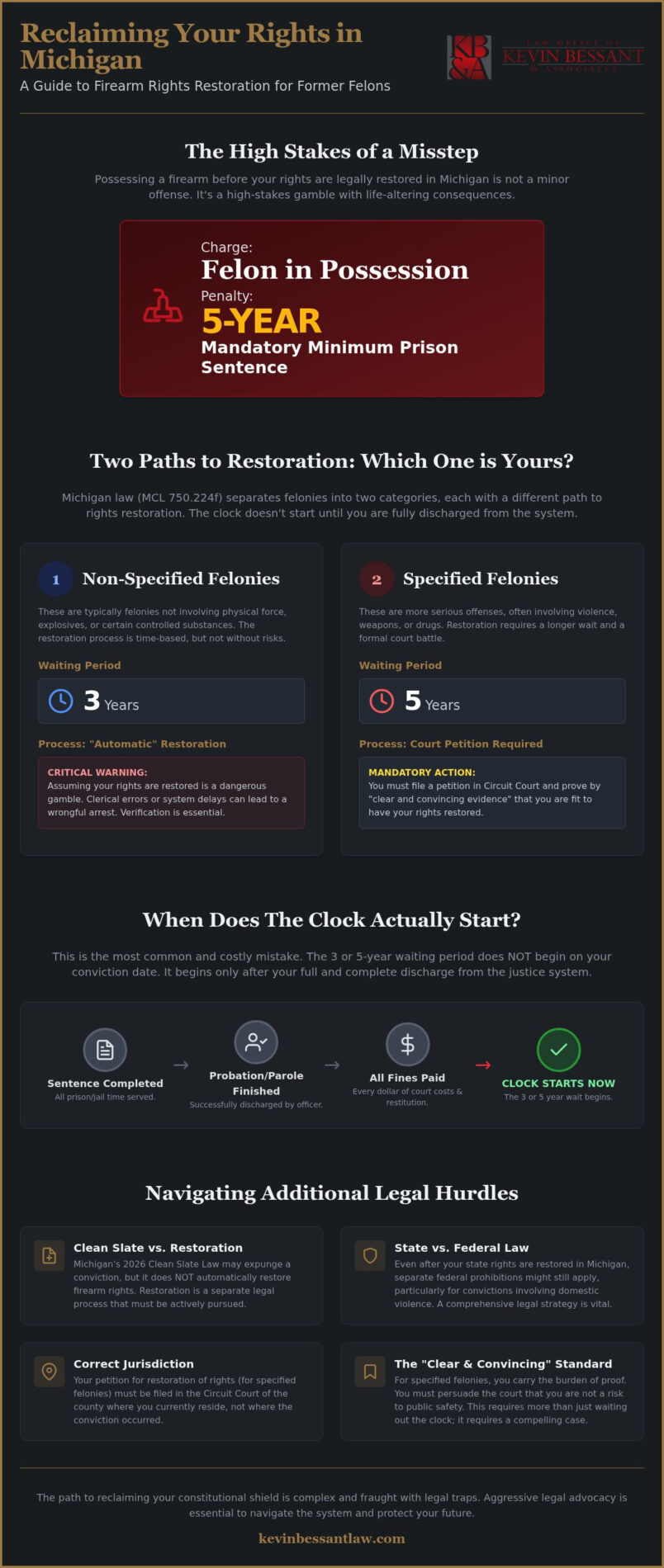
Michigan law divides felonies into “specified” and “non-specified” categories. While non-specified felonies theoretically allow for “automatic” restoration after three years, this is a dangerous assumption. Don’t bet your freedom on a clerical update that might not have happened. If the police run your name and the system hasn’t cleared, you’re headed back to a cell. For specified felonies, the five-year wait is only the beginning; you must petition the court and prove your worthiness by clear and convincing evidence. Standing alone against a prosecutor who wants to keep you disarmed is a losing battle. You need a battle-ready advocate to ensure your petition is airtight. Our firm stands in the gap to prevent these procedural traps from becoming life-altering prison sentences.
Specified vs. Non-Specified Felonies: Decoding MCL 750.224f
Michigan law doesn’t treat all convictions equally. MCL 750.224f creates a strict hierarchy that dictates your path to the restoration of firearm rights Michigan. If your crime is “non-specified,” you face a three-year waiting period. For “specified” felonies, that wait stretches to five years and requires a formal petition to the circuit court. The system is designed to be confusing, and the distinction between these two categories determines whether you get your rights back through time or through a high-stakes legal battle.
Don’t assume the calendar is your friend. The timer for the restoration of firearm rights Michigan only begins once you’ve achieved a full “discharge.” This means every fine is paid, every hour of community service is logged, and your parole or probation officer has officially signed off. If you owe even a single dollar in court costs, the clock hasn’t started. Possessing a firearm one day before this period ends triggers a “Felon in Possession” charge, carrying a five-year mandatory minimum that can’t be bargained away.
Determining Your Felony Classification
It’s not just the name of the charge that matters; the technical criteria focus on the specific elements of your crime. A “specified felony” often involves physical force, explosives, or controlled substances. You need to verify your exact MCL code to see if you’re facing the mandatory petition process. Use this checklist to evaluate your status:
- Assaultive Crimes: Any felony involving the use or threatened use of physical force.
- Drug Offenses: Violations involving the manufacture, possession, or distribution of controlled substances punishable by more than one year.
- Burglary: Breaking and entering an occupied dwelling.
- Weapons Offenses: Any crime involving the unlawful use or possession of a firearm.
If your conviction fits any of these, you can’t just wait three years and hope for the best. You must fight for your rights in court. Before you take that risk, reach out for a professional review of your criminal history to avoid a costly denial.
The 2026 Legal Landscape for Gun Rights
As of August 2026, the Michigan Supreme Court has maintained a rigorous standard for these petitions. Prosecutors in Wayne and Oakland counties are notorious for challenging even the smallest technicality in your discharge records. A common error is miscalculating the date of final discharge, especially if you had a probation violation that extended your term. Recent rulings emphasize that the burden of proof rests entirely on you to provide “clear and convincing evidence” that you aren’t a danger to society. If your paperwork doesn’t perfectly align with the court’s records, your petition will be dismissed, and you’ll be forced to wait years before trying again. We stand as your formidable shield against these procedural traps, ensuring your path to restoration is handled with surgical precision.
Restoration vs. Expungement: Which Path Protects Your Future?
Don’t fall for the myth that a “clean record” automatically means you’re legally armed. Michigan’s 2026 Clean Slate Law has changed the game for thousands of citizens by automating the set-aside process for certain offenses. However, this legislative update hasn’t simplified the Second Amendment. Expungement and the restoration of firearm rights Michigan are two distinct legal weapons. You need to know which one to fire first to ensure you don’t end up back in a courtroom facing new felony charges.
Expungement, or “setting aside” a conviction, acts as a shield for your reputation. It hides your past from employers, landlords, and public searches. But the Michigan State Police and federal agencies maintain their own databases that don’t always sync with an “automatic” update. Even if your record is cleared under the 2026 rules, your name may still trigger a “denied” status during a background check. Relying on a clerical algorithm to protect your freedom is a high-stakes gamble you can’t afford to lose.
Does Expungement Restore Your 2nd Amendment Rights?
Technically, a successful set-aside should remove the firearm disability associated with that conviction. But the reality is far more complex. Automatic expungement is often a sterile clerical process that lacks the legal finality required to satisfy federal authorities or the FBI’s NICS system. If you want a guarantee, a targeted petition for the restoration of firearm rights Michigan provides a specific court order you can carry in your pocket. It’s a definitive ruling from a judge that no background check can ignore. It bridges the gap between state-level forgiveness and federal eligibility, ensuring your constitutional rights are actually functional, not just theoretical.
Strategic Advocacy: Using Both Tools Together
The most effective way to secure your future is a dual-track strategy. Clearing your record first creates a foundation of rehabilitation that judges respect. A judge in Wayne County is far more likely to grant a firearm restoration petition if the underlying conviction has already been set aside. It proves you’ve moved beyond your past. If you’re serious about deep record clearing, you need an Expungement Attorney Michigan who understands how these two processes intersect. We don’t just look for a quick fix; we build a wall of credibility that protects your reputation and your right to bear arms simultaneously. Don’t leave your rights to a state-run computer. Take control of the process and ensure your shield is fully restored.
The Circuit Court Petition: Navigating the Technical Restoration Process
Filing a petition for the restoration of firearm rights Michigan is a formal civil action governed by MCL 28.424. This isn’t a simple request or a clerical update; it’s a high-stakes litigation process where the burden of proof rests entirely on your shoulders. You must prove by “clear and convincing evidence” that your record and reputation demonstrate you aren’t a danger to public safety. This is a high legal bar that requires much more than just the passage of time. You’re effectively on trial again, but this time, you’re fighting to reclaim your status as a full citizen. One critical technicality people often miss is the venue. You don’t file in the court where you were originally convicted. You must file in the Circuit Court of the county where you currently reside. If you live in Wayne County but your conviction happened in Macomb, a Wayne County judge will decide your future.
Winning Your Case in the Wayne County Circuit Court
In Detroit and the surrounding Wayne County courts, judges are often skeptical of restoration petitions. You need to build a “shield” of evidence that makes a denial impossible. This includes presenting verified employment history, proof of community involvement, and credible character references who can testify to your rehabilitation. The County Concealed Weapons Licensing Board also maintains a presence in the background of these proceedings, and their input can influence the court’s perception of your risk level. Standing in front of a Detroit judge without a battle-ready advocate is a dangerous gamble. Contact our firm today to ensure your petition is backed by the aggressive advocacy required to win in these tough jurisdictions.
The Federal Ban (18 USC 922(g)(1)) Reality Check
Winning at the state level is only half the battle. A Michigan judge’s order does not automatically override federal firearm laws. Under 18 USC 922(g)(1), the federal government classifies anyone convicted of a felony as a “prohibited person,” a status that is effectively permanent under federal law unless specific criteria are met. For the FBI and ATF to recognize your state-level restoration, the process must satisfy the federal “restoration of civil rights” standard. This means your rights to vote, serve on a jury, and hold public office must also be fully restored. If your legal strategy doesn’t account for this federal trap, you could walk out of a Michigan court with a restoration order and still face a ten-year federal prison sentence for possessing a firearm. A felony conviction creates a federal lifetime ban that remains in force until every legal technicality is perfectly aligned.
Kevin Bessant: Your Formidable Shield Against Michigan Gun Convictions
The Michigan legal system isn’t built to hand your rights back; it’s built to keep you disarmed and under state control. Prosecutors in Detroit and Southfield often view your petition for the restoration of firearm rights Michigan as a risk they aren’t willing to take. They’ll use every technicality, every missed payment, and every past mistake to keep you from legally owning a weapon. You shouldn’t stand alone against a system that’s already decided your status. Kevin Bessant acts as your formidable shield, standing in the gap to ensure the court sees the man you are today, not the mistake you made years ago. As a dedicated Gun Charge Lawyer Detroit, he understands the aggressive tactics needed to win in high-stakes litigation.
Local knowledge is your greatest advantage in this struggle. Every courtroom has its own rhythm, and every judge has a specific standard for what constitutes “clear and convincing evidence.” Having an advocate who has spent decades in the trenches of Wayne, Oakland, and Macomb County courts means your petition won’t just be another piece of paper on a desk. We know how to anticipate prosecutor objections and shut them down before they can derail your future. This “advocate-versus-system” approach is designed to seize your rights back from a bureaucracy that prefers you remain defenseless.
A Battle-Ready Approach to Restoration
Our methodology for the restoration of firearm rights Michigan is surgical and exhaustive. We don’t just file forms; we build a comprehensive case for your rehabilitation that leaves no room for doubt. This involves a deep dive into your discharge records, character profile, and local court precedents to ensure your petition is airtight before it ever reaches a judge’s hands. With over 20 years of criminal litigation experience, Kevin Bessant provides the protective, high-stakes representation your Second Amendment rights deserve. We treat your freedom with the urgent necessity it requires, positioning you for the best possible outcome in a system that is often hostile to gun owners.
Take the First Step Toward Reclaiming Your Rights
The system will not help you. It will not remind you when your waiting period is over, and it certainly won’t guide you through the federal traps that can lead to a ten-year prison sentence. You need a battle-ready advocate who knows exactly how to navigate this treacherous territory. Reclaiming your Second Amendment shield starts with a single, decisive action. Don’t let another year pass while you remain vulnerable and stripped of your constitutional heritage. Take control of your future and force the system to recognize your rights. Protect Your Rights – Schedule Your Consultation Now and let us stand in the gap for you.
Legal Authority: Statute and Case Law
Michigan’s firearm disability and waiting periods are codified at MCL 750.224f, and the circuit court restoration petition process is codified at MCL 28.424.
- Caron v United States, 524 US 308, 316; 118 S Ct 2007; 141 L Ed 2d 303 (1998) — the U.S. Supreme Court held that under 18 USC 921(a)(20), a state’s restoration of civil rights only lifts the federal firearm ban if the state fully restores the right to possess firearms; even a partial state restriction, such as a limit on one type of weapon, is enough to keep the federal ban in effect for every firearm.
For the current statutory text, see the Michigan Legislature’s MCL database.
Reclaim Your Shield and Secure Your Family’s Future
Reclaiming your Second Amendment shield isn’t about waiting for a calendar date; it’s about forcing the system to recognize your rehabilitation. You’ve learned that Michigan law creates a technical maze of specified felonies and mandatory prison traps that can destroy your progress in an instant. Whether you’re facing a petition in the Wayne County Circuit Court or navigating the delicate balance between state restoration and federal prohibitions, you cannot afford to stand alone. The system is designed to keep you disarmed, but you have the power to fight back with a battle-ready advocate by your side.
Kevin Bessant brings 20+ years of aggressive criminal defense experience and a deep specialization in Michigan weapons law to your corner. We have a proven track record of securing results in the Wayne County Circuit Court for citizens just like you. Don’t let your past dictate your future safety. Secure Your 2nd Amendment Rights – Contact the Law Office of Kevin Bessant & Associates today. Your path to the restoration of firearm rights Michigan starts with a single, decisive step toward professional protection. It’s time to take your rights back.
What does it take for a state restoration to actually lift the federal gun ban?
Caron v United States, 524 US 308 (1998), holds that a state must completely restore your firearm rights for the federal ban to lift; even a partial state restriction, such as allowing rifles but not handguns, is enough to keep the federal prohibition in force for every firearm.
Frequently Asked Questions
Is a CCW charge a felony in Michigan in 2026?
Yes, Carrying a Concealed Weapon (CCW) under MCL 750.227 remains a felony punishable by up to five years in prison. This is a serious weapons offense that triggers an immediate and long-term loss of your Second Amendment rights. Don’t mistake a CCW for a minor licensing issue. It’s a high-stakes criminal charge that demands an aggressive defense to avoid becoming a prohibited person for life.
How long do I have to wait to get my gun rights back in Michigan?
Your waiting period depends on the classification of your conviction. For non-specified felonies, you must wait three years after you’ve successfully completed all terms of your sentence, including parole and fines. Specified felonies require a five-year wait followed by a formal petition. The clock doesn’t start until your final discharge is signed. Any slip-up during this time resets your path to the restoration of firearm rights Michigan.
What is a “specified felony” for firearm restoration?
A specified felony is a crime that involves the use of force, explosives, controlled substances, or burglary of an occupied dwelling. Under MCL 750.224f, these offenses are treated with heightened scrutiny because the state deems them inherently dangerous. If your conviction falls into this category, your rights aren’t restored automatically. You’re forced to prove your rehabilitation to a judge through clear and convincing evidence to reclaim your shield.
Can a state judge restore my federal gun rights?
No, a Michigan state judge lacks the authority to override federal law. While a state-level order is necessary, the federal government only recognizes it if your core civil rights, like voting and serving on a jury, are also restored. If the federal prohibited person status remains on your record, you can still face ten years in federal prison. You need a strategy that addresses both state and federal jurisdictions simultaneously.
Does Michigan Clean Slate expungement restore my right to own a gun?
Setting aside a conviction through Michigan’s Clean Slate law generally removes the legal disability that prevents gun ownership. However, this isn’t always a seamless process. Federal databases and the Michigan State Police may not update their records immediately, leaving you vulnerable to a Felon in Possession arrest. You must verify that your record is clear across all systems before you attempt to purchase or carry a weapon for protection.
What happens if I am caught with a gun before my rights are restored?
You face a mandatory prison sentence and a new felony conviction. Michigan law treats Felon in Possession as a five-year felony with strict mandatory minimums. The system won’t accept “I thought my rights were back” as a defense. Even having a firearm in your home can trigger these charges. Don’t gamble with your freedom by carrying before your restoration of firearm rights Michigan is legally and officially finalized.
Where do I file a petition for restoration of firearm rights in Michigan?
You must file your petition in the circuit court of the county where you currently reside. This is a critical technicality; filing in the court where the crime occurred will result in an immediate dismissal if you’ve moved. If you live in Detroit, you’ll fight your battle in the Wayne County Circuit Court. Precision in these procedural steps is the only way to avoid costly denials and wasted time.
How much does a firearm rights restoration attorney cost in Detroit?
Legal fees vary based on the complexity of your criminal history and the specific requirements of the local court. We don’t provide flat-rate quotes because every case is a unique battle against a hostile system. You aren’t just paying for paperwork; you’re investing in a battle-ready advocate who knows how to navigate Detroit and Southfield courtrooms. Contact us for a confidential review of your situation to discuss your future.