

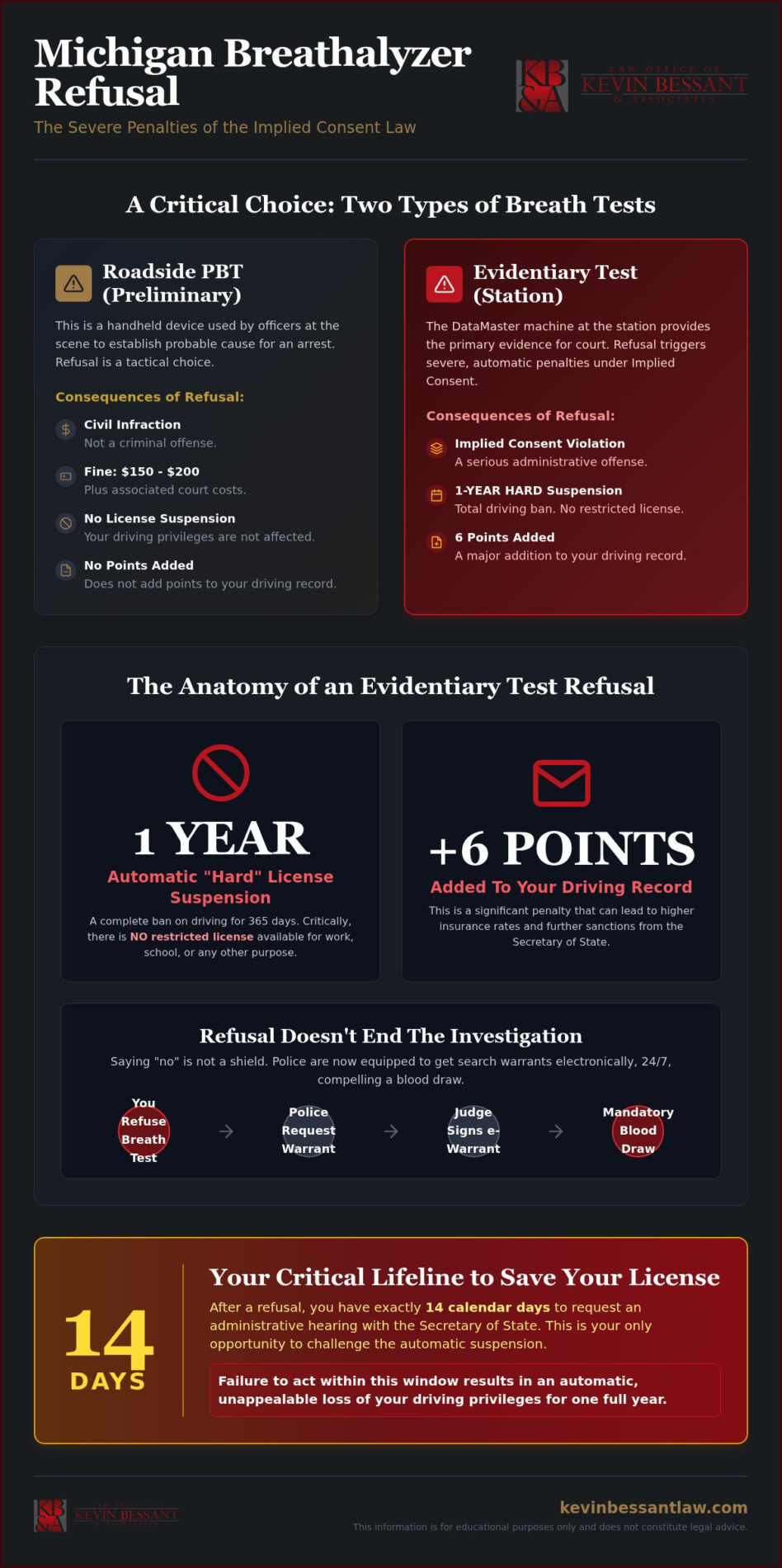
You might think that staying silent and refusing a breath test is the safest way to avoid a DUI conviction, but the reality of Michigan breathalyzer refusal penalties is far more dangerous than most drivers realize. In 2026, Michigan’s Implied Consent Law remains unforgiving. A single refusal at the police station triggers an automatic one-year hard suspension of your driver’s license and adds six points to your record. You won’t get a restricted license for work or school; you simply lose the right to drive. It’s a high-stakes crisis that demands an immediate, battle-ready response.
It’s natural to feel anxious when the police demand a chemical sample while threatening to get a warrant anyway. You’re likely confused about whether your refusal helped or hurt your case. This guide provides the vital shield you need. Discover the severe consequences of refusing a breath test in Michigan and how an aggressive defense can save your driving privileges. We’ll break down the critical 14-day window to appeal your suspension, the difference between roadside PBTs and evidentiary tests, and the strategic steps required to protect your future.
Key Takeaways
- Differentiate between a roadside PBT and the station’s evidentiary test to understand which refusal carries the heaviest weight.
- Act within the strict 14-day window to request a hearing or face an automatic, unappealable loss of your driving privileges.
- Learn why Michigan breathalyzer refusal penalties trigger an automatic one-year hard license suspension and add six points to your driving record.
- Realize that refusing a breathalyzer doesn’t stop the investigation, as judges now sign electronic search warrants for blood draws 24/7.
- Secure a battle-ready defense to stand between you and a legal system designed to punish your silence with life-altering sanctions.
Understanding the Choice: Roadside PBT vs. Station Breath Tests
The moment you’re pulled over on a dark Michigan road, the officer is already building a case against you. They’ll often present a handheld device, the Preliminary Breath Test (PBT), as if it’s a mandatory part of the stop. It isn’t. Understanding the distinction between this roadside gadget and the heavy-duty machine at the station is the first step in surviving the legal system. If you don’t know the difference, you’re walking into a trap that triggers severe Michigan breathalyzer refusal penalties. You need to know exactly what you’re up against before you make a choice that could cost you your freedom to drive.
The Roadside PBT: A Tool for Probable Cause
Officers use the PBT as a shortcut to establish probable cause for an arrest. They want you to blow into that handheld tube to give them a number they can use to put you in handcuffs. In 2026, refusing a roadside PBT is merely a civil infraction. You’ll likely face a fine between $150 and $200 plus court costs. Crucially, a PBT refusal alone does not result in points on your record or an automatic license suspension. It’s a tactical choice; sometimes, denying the officer that initial evidence is your best move, even if it costs you a couple of hundred dollars. Don’t let the officer’s pressure tactics convince you that your license is at stake at the side of the road.
The Evidentiary Machine: The Test That Actually Counts
Once you’re at the station, the game changes completely. Here sits the DataMaster, a large machine whose results are the primary evidence used to convict you in court. This is where the Michigan Implied Consent Law comes into play. By simply holding a Michigan driver’s license, you’ve already agreed to take this specific test if arrested for an OWI. The law treats your signature on your license as a binding contract with the state.
Officers often fail to explain that the station test is the “mandated” one. They might treat it with the same casualness as the roadside stop, but the consequences are worlds apart. Refusing this evidentiary test is what triggers the catastrophic Michigan breathalyzer refusal penalties people fear most. You aren’t just looking at a fine anymore. You’re looking at a one-year “hard” suspension of your license where no restricted driving is allowed. The system is designed to move fast, hoping you’ll make a mistake before you can call for help. If you’ve already refused, your clock is ticking. You need a battle-ready advocate who knows how the police manipulate these two tests to their advantage. Visit our firm’s page to see how we stand in the gap for our clients.
Michigan Implied Consent Law: The High Cost of Refusing a Chemical Test
When you signed for your Michigan driver’s license, you didn’t just receive a plastic ID; you entered into a binding legal contract with the state. This agreement is known as Implied Consent. It means you’ve already given permission for a chemical test of your breath, blood, or urine if an officer suspects you of operating while intoxicated. If you break this agreement by saying “no” at the station, the Secretary of State (SOS) strikes back with immediate and overwhelming force. These administrative Michigan breathalyzer refusal penalties are entirely separate from your criminal case. Even if a judge eventually dismisses your OWI charge, the SOS can still strip you of your driving privileges for the refusal alone.
The system is designed to punish those who challenge its authority. You are facing a dual-front war: one in the criminal court and one with the Secretary of State. While your defense attorney fights the criminal charges, you must also navigate the administrative nightmare triggered by your refusal. If you don’t have a shield standing in the gap for you, the state will move quickly to dismantle your ability to live your life. You need to speak with an experienced advocate immediately to begin building your counter-strike against these sanctions.
Automatic License Suspension and Points
A first-time chemical test refusal triggers a mandatory one-year “hard” suspension of your driver’s license. This isn’t a minor inconvenience where you can drive to work, school, or the grocery store; it’s a total ban on operating any motor vehicle for 365 days. In addition to the loss of your license, the state adds six points to your Michigan driving record instantly. Unlike a standard DUI conviction where a judge might grant restricted driving privileges, a refusal suspension is an administrative hammer that leaves no room for hardship appeals unless you win a formal hearing. The law also mandates a $125 reinstatement fee once your suspension period finally ends, making the path back to the road both long and expensive.
Impact on CDL Holders and Professional Drivers
For those who drive for a living, the consequences of a refusal are catastrophic. A single refusal can trigger a “one strike” rule for Commercial Driver’s License (CDL) holders, effectively terminating a career in trucking or delivery in an instant. The state does not offer “second chances” for professional drivers who violate the Implied Consent agreement. Michigan’s Implied Consent Law applies to every motorist operating a vehicle on state roads, regardless of whether their license was issued in Michigan or by another state. If you hold a CDL, the system views your refusal as a fundamental breach of trust, and the resulting disqualification can be permanent or last for several years, depending on your prior record. Do not wait for the suspension notice to arrive in the mail; the time to act is now.
Strategic Refusal: When Silence Triggers a Search Warrant and Blood Draw
Many drivers believe that staying silent and refusing a breathalyzer is a clever tactical move to keep evidence out of the prosecutor’s hands. This is a dangerous misconception. In 2026, refusing the station breath test doesn’t stop the investigation; it merely changes the police’s method of collection. While you’re being processed for your refusal, officers are already contacting a judge. With the rise of electronic search warrants, a judge can sign off on a blood draw in minutes, any time of day or night. You end up trapped in a “Double Penalty” scenario where you face the full weight of Michigan breathalyzer refusal penalties while the state still secures the high-impact blood evidence they wanted in the first place.
Beyond the physical evidence, your refusal gives the prosecution a powerful psychological weapon. They will argue in court that your silence was a “consciousness of guilt,” suggesting to a jury that you only refused because you knew the results would prove you were intoxicated. This creates a mountain of prejudice that is difficult to climb without a fierce, battle-ready advocate by your side. You need someone who isn’t intimidated by the system’s aggressive tactics. Check out how we fight back against these overreaching prosecution strategies.
The Forced Blood Draw Process
If you refuse the DataMaster at the station, the police won’t just let you go. They’ll transport you in handcuffs to a local hospital or clinical facility for a forced blood draw. In areas like Detroit, Southfield, and Warren, law enforcement frequently utilizes “no-refusal” task forces where phlebotomists are on standby to assist officers. Blood evidence is often viewed as more scientifically precise than breathalyzer results, making it significantly harder to challenge in a courtroom. The state is banking on the fact that once they have your blood, you’ll simply give up and plead guilty. It’s a high-pressure environment designed to make you feel like resistance is futile.
Fighting the Search Warrant Validity
Just because the police obtained a warrant doesn’t mean that warrant is valid. An aggressive defense begins by scrutinizing every word the officer wrote in their affidavit to the judge. Kevin Bessant uses over 20 years of criminal defense experience to identify procedural errors and lack of probable cause that could lead to the suppression of blood evidence. We look for breaks in the chain of custody and errors in how the blood was stored or tested. If the officer lied or exaggerated the facts to get that warrant signed, we will move to have that evidence thrown out entirely. You are not alone in this fight; you have a shield ready to stand between you and the state’s evidence.
Beating the 14-Day Deadline: How to Save Your Driver’s License
The clock is ticking with lethal precision the moment you leave the police station. In Michigan, you have exactly 14 days from the date of your chemical test refusal to request an administrative hearing with the Secretary of State. If you miss this window by even a single hour, you forfeit your right to a defense. The result is an automatic, unappealable one-year hard suspension. There are no “hardship” licenses or restricted driving privileges available once this deadline passes. You must treat this 14-day period as the most critical phase of your entire case. This is your only opportunity to stop the state from dismantling your life before your criminal case even reaches a courtroom.
It’s vital to understand that this hearing isn’t a criminal trial; it’s an administrative battle focused solely on the circumstances of your refusal. While the criminal court decides if you were intoxicated, the Secretary of State hearing decides if you violated the Implied Consent agreement. This creates a unique strategic advantage for your defense. It’s the first time your lawyer can force the arresting officer to testify under oath. We use this hearing to cross-examine the officer, expose inconsistencies in their story, and gather evidence that can be used to crush the criminal OWI charges later. To protect your future, you must request a consultation today before your time runs out.
The Implied Consent Hearing Request
Filing the request is a precise legal procedure that leaves no room for error. First, we file a formal demand for a hearing with the Michigan Secretary of State to halt the automatic suspension. Next, we immediately secure the police reports and the specific refusal documentation recorded by the officer. Finally, we build a defense tailored to the narrow legal issues allowed at these hearings. We don’t just “show up”; we walk into that room with a methodical plan to dismantle the officer’s justification for the Michigan breathalyzer refusal penalties they’re trying to impose.
Winning the Hearing: The Four Legal Issues
The state’s power at these hearings is limited to four specific legal questions. If we can prove the officer failed on even one of these points, you win, and your license is saved. We focus our attack on these areas:
- Reasonable Grounds: Did the officer actually have a legal reason to believe you were driving impaired before they stopped you?
- The Arrest: Were you legally and officially placed under arrest, or did the officer jump the gun?
- Advice of Rights: Did the officer read you your specific Implied Consent rights exactly as the law requires?
- Reasonableness of Refusal: Was your refusal actually “unreasonable” under the specific circumstances of the arrest?
The system counts on you being too overwhelmed to fight back within the 14-day limit. Don’t give them that satisfaction. By challenging these four issues with an aggressive advocate, you turn a desperate situation into a calculated counter-strike against the state’s overreach.
Aggressive DUI Defense: Why Kevin Bessant is Your Shield Against Refusal Penalties
The legal system is built to crush those who stand their ground. When you refuse a breath test, the state treats you as an enemy of the process. You are no longer just a driver; you are a high-stakes target for both administrative and criminal sanctions. The Law Office of Kevin Bessant & Associates stands in the gap, acting as a vital shield between you and a system that wants to revoke your freedom and your driving privileges. We don’t just “handle” cases; we wage a vigorous defense for our clients. Whether you are facing a judge in Detroit or Southfield, you need an advocate who knows exactly how to dismantle the prosecution’s narrative and challenge Michigan breathalyzer refusal penalties with force.
Standing alone against the police and the Secretary of State is a recipe for disaster. The prosecution has unlimited resources, and they’ve already begun building their case against you. You need a formidable presence in the courtroom to even the odds. We specialize in OWI/DUI defense litigation and have spent decades navigating the treacherous territory of Michigan’s implied consent laws. We understand the fear of losing your license for a full year, and we take that threat with the utmost seriousness. Our firm is dedicated to achieving favorable outcomes for those who refuse to be intimidated by the system.
A Proactive Approach to Your Freedom
We don’t wait for the court to set the pace. Our firm moves immediately to protect your driving privileges and your future. With 20+ years of criminal defense experience, Kevin Bessant understands the inner workings of local courts in Warren, Southfield, and Detroit. We attack the case from two sides simultaneously: the criminal OWI charge and the high-stakes Secretary of State Implied Consent hearing. This dual-front strategy ensures that no part of your defense is left to chance. Learn more about Why Us and how our commitment to aggressive advocacy acts as a vital shield for our clients.
Take Action Before the 14-Day Window Closes
Every hour you spend in indecision is an hour the prosecution uses to solidify their case. They are already reviewing the officer’s body cam footage and preparing their arguments for your hearing. You cannot afford to be passive while the state prepares its strike. You need a battle-ready advocate who isn’t intimidated by aggressive police tactics or electronic search warrants. The Law Office of Kevin Bessant & Associates provides the protective representation necessary to navigate this crisis. We know the law, we know the local judges, and we know how to win. Contact us today for a Free Consultation to shield your license and secure your future. Don’t let the 14-day window slam shut on your life.
Legal Authority: Statute and Case Law
Michigan’s Implied Consent law is codified at MCL 257.625a, which sets the one-year hard suspension, six points, and the 14-day hearing deadline for a chemical test refusal.
- Missouri v McNeely, 569 US 141, 152; 133 S Ct 1552; 185 L Ed 2d 696 (2013) — the U.S. Supreme Court held that the natural dissipation of alcohol in the bloodstream is not, by itself, an automatic exigency justifying a warrantless blood draw; police must still get a warrant for a forced blood test unless the specific circumstances of the case present a genuine emergency.
For the current statutory text, see the Michigan Legislature’s MCL database.
Secure Your Future Before the State Takes Control
The state is counting on your silence and your hesitation. If you’ve been arrested for an OWI, the clock is already running down on your 14-day window to save your license. Don’t let the weight of Michigan breathalyzer refusal penalties crush your ability to work or care for your family. You’ve seen how the police use electronic warrants to get blood evidence anyway and how the Secretary of State moves to suspend your driving privileges automatically. You need a battle-ready advocate who understands the high-stakes nature of Detroit and Southfield courts.
The Law Office of Kevin Bessant & Associates brings 20+ years of high-stakes criminal defense experience to stand in the gap for you. We provide the aggressive advocacy needed to challenge Implied Consent hearings and protect your record from devastating points. Your situation is serious, but it isn’t hopeless. By taking immediate action, you can turn the tide against a system designed to punish you. Our firm is ready to act as your vital shield and fight for your freedom.
Shield your license-Contact the Law Office of Kevin Bessant & Associates for a Free Consultation. We are standing by to protect your rights and keep you on the road.
Does the fact that alcohol dissipates over time let police skip getting a warrant?
No. Missouri v McNeely, 569 US 141 (2013), holds that the natural dissipation of alcohol in the bloodstream is not, by itself, an automatic emergency that lets police force a blood draw without a warrant; the specific facts of the stop still have to show a genuine emergency.
Frequently Asked Questions
Is it better to refuse a breathalyzer in Michigan?
Refusing a station breath test is rarely better because it triggers a one-year hard license suspension regardless of your eventual guilt or innocence. While you might keep a specific BAC number off the immediate record, police can often secure a warrant for your blood anyway. You end up facing the same evidence plus the harshest Michigan breathalyzer refusal penalties available. It is a lose-lose situation without a battle-ready advocate to intervene.
What happens if I refuse the roadside PBT but take the station test?
If you refuse the roadside PBT but cooperate at the station, you’ll only face a civil infraction fine of up to $200 plus court costs. This is often a strategic choice. Because you complied with the evidentiary test at the station, you have fulfilled your obligations under the Implied Consent law. You avoid the six points and the automatic one-year suspension that follows a station-level refusal.
Can I get a restricted license if I lose my license for breathalyzer refusal?
You cannot get a restricted license during an Implied Consent suspension. Michigan law mandates a “hard” suspension for one full year, meaning you are prohibited from driving to work, school, or medical appointments. The system is designed to be unforgiving. Your only chance to stay on the road is to win your administrative hearing within the 14-day window following your arrest.
How long does a breathalyzer refusal stay on my Michigan driving record?
A breathalyzer refusal remains on your Michigan driving record permanently. While certain criminal OWI convictions may eventually be eligible for expungement, administrative entries on your driving record are different. This entry acts as a permanent red flag for insurance companies and law enforcement. It can result in significantly higher premiums and professional complications for the rest of your life.
Will I go to jail just for refusing the breath test?
You will not go to jail solely for the act of refusing a breath test. Refusal is an administrative violation handled by the Secretary of State, not a criminal offense. However, the police will still proceed with criminal OWI charges against you. While the refusal itself doesn’t carry a jail sentence, the underlying drunk driving charge carries serious jail time and other criminal penalties.
Can a lawyer help me if I already missed the 14-day hearing deadline?
Missing the 14-day deadline is a legal catastrophe that is extremely difficult to reverse. Once that window slams shut, the Secretary of State imposes the suspension automatically and it’s typically unappealable. There are very few procedural exceptions to this rule. You must secure a shield for your license immediately after your arrest to ensure all paperwork is filed before this deadline passes.
What if the police didn’t tell me my license would be suspended for refusal?
If the officer failed to read you your rights, you have a strong chance of defeating the Michigan breathalyzer refusal penalties at your hearing. The law requires police to explicitly warn you that refusal results in a one-year suspension and six points. If they skipped this step or provided incorrect information, the suspension can be overturned. This is a technical defense that requires a seasoned attorney to prove.
Does a refusal count as a DUI conviction?
No, a refusal is not a DUI conviction; it is an administrative violation of the state’s Implied Consent law. These are two separate battles fought on different fronts. You can be found “Not Guilty” of the criminal OWI charge in court but still lose your license for a year for the refusal. This dual-front system is why you need a defense that protects you in both the courtroom and the station.