

In Michigan, your freedom isn’t just decided by a judge; it’s calculated on a cold, clinical grid where the Michigan felony sentencing guidelines treat your life like a math problem. It’s a high-stakes game where a single point can mean years of your life. You likely feel the weight of this system already, fearing that mandatory minimums or an old prior record will trap you in a cage. The system is designed to be efficient for the state, but it is often devastating for the individual standing alone.
We understand that these rules are confusing and intimidating, often making you feel like your future is out of your hands. This guide promises to help you master the complex math of the sentencing grid and shows you how an aggressive defense can actively lower your minimum prison term. We will preview the 2026 commission updates, break down the “Class A” through “Class E” rankings, and explain how we challenge every point the prosecution tries to use against you. Your life is not a statistic, and it’s time you had a battle-ready advocate to stand in the gap and protect your future.
Key Takeaways
- Understand how Michigan’s indeterminate sentencing system works, where the legislature sets the maximum term but your defense strategy influences the minimum.
- Learn to navigate the Michigan felony sentencing guidelines grid by identifying how Prior Record Variables and Offense Variables directly dictate your potential prison time.
- Discover the devastating impact of Habitual Offender enhancements and why preventing a 2nd, 3rd, or 4th offender status is critical for your freedom.
- Identify tactical ways to challenge errors in your Pre-Sentence Investigation (PSI) report before a judge uses flawed data to increase your sentence.
- See how an aggressive defense shield can “lock in” lower scores during negotiations in Detroit, Southfield, and Warren courts to fight for your future.
Understanding the Michigan Felony Sentencing Guidelines Framework
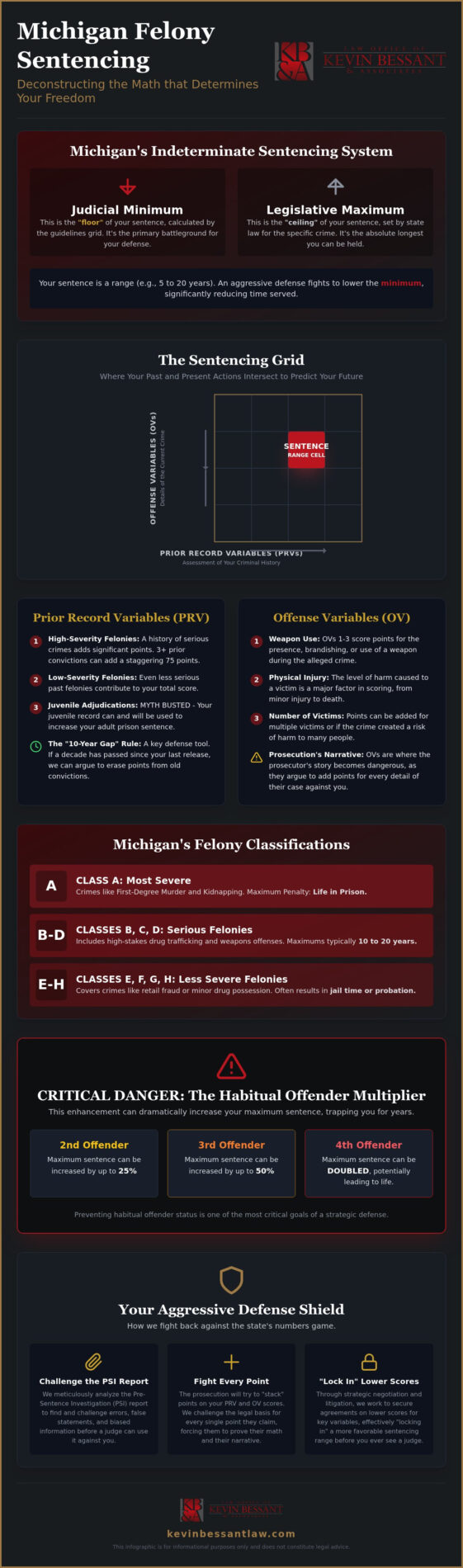
The Michigan felony sentencing guidelines act as the clinical blueprint for every felony case in Detroit, Southfield, and Warren. This isn’t just a list of suggestions; it’s a rigorous scoring system used to determine the minimum prison term a defendant must serve before becoming eligible for parole. In Michigan, we use a system of indeterminate sentencing. This means your sentence is almost always expressed as a range, such as 5 to 20 years. While the state legislature sets the absolute ceiling for a crime, your defense attorney’s primary mission is to aggressively challenge the math that determines the floor. You shouldn’t stand alone against a system that views your life as a series of data points.
Citing Sentencing Guidelines provides a foundational look at how these frameworks aim to eliminate “judicial shock” and ensure consistency. The goal is to prevent a situation where two people committing the same crime receive wildly different sentences based on which county they’re in. However, consistency for the state often means a lack of empathy for the individual. You need a shield to ensure that “consistency” doesn’t result in an unnecessarily long stay in a prison cell.
The 8 Felony Classes (A through H)
Michigan ranks every felony into one of eight distinct classes. Class A offenses are the most severe, carrying a maximum of life in prison for crimes like First-Degree Murder or Kidnapping. Classes B through D involve serious felonies, such as high-stakes drug trafficking or weapons offenses, with maximums typically ranging from 10 to 20 years. At the lower end, Classes E through H cover less severe crimes like retail fraud or minor drug possession. These often result in jail time or probation rather than prison. Don’t let the prosecution over-classify your actions; we fight to keep you in the lowest class possible.
Legislative Maximums vs. Judicial Minimums
The distinction between a maximum and a minimum sentence is the most critical concept to grasp. The Michigan Legislature sets the statutory maximum, which is the absolute longest period the state can legally hold you. However, the Michigan felony sentencing guidelines focus on the minimum term. This is the date you first become eligible for release. Your lawyer must focus entirely on this “bottom number.” If we can aggressively lower the scored range, we can significantly reduce the time you spend behind bars. We identify the errors in the state’s logic to protect your freedom. If you’re facing these high stakes, contact us immediately to start building your defense.
The Scoring System: How PRVs and OVs Determine Your Future
The Michigan felony sentencing guidelines operate through a clinical, two-axis mathematical grid. It looks like a simple spreadsheet, but this document dictates the next decade of your life. On the horizontal axis, the court plots your Prior Record Variables (PRV). On the vertical axis, they score your Offense Variables (OV). Where these two numbers intersect is called a “cell.” This cell contains the specific range of months that represents your minimum prison sentence. If the prosecution stacks points on either axis, that cell moves deeper into the grid, potentially adding years to your stay in a state facility. You cannot leave these calculations to chance.
Prior Record Variables (PRV) Explained
Prior Record Variables are a point-based assessment of a defendant’s entire criminal history. This isn’t just about what you did yesterday; it is about every mistake the system has recorded. PRV 1 and 2 score your prior high-severity and low-severity felony convictions. For instance, having three or more prior high-severity felonies adds a staggering 75 points to your score. Many people mistakenly believe their juvenile records disappear once they turn 18. In the Michigan sentencing world, this is a dangerous myth. PRV 3 and 4 specifically score juvenile adjudications, meaning a mistake from your teenage years can directly increase your adult prison sentence today. However, we aggressively look for the “10-year gap” rule. If you’ve maintained a clean record for a decade between your last release and the current offense, we can often argue to strike those old points entirely.
Offense Variables (OV) and ‘Points’ for Conduct
While PRVs look backward, Offense Variables score the specific details of the alleged crime. This is where the prosecution’s narrative becomes dangerous. OV 1 through 3 focus on weapon use and physical injury. Points escalate quickly if a firearm was pointed at or discharged toward a victim. OV 9 scores the number of victims involved; if the state claims more than two people were placed in danger, your score jumps. Finally, OV 13 looks for a continuing pattern of felonious activity. The state often tries to “double count” conduct to inflate these numbers. We act as your shield, challenging the evidence behind every point to keep your score in the lowest possible range. If you are worried about how your history will impact your current case, contact us to review your scoring today.
The intersection of these scores is the battlefield. A single error in how a probation officer calculates your PRVs or a prosecutor’s exaggeration of an OV can change your life forever. We don’t accept their math as fact. We investigate the underlying records and fight to ensure the judge sees a fair, accurate, and minimized score before the gavel falls.
The Habitual Offender Multiplier: A Danger to Your Freedom
Prosecutors in Michigan have a devastating tool at their disposal called the Habitual Offender notice. This isn’t a separate crime. Instead, it’s a legal enhancement that allows the state to punish you more severely based on your prior record. If you have at least one prior felony conviction, the prosecutor can file this notice to “enhance” your potential sentence. It is an aggressive move designed to strip away your leverage and force a plea. You must understand that once this notice is filed, the standard Michigan felony sentencing guidelines calculations change. The system stops looking at the crime in isolation and starts looking at you as a career offender. We stand in the gap to prevent this label from defining your future.
How Habitual Status Increases the Statutory Maximum
The most immediate threat of a habitual notice is the jump in your statutory maximum. This is the absolute longest the state can keep you in prison. A Habitual 2nd status increases that maximum by 25 percent. If you’re facing a 5-year felony, it suddenly becomes a 6.25-year threat. A Habitual 3rd status increases it by 50 percent; that same 5-year felony now carries a 7.5-year maximum. The most severe is Habitual 4th. This status can increase the maximum of any felony to Life if the original crime carried a maximum of 5 years or more. It effectively doubles the stakes of your case. Don’t wait for the prosecutor to finalize these numbers. You need an advocate who knows how to challenge the validity of those prior convictions immediately.
The Impact on Guideline Ranges
The danger doesn’t stop at the statutory maximum. Habitual status triggers a mathematical expansion of the Michigan felony sentencing guidelines grid itself. This is often called the “Top-End” shift. While your Prior Record Variable (PRV) score already accounts for your past, the habitual multiplier takes the resulting grid range and stretches the upper limit. For a Habitual 4th offender, the top end of the minimum sentence range is increased by 100 percent. This means your earliest possible release date could be pushed back by years.
Habitual 4th is the most dangerous label in the Michigan court system because it gives judges immense power to impose long-term incarceration. Our strategy focuses on negotiating the removal of these notices during the preliminary stages of your case. We fight to “lock in” the standard ranges before the multiplier can do its damage. If you’re facing a habitual notice in Warren or Detroit, learn why our aggressive approach is your best defense against these life-altering enhancements.
Strategic Defense: Challenging Your Sentencing Score
The Michigan felony sentencing guidelines aren’t a final verdict; they’re a battlefield. Many defendants make the fatal mistake of assuming the points calculated by a probation officer are set in stone. They aren’t. If the state’s math is wrong, you pay the price in years of your life. An aggressive defense doesn’t just look at the charges; it dissects the scoring variables to find every possible opening to lower your minimum term. We don’t just “accept” the prosecution’s narrative. We rewrite it through evidence and tactical objections.
In Michigan, the guidelines are technically advisory, but they still carry immense weight. To get a sentence below the calculated range, your advocate must present a “departure” argument based on proportionality. This means proving that the guidelines don’t accurately reflect the specific circumstances of your case or your character. We use this legal lever to push for a sentence that is reasonable and fair, rather than one that is merely clinical and punitive. Why choosing the right advocate matters becomes clear in these high-stakes moments when your freedom depends on a lawyer’s ability to outmaneuver the state’s scoring.
Identifying and Correcting Scoring Errors
Scoring errors are rampant in felony cases across Detroit and Southfield. One of the most common battlegrounds is Offense Variable 4 (OV 4), which scores 10 points for “Psychological Injury” to a victim. Prosecutors often try to claim these points without a shred of medical evidence or professional testimony. We demand proof. If there isn’t a documented, serious psychological injury, those 10 points must be stripped away. Similarly, we aggressively challenge the “Intent to Kill” score in felony assault cases. The state frequently overreaches, trying to score an assault as if it were an attempted murder. We also meticulously verify out-of-state records. Michigan law requires a specific “mapping” of foreign convictions; if the out-of-state crime doesn’t perfectly match a Michigan felony, those points shouldn’t haunt you here.
The Role of the Pre-Sentence Investigation (PSI)
The Pre-Sentence Investigation (PSI) report is the single most important document the judge will read before sentencing. It contains the probation agent’s version of your life, your crime, and your “score.” You must review this report with your attorney long before you step into the courtroom. Agents often include hearsay, unproven allegations, or flat-out inaccuracies that can artificially inflate your Michigan felony sentencing guidelines score. We don’t wait for the hearing to speak up. We file formal objections to the PSI to ensure the judge is working with facts, not fiction. If you’re facing a felony in Warren or Detroit, schedule a consultation today to ensure your PSI is accurate and your score is minimized.
Why You Need an Aggressive Shield in Michigan Felony Courts
Detroit, Southfield, and Warren felony courts are high-pressure environments where the system is built to process cases with clinical efficiency. In 2026, the volume of high-stakes felonies means the prosecution often relies on the complexity of the Michigan felony sentencing guidelines to pressure defendants into unfavorable deals. You aren’t just a file number. You’re a person with a life that can be derailed by a single mathematical error or an unchallenged variable. You need an advocate who stands in the gap and refuses to let the state dictate your future based on flawed logic or aggressive scoring.
Kevin Bessant acts as your vital shield against this overwhelming legal machinery. We don’t wait for the sentencing day to start fighting. Our advocacy begins at the bond hearing and continues through every stage of plea negotiations. We fight to “lock in” lower scores before you ever stand in front of a judge. If the prosecutor wants a resolution, they must agree to a scoring range that respects your rights and protects your freedom. We aren’t intimidated by the threat of habitual enhancements or clinical grids. We use over 20 years of experience to dismantle the prosecution’s narrative and secure the best possible outcome.
Navigating Detroit and Wayne County Court Dynamics
Wayne County has its own unique rhythm and judicial tendencies. Judges in Detroit often have specific views on sentencing departures and proportionality that an inexperienced lawyer might miss. A vigorous defense directly impacts the prosecutor’s willingness to drop habitual offender notices. When they know we’re ready to challenge every Prior Record Variable and Offense Variable with surgical precision, their leverage disappears. For those facing specific high-stakes weapons allegations, our Aggressive Gun Charge Defense in Detroit provides the specialized, battle-ready protection required to navigate these local dynamics.
Contact the Law Office of Kevin Bessant & Associates
Don’t walk into a sentencing hearing alone. The stakes are too high, and the system is not your friend. The Law Office of Kevin Bessant & Associates provides the assertive, protective representation you need to survive a felony charge. We protect your rights from the moment of arrest, ensuring that the clinical math of the Michigan felony sentencing guidelines doesn’t swallow your future. We are the formidable force you need in your corner when the state is pushing for maximum penalties. Take the first step toward securing your freedom today. Schedule your confidential consultation and let us start building your shield.
Legal Authority: Statute and Case Law
Michigan’s sentencing guidelines statute is codified at MCL 769.34, with habitual offender enhancements at MCL 769.10 through MCL 769.12.
- People v Lockridge, 498 Mich 358, 365, 391-392; 870 NW2d 502 (2015) — the Michigan Supreme Court held that the previously mandatory sentencing guidelines are advisory only, meaning a judge may depart from the calculated range without articulating “substantial and compelling” reasons, but the court must still calculate the guidelines range and take it into account, and any departure must be reasonable.
- People v Cobbs, 443 Mich 276, 283; 505 NW2d 208 (1993) — established the practice allowing a judge to give a preliminary sentence evaluation before a guilty plea; if the judge later wants to exceed that evaluation, the defendant has an absolute right to withdraw the plea.
For the current statutory text and published opinions, see the Michigan Legislature’s MCL database and the Michigan Courts case search.
Protect Your Future Against the Sentencing Grid
The Michigan felony sentencing guidelines are not an inevitable fate; they’re a clinical system that demands a vigorous challenge. You’ve seen how Prior Record Variables and Offense Variables can be manipulated by the state to inflate your prison time. You’ve learned that habitual offender notices are dangerous multipliers that strip away your leverage. Standing alone against this machinery is a risk you cannot afford to take. You need a shield that understands the inner workings of the Detroit and Wayne County courts to fight for every point on that grid.
With 20+ years of high-stakes criminal defense experience, Kevin Bessant provides the aggressive advocacy required for the most serious homicide and weapons charges. We don’t just accept the prosecution’s math. We dismantle it. Your freedom is the only outcome that matters, and we have the expertise to protect it from the moment of arrest through final sentencing. Don’t let a clinical calculation define your life. Secure Your Aggressive Felony Shield—Contact Kevin Bessant Today. You have the right to a battle-ready defense, and your journey toward a better outcome starts now.
Frequently Asked Questions
Is the judge required to follow the Michigan sentencing guidelines?
Judges are not legally bound to follow the Michigan felony sentencing guidelines because People v Lockridge, 498 Mich 358 (2015), held they are advisory only. A judge has the discretion to sentence outside the calculated range without stating “substantial and compelling” reasons, but must still calculate the range, take it into account, and impose a reasonable sentence.
Can a lawyer get my felony points reduced?
Yes, a battle-ready advocate can reduce your points by filing formal objections to the Pre-Sentence Investigation report. We challenge the prosecution’s interpretation of Offense Variables, such as whether a weapon was actually used or if a victim suffered serious injury. By stripping away these points, we move your case into a lower-scoring cell on the sentencing grid, directly reducing your minimum prison term.
What happens if the judge ‘departs’ from the guidelines?
If a judge departs from the Michigan felony sentencing guidelines, they must prove the sentence is proportionate to the offense and the offender. A downward departure is a victory where the judge sentences you below the calculated range. Conversely, we aggressively challenge upward departures by arguing the judge’s reasoning is flawed or that the guidelines already accounted for the factors they’re citing today.
How do prior out-of-state convictions affect my Michigan score?
Out-of-state convictions are scored by comparing the foreign statute to Michigan law. If the out-of-state crime is equivalent to a Michigan felony, it counts toward your Prior Record Variables. We meticulously review these records to ensure the prosecution doesn’t over-score an out-of-state offense. If the foreign law is broader than Michigan’s, those points can often be successfully challenged and removed from your final score.
Does a plea bargain always include a sentencing agreement?
A plea bargain doesn’t always guarantee a specific sentence. Many pleas are “open,” meaning you admit guilt and leave the minimum term entirely up to the judge’s discretion. To avoid this uncertainty, we fight for specific sentencing agreements that cap your prison time, ensuring you aren’t walking into the courtroom blind to your future. We push for certainty so you can plan for your life.
What is a ‘Cobbs Agreement’ in Michigan sentencing?
A Cobbs Agreement is a powerful tool where the judge provides an evaluation of what your sentence will be if you plead guilty. It offers a layer of protection because if the judge changes their mind at the final hearing and tries to give you a longer term, you have the absolute right to withdraw your plea. It’s a vital shield against judicial unpredictability and prosecutor overreach.
Can my sentencing guidelines be changed after I am already in prison?
Changing your guidelines after you’re in prison is difficult but possible through the appeals process. If your original lawyer failed to object to a clear scoring error, we can file a motion for resentencing. The system doesn’t make this easy, so you need a dedicated protector to prove the original score was inaccurate and that your current incarceration is based on faulty math and missed objections.
How much does a prior misdemeanor count toward my felony guidelines?
Prior misdemeanors are scored under Prior Record Variable 5 (PRV 5). While one or two minor offenses might not drastically change your cell, a history of misdemeanors can add up to 20 points. These points are often the difference between a jail-only sentence and a prison term. We investigate these old records to see if they are even eligible to be scored against you in court.