
Your child’s entire future can vanish in a single courtroom hearing. When a prosecutor pursues a juvenile waiver to adult court Michigan, they aren’t just looking for a conviction. They’re trying to strip away the protections of the juvenile system and expose your teenager to adult prison. You’re likely feeling overwhelmed by the complexity of Michigan’s laws and terrified that a permanent criminal record will destroy your child’s career before it even begins. We understand that fear, and we know exactly what’s at stake.
This 2026 guide provides the aggressive legal roadmap you need to navigate this high-stakes crisis. You’ll learn how the July 2026 legislative reforms, which expanded defense rights and restricted attorney waivers, impact your child’s case. We’ll break down the specific criteria a judge uses to decide between rehabilitation and punishment. Most importantly, you’ll discover how a fierce, battle-ready defense can prove your child belongs in the juvenile family division. We’re here to help you secure a path toward rehabilitation instead of a life behind bars.
Key Takeaways
- Discover the three specific legal mechanisms, Traditional, Automatic, and Designation, that prosecutors use to transfer a minor into the adult criminal justice system.
- Learn how the July 2026 legislative updates strengthen your child’s right to counsel during a juvenile waiver to adult court Michigan.
- Identify the six mandatory factors under MCL 712A.4(4) that a judge must evaluate to determine if a child is suitable for juvenile rehabilitation.
- Understand how aggressive legal advocacy at the Phase 1 Probable Cause hearing can stop a waiver in its tracks and keep the case in the family division.
- Grasp the life-altering stakes of an adult conviction, including permanent criminal records that can destroy future employment and housing opportunities.
What is a Juvenile Waiver to Adult Court in Michigan?
A juvenile waiver is a prosecutorial motion specifically designed to treat a minor as an adult, stripping them of the protections found in the youth justice system. In Michigan, this process is officially known as a “Waiver of Jurisdiction.” It represents a violent shift in how the state views your child. Instead of focusing on rehabilitation, the legal system pivots toward punishment. When a juvenile waiver to adult court Michigan occurs, the court essentially declares that the minor is no longer entitled to the leniency typically afforded to children.
Current Michigan law, following the full implementation of “Raise the Age” legislation in 2024, generally treats 18-year-olds as adults. However, for minors as young as 14, a juvenile transfer to adult court remains a terrifying possibility. This isn’t a mere administrative change. It’s a life-altering event that determines whether your child will be sent to a youth facility or an adult prison. You can’t afford to treat this as a standard legal procedure; it is a battle for your child’s future.
The Family Division vs. General Criminal Jurisdiction
Most juvenile cases begin in the Family Division of the Circuit Court. In this setting, the law prioritizes the “best interests of the minor.” The goal is to provide services, counseling, and structure to prevent future offenses. This is where we want to keep your child. The environment is designed to be rehabilitative, not retributive.
In contrast, the “Adult Court” operates under general criminal jurisdiction. If a judge grants a waiver, your child is moved to the same courtrooms where hardened felons are tried. The penalties are identical to those faced by adults. If convicted, your child faces adult prison sentences and a permanent criminal record. This record will follow them for the rest of their life, affecting college admissions, housing, and career opportunities. You need a fierce advocate who knows how to block this transfer before the damage is done.
Why Prosecutors Seek Waivers in Michigan
Prosecutors usually push for waivers when they believe the juvenile system is too “soft.” They target high-stakes offenses such as:
- Homicide and murder charges
- Felony assault or battery
- Armed robbery and weapons offenses
The primary driver for these motions is the “seriousness of the offense.” Prosecutors want harsher sentences than the juvenile system allows. They seek to bypass the rehabilitative ideal to satisfy a retributive agenda. They want to make an example of your child. Our job is to stand in the gap and ensure that doesn’t happen. We challenge the prosecutor’s narrative to show that your child’s needs are best met through rehabilitation, not incarceration.
The Three Paths to Adult Court: Traditional, Automatic, and Designation
Prosecutors don’t just use one method to move your child’s case. They choose the legal path that offers the least resistance and the harshest potential punishment. Understanding the specific mechanism used in a juvenile waiver to adult court Michigan is the first step in building a formidable wall of defense. The system provides three distinct ways to strip a minor of their juvenile status, and each requires a unique defensive strategy to defeat.
Traditional Waiver Proceedings (MCL 712A.4)
Under MCL 712A.4, the court follows a high-pressure, two-phase process. Phase 1 is the Probable Cause hearing. If the judge finds enough evidence that a felony was committed, the case moves to Phase 2, the “Waiver Hearing.” This is the real battleground. During Phase 2, the judge has massive discretion to decide if your child stays in the juvenile system or is cast into the adult system. The prosecutor carries the heavy burden of proving that waiving jurisdiction is in the public’s best interest. It’s a complex legal hurdle, as explored in this academic analysis of Michigan’s waiver laws. We fight to ensure the judge sees the child, not just the charge.
Automatic Waiver for Specified Juvenile Violations
This is the most direct threat to your child’s freedom. For “specified juvenile violations,” the law allows the prosecutor to bypass the juvenile court’s family division entirely. Common specified violations include murder, first-degree arson, and armed robbery. In these scenarios, the system treats the minor as an adult from the moment of the arrest. There is no “best interests” hearing to stop the process. You must hire an aggressive juvenile crime attorney Detroit immediately to challenge the underlying evidence and negotiate for a return to juvenile jurisdiction.
Prosecutor and Court Designation
Designation is a hybrid tactic frequently used in Detroit and Southfield courts for mid-level felonies. The case technically remains in juvenile court, but the minor is “designated” to receive an adult sentence. This often results in “blended sentencing.” Your child may be placed on juvenile probation, but if they fail to meet any requirement, a pre-determined adult prison sentence is automatically triggered. It is a legal trap designed to keep the threat of prison hanging over a child’s head for years. We also look for strategic safety nets like the Holmes Youthful Trainee Act (HYTA). Even when a waiver is threatened, HYTA can act as a shield to keep a conviction off a permanent record. If you are worried about which path the prosecutor is taking, contact our office today to start building your defense.
Juvenile vs. Adult Court: Why the Stakes Are Life-Altering
The juvenile justice system was built on the “Rehabilitative Ideal.” It assumes children have the capacity to change and grow. When a prosecutor initiates a juvenile waiver to adult court Michigan, that ideal is discarded. You’re no longer in a system that wants to help your child; you’re in a system of “Retributive Justice” that only wants to punish. If the juvenile waiver to adult court Michigan is successful, the state treats your teenager like a grown adult with zero regard for their age or brain development.
In juvenile court, records are often confidential or easily sealed once the case concludes. In adult court, a conviction is a public brand. An adult conviction in Michigan can never be hidden from certain background checks. This means a mistake at 15 or 16 could block your child from medical school, government careers, or even basic apartment rentals decades later. The digital shadow of an adult record is permanent.
Detention environments are equally stark. Juvenile centers focus on education, structure, and therapy to keep kids on the right path. County jails and state prisons are designed for adults. They’re dangerous, violent, and entirely unequipped to handle the psychological needs of a child. Don’t let the system throw your child into a cage with hardened criminals.
The “Safety Net”: Holmes Youthful Trainee Act (HYTA)
Even if the case is moved to adult court, we search for every possible escape hatch. The Holmes Youthful Trainee Act (HYTA) is a critical tool. As of 2026, HYTA eligibility covers individuals aged 11 to 26. If a judge grants HYTA status, the juvenile pleads guilty, but the conviction is never officially entered. If they successfully complete probation, the case is dismissed. It’s often the last line of defense to keep a record clean after a waiver has been granted. It’s a complex process, but it can save a career.
The Reality of Adult Prison for Minors
Adult prison is no place for a child. These facilities lack age-appropriate educational resources and counseling. Your child won’t be surrounded by peers; they’ll be surrounded by career criminals who prey on the vulnerable. The physical and psychological dangers are immense. Statistics show that children in adult facilities are significantly more likely to suffer from trauma and assault. You need a shield against this outcome. Kevin Bessant acts as that vital shield, fighting to keep your child in the family division where they can get help instead of a prison cell. Our experience in high-stakes litigation is your child’s best chance at a future.
How a Judge Decides: Factors in a Michigan Waiver Hearing
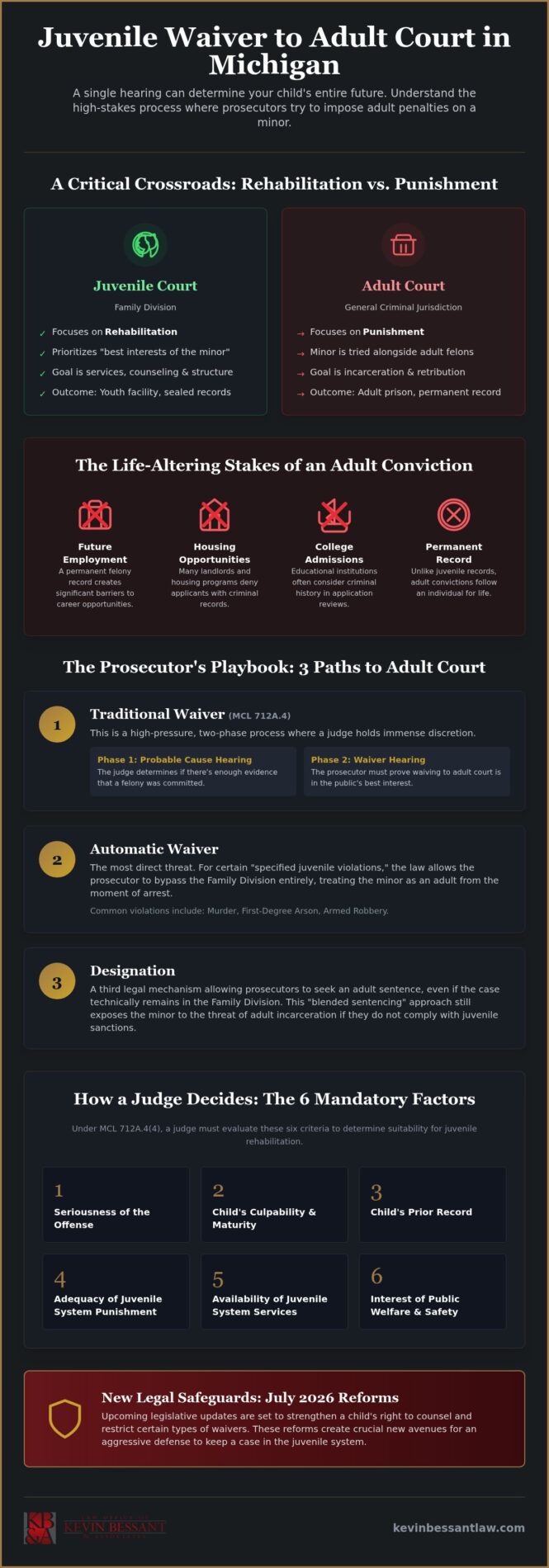
A Michigan judge doesn’t just guess whether your child should be tried as an adult. They’re bound by specific legal criteria. In a juvenile waiver to adult court Michigan, the court must weigh six mandatory factors under MCL 712A.4(4). This is the moment where the prosecutor will try to paint your child as a lost cause. We’re there to prove otherwise. The judge’s decision hinges on whether the “best interests of the public” outweigh the “best interests of the juvenile.”
MCL 712A.4(4) mandates that the court evaluates these six factors:
- Factor 1: Offense Seriousness. Was the act aggressive, violent, or premeditated?
- Factor 2: Culpability. What was the minor’s actual role? Were they a leader or a pressured follower?
- Factor 3: Delinquency Record. Does the child have a history of breaking the law or prior court involvement?
- Factor 4: Programming History. How has the child reacted to past programs, schools, or interventions?
- Factor 5: System Adequacy. Can the juvenile system provide enough punishment and rehabilitation to protect the public?
- Factor 6: Dispositional Options. What specific programs are available to keep the public safe while helping the child?
Winning the “Best Interests” Argument
The prosecutor wants the judge to focus only on the crime. We force the court to look at the child. Winning this phase requires more than just a lawyer; it requires a serious felony defense Michigan expert who understands how to counter a prosecutor’s narrative. We use expert witnesses, including psychologists and social workers, to demonstrate a clear path to rehabilitation. Engaging a family with the right therapeutic support can provide the foundation necessary to prove that the juvenile system has the tools to correct the behavior. If we can show that the public remains safe while your child receives treatment, we win the argument to keep the case in family court.
Your child’s life outside the courtroom is our strongest weapon. We use school records, teacher testimonials, and family environment details as mitigating evidence. A “clean” prior record is often the most powerful defense against a waiver motion. It shows the judge that the current charge is an isolated incident, not a pattern of behavior.
Parents play a vital role in this struggle. You must gather every positive document available: report cards, certificates of achievement, and letters from community leaders. This documentation provides the ammunition we need to fight for your child’s future. Don’t let the prosecutor define your child by their worst day. The stakes couldn’t be higher. If you’re facing a waiver hearing, you need a battle-ready advocate immediately. Contact our Detroit office now to protect your child from the adult system.
Fighting the Waiver: How Aggressive Defense Protects Your Child
The waiver hearing is a mini-trial. The prize is your child’s future. When facing a juvenile waiver to adult court Michigan, you aren’t just arguing for leniency. You’re fighting against a prosecutorial machine that wants to treat a teenager like a career criminal. Our first line of attack is Phase 1: Probable Cause. If the prosecutor can’t prove that a felony was committed or that your child was involved, the entire waiver process collapses. We don’t take the state’s evidence at face value. We tear it apart.
Strategic compromises are also part of the battle. If the evidence is overwhelming, we may negotiate for “Designation” instead of a full “Waiver.” As we’ve explored, designation keeps the case in the juvenile family division. It provides a path to rehabilitation while satisfying the court’s need for oversight. Standing alone against Michigan’s legal system is a dangerous mistake. The court moves fast. The prosecutor is experienced. You need a seasoned guide who knows the terrain and won’t back down.
Why Kevin Bessant is the Shield Your Child Needs
Kevin Bessant brings over 20 years of experience in high-stakes Detroit and Southfield criminal courts. This firm doesn’t just “consult.” We advocate. We act as a vital shield between your family and a system that often prioritizes convictions over corrections. We understand the specific nuances of Wayne, Oakland, and Macomb county courts. Our approach is assertive and protective because we know exactly what’s at stake for your child. The system is already moving against your child. You must move faster.
Next Steps: Securing Your Child’s Freedom
Your first priority is keeping your child home. A bond hearing lawyer Detroit is essential to ensure your child isn’t sitting in a detention cell while we build their defense. Being home allows for better communication and less trauma during this crisis. Once bond is secured, we focus entirely on winning the waiver battle. Don’t wait for the prosecutor to make the next move. Contact the Law Office of Kevin Bessant & Associates today for a comprehensive case evaluation. This is an advocate-versus-system struggle. Ensure you have the strongest advocate in your corner before it’s too late.
Legal Authority: Statute and Case Law
Michigan’s traditional waiver process is codified at MCL 712A.4, with the six mandatory best-interests factors at MCL 712A.4(4), and the Holmes Youthful Trainee Act at MCL 762.11.
- Kent v United States, 383 US 541, 562; 86 S Ct 1045; 16 L Ed 2d 84 (1966) — the U.S. Supreme Court held that a juvenile waiver hearing “must measure up to the essentials of due process and fair treatment,” including the right to counsel, access to records the court relied on, and a statement of the reasons for the waiver decision.
For the current statutory text, see the Michigan Legislature’s MCL database.
Defend Your Child’s Right to a Future
A juvenile waiver to adult court Michigan is a direct assault on your teenager’s freedom and potential. You’ve seen how the system uses traditional and automatic paths to trade rehabilitation for punishment. You now understand the specific factors a judge weighs and why the 2026 legislative reforms make immediate, aggressive legal representation mandatory. The stakes are too high for you to stand alone against a prosecutor who views your child as a statistic.
The Law Office of Kevin Bessant & Associates offers more than just legal advice; we provide a vital shield. With 20+ years of criminal defense experience and specialized expertise in the Michigan Juvenile Code, Kevin Bessant is the dedicated advocate Detroit and Southfield families rely on during their darkest hours. We know the local courts, we know the law, and we know how to fight. Don’t let the system take your child’s future. Contact Kevin Bessant for an aggressive defense today.
There is still a path toward rehabilitation and a clean record. Let’s work together to ensure your child’s mistake doesn’t define the rest of their life.
Frequently Asked Questions
Can a 14-year-old be tried as an adult in Michigan?
Yes. Michigan law allows for any juvenile aged 14 or older to be waived to adult court for an offense that would be a felony if committed by an adult. This age threshold is the minimum for a “Traditional Waiver.” For certain serious crimes, the process can feel automatic and overwhelming. You must act immediately to challenge the prosecutor’s motion before the judge makes a final determination that could destroy your child’s life.
What is the “Automatic Waiver” list in Michigan?
The “Automatic Waiver” list includes “specified juvenile violations” like murder, first-degree arson, armed robbery, and first-degree criminal sexual conduct. For these specific charges, the prosecutor can bypass the juvenile court’s family division and file directly in adult criminal court. This removes the “best interests” hearing entirely. It is a direct threat that requires an aggressive defense to challenge the underlying probable cause evidence and fight for a return to juvenile jurisdiction.
How long does a juvenile waiver hearing take?
A waiver hearing is not a single event; it’s a process. It typically involves two distinct phases: the Probable Cause phase and the Waiver Hearing phase. Depending on the complexity of the evidence and the number of expert witnesses involved, the entire process can take several weeks or even months to resolve. We use this critical time to build a comprehensive case for your child’s rehabilitation within the juvenile family division.
Will my child go to jail during the waiver process?
Not necessarily. While the prosecutor may push for detention, your child’s placement depends on the outcome of the bond hearing. We fight to keep your child home or in a juvenile facility rather than an adult county jail. Securing a favorable bond is a critical first step. It keeps your child safe from the dangers of adult incarceration while we prepare to fight the juvenile waiver to adult court Michigan.
Can a juvenile waiver be appealed if the judge grants it?
Yes, you can appeal a judge’s decision to waive jurisdiction, but the window to act is extremely narrow. These are often “interlocutory appeals,” meaning they happen before the actual criminal trial begins. Because the stakes involve a child’s permanent future, these appeals are high-pressure legal battles. You don’t have time to wait for a trial to end. You need an attorney who can file the necessary motions immediately to stay the proceedings.
What is the difference between a waiver and a designation?
A waiver moves the entire case to the adult criminal division where the minor faces adult prison and a permanent record. A designation keeps the case in the juvenile family division, but the juvenile can still receive an adult sentence if they fail their probation. Designation is often a strategic middle ground. It allows for juvenile rehabilitation while the threat of an adult sentence serves as a “blended” deterrent to satisfy the court’s safety concerns.
Does HYTA apply if my child is waived to adult court?
Yes. The Holmes Youthful Trainee Act (HYTA) is a vital safety net for individuals aged 11 to 26 who are facing adult criminal charges. Even if your child is waived to adult court, we can petition the judge for HYTA status. If granted, and if your child successfully completes their requirements, the conviction is never entered on their public record. It is often the last line of defense against a permanent felony record.
What due process rights does my child have at a waiver hearing?
Kent v United States, 383 US 541 (1966), holds that a juvenile waiver hearing must meet the essentials of due process and fair treatment, including the right to a hearing, representation by counsel, access to the records the court relied on, and a statement of the reasons for the decision.
How much does a juvenile defense lawyer cost in Michigan?
Legal fees for high-stakes juvenile defense vary based on the complexity of the felony charges and the number of expert witnesses required. While we don’t provide a specific dollar amount without a consultation, you should view this as an investment in your child’s entire future. A permanent adult record costs much more in lost career opportunities and housing. Contact our office for a case evaluation to discuss your specific situation and defense needs.