

Selling or transferring a firearm to someone who isn't legally allowed to have one is a felony in Michigan, and it can also trigger federal charges under 18 U.S.C. § 922(d) that carry up to 10 years in federal prison. If you're facing an illegal firearm sale charge in 2026, the defense strategy you pick in the first 30 days shapes everything that follows.
- Challenging whether you knew the buyer was prohibited is the strongest illegal firearm sale charge Michigan defense in most cases.
- Fourth Amendment suppression motions can gut cases built on undercover stings or wiretap evidence.
- Entrapment only works when police induced a sale you weren’t already predisposed to make.
- Federal exposure under 18 U.S.C. § 922 often runs alongside Michigan state charges in 2026 firearm sale cases.
- A free case evaluation before your arraignment date matters more than which defense sounds best on paper.
Why this matters
Michigan treats the sale or transfer of a firearm to a prohibited person as a felony, not a misdemeanor. Stack a state charge on top of a parallel federal firearms trafficking investigation, and you're looking at two separate courtrooms, two separate prosecutors, and two separate sets of rules about what evidence gets in.
Most of these cases start the same way: an undercover buyer, a confidential informant, or a straw purchase that got flagged during a background check trace. The government's case is almost never built on a confession — it's built on recorded calls, text messages, and surveillance. That's exactly where a defense gets built or falls apart.
The strongest illegal firearm sale charge Michigan defense usually attacks the knowledge element — whether you actually knew, or had reason to know, the buyer was prohibited from owning a gun. Weak or nonexistent evidence of that knowledge is where most of these cases crack.
Which defense works best for an illegal firearm sale charge
Best overall: challenging the knowledge element. Best for sting-operation cases: a Fourth Amendment suppression motion. Best for induced sales: an entrapment defense. Best for occasional private sellers: challenging the "engaged in business" element. Best for forensic disputes: chain-of-custody challenges. Best for first-time offenders with no record: negotiating a reduced charge.
No two of these apply the same way, and picking the wrong one wastes time you don't have before a preliminary exam. Kevin Bessant Law's criminal defense team evaluates which of these actually fits the facts of your arrest before filing anything.
What makes the strongest defense against a firearm sale charge
- Attacks an actual element of the crime the prosecutor has to prove beyond a reasonable doubt, not a technicality that sounds good but doesn't move the needle.
- Matches how the case was built — sting operations, informants, and paper trails each open different doors.
- Survives a preliminary exam, where a judge in Wayne, Oakland, Macomb, Washtenaw, or Monroe County decides if there's probable cause to bind the case over.
- Doesn't require you to testify unless the strategy specifically calls for it — most of the strongest defenses are built on cross-examination and motions, not your own words on the stand.
- Accounts for parallel federal exposure, since a state firearm sale charge and a federal 922(d) investigation don't always move on the same timeline.
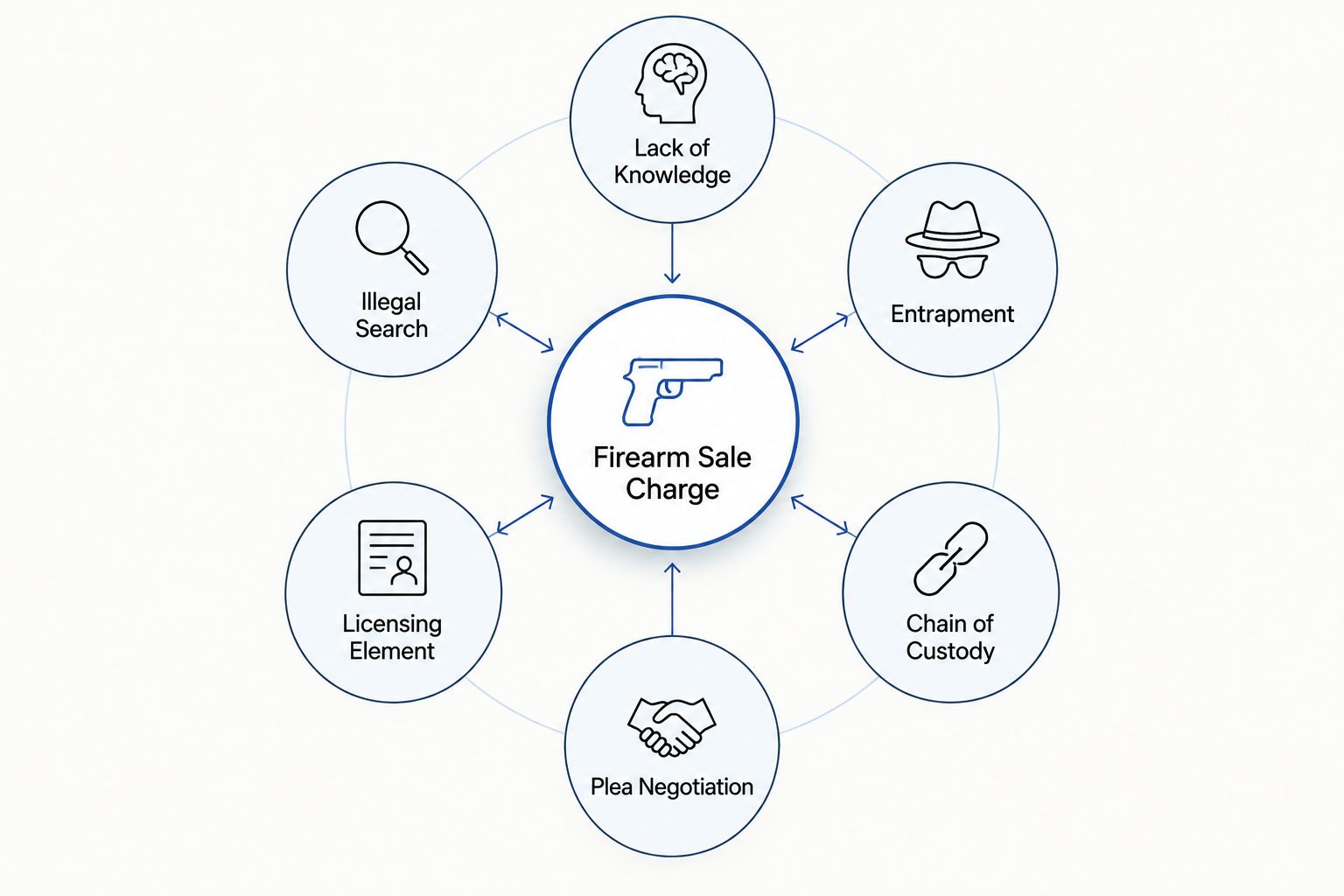
Firearm sale defenses in Michigan: at a glance
| Defense strategy | Best for | Standout feature | Key limitation |
|---|---|---|---|
| Challenging the knowledge element | Private sellers unaware of buyer's status | Attacks the core mens rea requirement | Requires proof of what you didn't know, which is hard to document |
| Fourth Amendment suppression motion | Cases built on stings or wiretaps | Can exclude the government's entire evidence base | Only works if the search or surveillance actually violated procedure |
| Entrapment defense | Sales induced by police pressure | Shifts focus onto law enforcement conduct | Fails if you were already predisposed to sell |
| Challenging the "engaged in business" element | Occasional or one-time sellers | Targets the federal dealer-licensing threshold | Doesn't apply to state charges that don't require repeat sales |
| Chain-of-custody challenge | Cases relying on forensic firearm ID | Questions whether the gun in evidence matches the one sold | Rarely wins the case alone; usually pairs with another defense |
| Negotiated reduced charge | First-time offenders, clean record | Avoids a felony trial outcome entirely | Requires prosecutor cooperation; not available in every case |
1. Challenging the knowledge element: best for private sellers who didn't know the buyer was prohibited
Michigan and federal law both require the seller to know, or have reason to know, that the buyer couldn't legally own a firearm. If you sold to a friend, a family member, or a stranger at a gun show with no red flags — no felony record disclosed, no visible warning signs — the prosecution has to prove you knew otherwise.
Knowledge-element pros:
- Attacks an actual required element of the crime, not a side issue
- Works well when the sale happened outside a controlled sting
- Can apply to both the state and any parallel federal charge
Knowledge-element cons:
- Text messages or recorded calls referencing the buyer's status can undercut this fast
- Requires a full review of every communication before trial, not just your memory of the conversation
Best for: private sellers with no direct knowledge of the buyer's prohibited status.
Verdict: Pursue this defense first in almost every case without a confirmed sting.
2. Fourth Amendment suppression motion: best for cases built on undercover stings
Many illegal firearm sale charges in Michigan originate from an undercover buyer, a wire, or a tip that led to a search warrant. If that warrant was defective, the informant's information was stale, or the surveillance exceeded its legal scope, a suppression motion can strip out the evidence the whole case depends on.
Suppression-motion pros:
- Can eliminate the prosecution's primary evidence in one ruling
- Forces the government to justify every step of how the case was built
- Applies equally to Detroit-area local investigations and joint federal task force operations
Suppression-motion cons:
- Requires a detailed factual record most defendants don't have on their own
- Judges deny more suppression motions than they grant when the warrant was properly executed
Best for: cases where an informant, wiretap, or undercover buyer triggered the investigation.
Verdict: Pursue when the search or surveillance history has real gaps.
3. Entrapment defense: best for sales induced by police pressure
If an undercover officer or informant pushed, pressured, or repeatedly solicited a sale you otherwise weren't going to make, entrapment becomes viable. Michigan's entrapment standard looks at police conduct, not just your state of mind — reprehensible tactics can support the defense even if you eventually agreed.
Entrapment pros:
- Shifts the trial's focus onto law enforcement behavior instead of your actions alone
- Can apply even when you technically committed the sale
Entrapment cons:
- Fails if evidence shows you were already willing or actively seeking a buyer
- Narrower under Michigan law than many defendants assume
Best for: defendants who can show repeated police-initiated contact before the sale occurred.
Verdict: Case-dependent — only viable with a documented pattern of inducement.
4. Challenging the "engaged in business" element: best for occasional private sellers
Federal law under 18 U.S.C. § 922(a)(1)(A) targets people "engaged in the business" of dealing firearms without a license — a threshold that implies repeated, profit-driven sales, not a single private transaction. If the government charged you as an unlicensed dealer over one or two isolated sales, this element is worth challenging directly.
Licensing-element pros:
- Directly attacks a federal charge's core requirement
- Strong when the sale record shows a one-time transaction, not a pattern
Licensing-element cons:
- Doesn't touch a separate state charge for selling to a prohibited person
- Requires transaction history that proves infrequency
Best for: defendants facing federal dealer-without-a-license charges over isolated sales.
Verdict: Pursue as a parallel strategy alongside your state defense.
5. Chain-of-custody challenge: best for cases relying on forensic firearm identification
When the prosecution's case hinges on matching a specific firearm to a specific sale through serial numbers or forensic tracing, gaps in how that evidence was stored, transferred, and tested become fair game.
Chain-of-custody pros:
- Can create reasonable doubt about whether the gun in evidence is the one actually sold
- Applies in both state and federal proceedings
Chain-of-custody cons:
- Rarely wins a case on its own
- Requires a paper trail review that takes real time to build
Best for: cases where firearm identification, not eyewitness testimony, carries the prosecution's burden.
Verdict: Situational only — pair it with a stronger primary defense.
6. Negotiated reduced charge: best for first-time offenders with no prior record
Not every case goes to trial, and not every case should. For defendants with no prior felony record and facts that don't clearly support a full dismissal, negotiating the charge down is sometimes the more realistic path.
Negotiated-charge pros:
- Avoids the uncertainty of a felony jury trial
- Can reduce long-term consequences on background checks and firearm rights
Negotiated-charge cons:
- Requires prosecutor willingness, which varies by county and by facts
- Still typically results in a conviction of some kind
Best for: first-time offenders where the evidence is strong but the record is otherwise clean.
Verdict: Consult first — this only works with the right facts and the right prosecutor.
How we ranked these defenses
Each strategy above is ranked by how directly it attacks a required legal element, how often it applies before a case reaches trial, and whether it survives a preliminary exam in Wayne, Oakland, Macomb, Washtenaw, or Monroe County courts. Strategies that only chip at the edges of a case, like chain-of-custody alone, rank lower than defenses that can end a case outright, like a granted suppression motion.
Which defense should you pursue?
If you had no reason to know the buyer was prohibited, start with the knowledge-element defense — it's the most broadly applicable illegal firearm sale charge Michigan defense across both state and federal cases in 2026. If your case started with an undercover buyer or a wiretap, a suppression motion deserves equal priority. Everyone else falls somewhere on the spectrum between entrapment, the licensing-element challenge, and a negotiated resolution — and that call depends on the specific facts of your arrest, not a general rule.
Get your case reviewed now
Free case evaluation, 20+ years defending Michigan firearm charges.
FAQ
What’s the best defense against an illegal firearm sale charge in Michigan?
Challenging whether you knew, or had reason to know, the buyer was prohibited from owning a firearm is the most broadly applicable defense in 2026. It attacks a required legal element the prosecutor must prove, rather than a procedural technicality.
Is a firearm sale charge a state or federal crime in Michigan?
It can be both. Michigan prosecutes the sale or transfer of a firearm to a prohibited person as a state felony, while federal law under 18 U.S.C. § 922(d) covers the same conduct separately, and both can be charged from the same arrest.
Can entrapment work as a defense to a firearm sale charge?
Entrapment can work, but only when police conduct induced a sale you weren’t already predisposed to make. It fails when evidence shows you were actively seeking a buyer before law enforcement got involved.
How does a Fourth Amendment challenge affect a firearm sale case?
A successful suppression motion can exclude evidence gathered through a defective search warrant, stale informant tip, or overreaching surveillance. Since most firearm sale cases rely on that evidence to prove the sale happened, a granted motion can end the case.
Does a firearm sale charge affect my right to own guns later?
A felony conviction for selling a firearm to a prohibited person typically results in loss of your own firearm rights under both Michigan and federal law. That’s a separate consequence from any prison exposure and applies regardless of sentence length.
What counties handle most Michigan firearm sale prosecutions?
Wayne, Oakland, Macomb, Washtenaw, and Monroe counties see the highest volume of these cases in Southeast Michigan given the region’s population and law enforcement task force activity, though the charge applies statewide.
Should I talk to police before getting a lawyer on a firearm sale charge?
No. Say nothing beyond identifying yourself, and call a criminal defense attorney immediately. Anything said before you have representation can be used to establish the knowledge element the prosecution needs.
Can a firearm sale charge be reduced or dismissed?
It depends on the facts, the evidence, and the prosecutor handling the case in that county. A reduced charge or dismissal is realistic in some cases and unrealistic in others, which is why the defense strategy has to match the specific facts before assuming any particular result.
One last thing
The single biggest mistake in these cases isn't what happens at trial — it's what gets said in the days right after arrest, before anyone's retained counsel. Text messages, jail calls, and casual explanations to investigators routinely hand the prosecution the knowledge element it otherwise couldn't prove on its own.
Related guides
- Best defenses against a Michigan drug manufacturing charge
- Best ways to get a Michigan criminal charge dismissed
- Best defenses against a Michigan home invasion charge
- Best defenses against a Michigan identity theft charge