

One split second mistake at a local shop shouldn’t be the wrecking ball that levels your entire professional future. For a student at Wayne State or the University of Detroit Mercy, a retail fraud charge is more than a legal hurdle. It’s a direct attack on your degree, your financial aid, and every job application you’ll ever submit. You’re likely feeling the crushing weight of anxiety right now, wondering how to tell your parents or if the university will move toward expulsion. It’s a high-stakes crisis that demands an assertive defense. Securing an aggressive shoplifting lawyer for student Detroit cases is the only way to stand in the gap between a momentary lapse and a life-altering conviction.
We understand that you’re facing a system designed to punish, not to understand. You deserve a battle-ready protector who knows the Wayne County courts and understands how to navigate the complexities of Michigan’s retail fraud statutes. This article explains the specific penalties for different levels of retail fraud and provides a clear roadmap for protecting your student status. We’ll show you how we fight to get charges dismissed and ensure your career prospects remain your own.
Key Takeaways
- Grasp the critical differences between Michigan’s retail fraud degrees and how each classification threatens your future professional licensing.
- Uncover the dual-threat reality where you must defend your status in both a criminal courtroom and a university disciplinary hearing.
- Learn why partnering with an aggressive shoplifting lawyer for student Detroit defense is vital for scrutinizing surveillance footage and flawed loss prevention reports.
- Explore proven defense tactics like “Lack of Intent” to prevent a momentary lapse from becoming a permanent criminal record.
- Understand the “Aggressive Shield” approach and how two decades of experience in Detroit courts can protect your degree and financial aid.
The High Stakes of Retail Fraud for Detroit College Students
A shopping trip to Midtown or a quick stop at a retailer along the Riverfront can vanish into a legal nightmare in seconds. In Detroit, retailers don’t just watch for theft; they aggressively pursue it with high-tech surveillance and dedicated loss prevention teams. If you’re a student at Wayne State or another local institution, you’re entering a system that treats a momentary lapse in judgment as a permanent stain on your character. While many people use the general term Shoplifting, Michigan prosecutors use the much more serious label of “Retail Fraud.”
The most dangerous mistake a student can make is falling into the “Student Trap.” This happens when you receive a citation or a “civil demand” letter and assume that paying the fine makes the problem go away. It doesn’t. Paying that fine is often an admission of guilt. That admission creates a permanent criminal record that will trigger red flags during every future background check for internships, medical residencies, or law licenses. You cannot afford to stand alone against these charges. You need the Law Office of Kevin Bessant & Associates to serve as your aggressive shield against a system that is ready to sacrifice your future for a corporate bottom line.
Retail Fraud vs. Shoplifting: What the Law Says
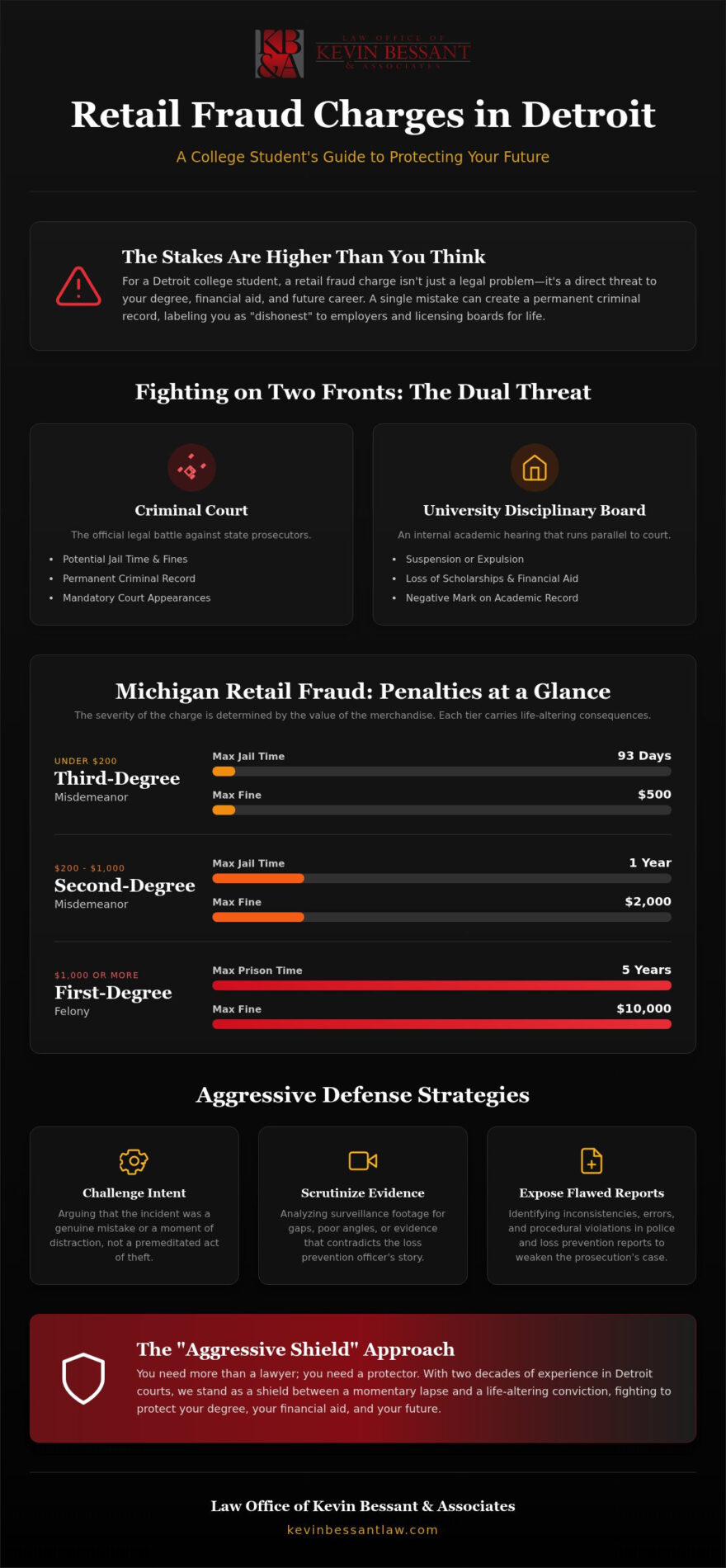
Michigan law categorizes retail fraud into three distinct degrees based on the value of the property and your prior record. Each level carries penalties that can derail your academic career:
- Third-Degree Retail Fraud: This applies to property valued under $200. It is a misdemeanor punishable by up to 93 days in jail and a $500 fine.
- Second-Degree Retail Fraud: This involves property valued between $200 and $1,000. It’s a misdemeanor that carries up to one year in jail and a $2,000 fine.
- First-Degree Retail Fraud: This is a felony charge for property valued at $1,000 or more. A conviction can result in up to five years in prison and a $10,000 fine.
Don’t let the “misdemeanor” label fool you. Any degree of retail fraud on your record signals “dishonesty” to future employers. Hiring an experienced shoplifting lawyer for student Detroit cases is the only way to challenge these classifications and fight for a dismissal.
Why Detroit Students are Targeted
Retailers in high-traffic areas like Midtown often profile young adults. Loss prevention officers are trained to be aggressive, frequently cornering students for questioning before the police even arrive. They might pressure you to sign “confessions” or promise leniency if you cooperate. These are tactics designed to build a case against you, not to help you. If you’ve been detained, remember that you have the right to remain silent. Contact a shoplifting lawyer for student Detroit defense immediately to ensure your rights aren’t trampled by overzealous security guards or prosecutors looking for an easy win.
Degrees of Michigan Retail Fraud: Penalties You Cannot Ignore
A retail fraud conviction is a scarlet letter for a college student. In the legal world, theft is classified as a “crime of moral turpitude.” This means employers, licensing boards, and housing managers view you as inherently dishonest. It doesn’t matter if the item was worth five dollars or five thousand. The mark on your record says the same thing. You must act with extreme urgency before your first court date in Detroit. Waiting until you are standing in front of a judge is a recipe for disaster. Hiring a shoplifting lawyer for student Detroit cases is your only line of defense against a system that doesn’t care about your GPA or your career goals.
3Rd Degree Retail Fraud: The “Minor” Mistake with Major Consequences
Third-degree retail fraud is often dismissed by students as a “slap on the wrist.” Don’t fall for that lie. While it carries a maximum of 93 days in jail and a $500 fine, the real damage is invisible. It lives on your permanent criminal record. If you’re applying for a nursing license, a teaching certificate, or a position in finance, this “minor” mistake can trigger an automatic disqualification. Our firm acts as an aggressive shield for students. We work to ensure a momentary lapse doesn’t turn into a lifelong barrier. If you’re facing these charges, you need a Retail Fraud Defense Attorney Michigan who understands the local Detroit court dynamics.
2Nd and 1st Degree: When Shoplifting Becomes a Felony Threat
The stakes escalate rapidly when the value of the merchandise exceeds $200 or if you have a prior conviction. Second-degree retail fraud moves you into a one-year jail sentence territory with fines up to $2,000. If the value hits $1,000 or more, you’re facing First-Degree Retail Fraud. This is a felony. In Michigan, a felony conviction for retail fraud can lead to five years in a state prison and a $10,000 fine. This isn’t just a hurdle; it’s a life-altering catastrophe. Felons lose the right to vote, the right to own a firearm, and often the right to work in their chosen field. You cannot gamble with your future. You need a shoplifting lawyer for student Detroit defense who is ready to litigate aggressively. If you’re feeling the pressure of an impending court date, reach out to our team today to start building your defense.
The Dual Threat: Criminal Court vs. University Disciplinary Boards
When you’re arrested for retail fraud in Detroit, the police are only half of your problem. You’re facing a dual threat that can end your academic career before the prosecutor even files a formal charge. Institutions like Wayne State University and the University of Detroit Mercy (UDM) have strict Student Codes of Conduct that categorize theft as a major violation. The moment the university receives word of your arrest, they may initiate a “Conduct Hearing.” This isn’t a friendly chat with an advisor. It’s a high-stakes interrogation that can lead to immediate suspension or expulsion. You need a shoplifting lawyer for student Detroit defense who understands that your standing with the university is just as vital as your standing with the court.
The danger of these university hearings is that they lack the constitutional protections of a courtroom. You don’t have a right to a public trial, and the burden of proof is often much lower than “beyond a reasonable doubt.” Most importantly, anything you say during a university disciplinary meeting can potentially be used against you in your criminal case. Do not walk into a dean’s office alone. Kevin Bessant acts as your advocate in both arenas, ensuring that your defense in one system doesn’t accidentally sabotage your future in the other. We stand in the gap to protect your right to stay in school while we fight the criminal charges simultaneously.
Protecting Your Scholarship and Financial Aid
A conviction for retail fraud doesn’t just stay on your record; it hits your bank account. Many students don’t realize that certain criminal convictions can trigger an immediate loss of federal financial aid, including Pell Grants and Stafford Loans. Merit-based scholarships often contain “moral character” clauses that allow the university to revoke funding the moment a student is found responsible for a crime of dishonesty. If you’re a younger student or a minor, you may also need an Aggressive Juvenile Crime Attorney Detroit to navigate the specific protections available in the juvenile system. We work to ensure your financial support remains intact so you can actually finish the degree you’ve worked so hard to earn.
Career Killers: Nursing, Law, and Education Degrees
Detroit is a competitive hub for healthcare, law, and education. If you’re pursuing a degree in these fields, a theft conviction is a “career killer.” Licensing boards for registered nurses, teachers, and attorneys conduct deep background checks into your past. They view a retail fraud charge as evidence of a lack of integrity, which can lead to a denial of your professional license. Furthermore, Detroit’s top-tier internship programs at major law firms or the “Big Three” automakers have zero tolerance for records involving dishonesty. Securing a shoplifting lawyer for student Detroit cases is the only way to pursue an expungement or dismissal that keeps these professional doors open. We fight to keep your record clean so your internship applications aren’t tossed in the trash before they’re even read.
Aggressive Defense Strategies for Detroit Shoplifting Charges
Standing in a Detroit courtroom requires more than a simple explanation; it requires a tactical assault on the prosecution’s case. The system is rigged to favor the testimony of retailers and their security teams, but they aren’t infallible. An experienced shoplifting lawyer for student Detroit defense knows how to dismantle their narrative by scrutinizing every piece of evidence. We don’t just wait for the prosecutor to make an offer. We actively hunt for procedural errors, grainy surveillance footage that lacks clarity, and inconsistent statements in loss prevention reports. If the evidence is weak, we fight to have it suppressed before your case ever reaches a jury.
One of the most powerful tools in our arsenal is the “Lack of Intent” defense. Michigan law requires the prosecution to prove that you intended to steal. In the chaotic environment of a busy Midtown store, it’s easy for a student to become distracted. Forgetting an item in the bottom of a cart or walking out while on a phone call isn’t a crime; it’s a mistake. We humanize you to the prosecutor, shifting the narrative from “criminal thief” to “distracted student.” By aggressively negotiating with the Wayne County Prosecutor’s Office, we often secure dismissals or diversions that keep your record entirely clean.
Challenging the Loss Prevention Officer (LPO)
Loss prevention officers are not police officers. They are private employees who often lack proper legal training, leading to significant violations of your rights during the detention phase. We investigate whether the LPO had probable cause to stop you or if they relied on profiling and guesswork. If they used excessive force or searched your private property without consent, we move to strike their testimony. Unlawful detention in a retail setting occurs when a store’s security personnel restrain a student without probable cause or for an unreasonable amount of time, providing a powerful basis for suppressing evidence. We expose these mistakes to weaken the prosecution’s leverage.
Negotiating for a Clean Slate
For students under the age of 26, the Holmes Youthful Trainee Act (HYTA) is a vital shield against a permanent record. HYTA allows a student to plead to a charge while the court withholds a formal conviction. If you successfully complete a period of probation, the case is dismissed, and no public record of the arrest or conviction ever exists. This is the “clean slate” that protects your future job applications and professional licenses. It’s a complex negotiation that requires a battle-ready advocate who knows how to present your academic achievements as a reason for leniency. Don’t leave your future to chance. Contact Kevin Bessant today to ensure your defense strategy is built to win.
Why Students Choose the Law Office of Kevin Bessant & Associates
The Detroit legal system is a machine designed to process defendants, not to protect futures. When you are a student at a local university, the stakes are too high to trust your defense to a public defender or a firm that treats you like just another case file. You need a shoplifting lawyer for student Detroit defense who understands the specific pressures you face. We don’t just “handle” cases; we act as an aggressive shield between you and a system that is ready to label you a criminal. With over 20 years of experience in Detroit and Wayne County courts, Kevin Bessant knows exactly how local prosecutors build their cases—and he knows how to tear them down.
We are not intimidated by aggressive prosecutors or corporate loss prevention teams. Our firm thrives in the “advocate-versus-system” dynamic. We understand that the prosecution’s goal is a conviction, but our goal is your total protection. Do not walk into a Detroit court alone. The judge and prosecutor aren’t there to hear your side of the story; they are there to enforce the law. We stand in the gap, providing a fierce, battle-ready voice that demands the best possible outcome for your case. We fight for dismissals because we know that anything less can have devastating consequences for your life.
A Record of Protecting Detroit’s Future Professionals
Our firm has a proven history of standing up for students who were on the verge of losing everything. We’ve successfully protected future doctors, nurses, and attorneys from permanent records that would have disqualified them from their chosen professions. This isn’t just about avoiding jail time; it’s about preserving your identity as a high-achieving student with a bright future. Our representation is assertive and high-stakes because we know exactly what you have to lose. Discover more about our commitment to excellence and why choose Kevin Bessant for your defense.
Immediate Action: Your Next Steps After an Arrest
If you’ve been arrested, your next moves will determine the rest of your life. Exercise your right to remain silent. Do not explain your side to the police, and do not apologize to the store security. Anything you say will be twisted and used against you during your arraignment. Call Kevin Bessant immediately. Time is of the essence before your first court appearance. We need to begin investigating the evidence and negotiating with the prosecutor before the system gains too much momentum. You are in a moment of crisis, but you don’t have to face it alone. Take the first step toward reclaiming your future and reach out to us right now for the aggressive representation you deserve.
Legal Authority: Statute and Case Law
Michigan’s retail fraud statutes are codified at MCL 750.356c (first degree) and MCL 750.356d (second and third degree), with HYTA deferral available under MCL 762.11.
- People v Reddick, 187 Mich App 547, 551; 468 NW2d 278 (1991) — addressed the sufficiency of evidence needed to sustain a retail fraud conviction, confirming that concealment of merchandise combined with conduct suggesting intent to avoid payment can support a conviction, but mere possession or proximity is not automatically enough.
- People v Kenny, Mich App (2016) — relying on the pattern jury instruction M Crim JI 23.13(3), the Michigan Court of Appeals held that a person can “steal” property under the retail fraud statutes by concealing it with intent to keep it, even without ever leaving the store.
For the current statutory text and published opinions, see the Michigan Legislature’s MCL database and the Michigan Courts case search.
Defend Your Degree and Reclaim Your Professional Future
A single arrest for retail fraud shouldn’t end your professional aspirations. You’ve worked too hard for your degree to let one mistake trigger university expulsion or a permanent criminal record. You’re facing a dual threat from Wayne County courts and university disciplinary boards; both systems are built to punish first. You need an advocate who isn’t intimidated by aggressive prosecutors or dean interrogations. With over 20 years of aggressive criminal defense experience and a proven track record in Wayne County courts, Kevin Bessant provides the specialized knowledge required to navigate these high-stakes student legal issues.
Don’t wait for the arraignment to start your defense. Securing an expert shoplifting lawyer for student Detroit cases is the only way to ensure your record remains clean and your financial aid stays intact. We act as your vital shield, standing in the gap to protect your integrity and your livelihood. You have a path forward, and we’re here to lead you through it. Secure Your Aggressive Shield: Contact Kevin Bessant Today. Your future is worth the fight, and you don’t have to face it alone.
Frequently Asked Questions
Will a shoplifting charge in Detroit show up on my student background check?
An arrest or conviction for retail fraud in Detroit will appear on your criminal record and be visible to anyone conducting a background check. This includes potential employers, university housing departments, and graduate school admissions boards. Without an aggressive defense to secure a dismissal or a non-public record under HYTA, this “dishonesty” mark can follow you for life. You must act quickly to shield your record from these invasive searches.
Can I be expelled from Wayne State or UDM for a retail fraud arrest?
Yes, universities like Wayne State and UDM have the authority to suspend or expel students for criminal conduct that violates their Student Code of Conduct. These disciplinary proceedings are separate from your criminal court case and often have a lower burden of proof. You are facing a dual threat that requires a shoplifting lawyer for student Detroit defense who can navigate both the courtroom and the university conduct board simultaneously to protect your academic standing.
What is the Holmes Youthful Trainee Act (HYTA) for Michigan students?
HYTA is a powerful legal tool for students in Michigan between the ages of 17 and 26. It allows an individual to plead guilty while the court withholds a formal entry of conviction. If you successfully complete probation, the case is dismissed, and no public record of the crime ever exists. This is a critical “clean slate” option that prevents a momentary lapse in judgment from destroying your future career prospects and professional reputation.
Do I have to tell my parents if I am arrested for shoplifting in Detroit?
If you are 18 or older, the court will not notify your parents of your arrest. However, the financial and academic consequences of a retail fraud charge often make it necessary to involve them. Between legal fees, court costs, and the potential loss of financial aid, most students find that parental support is vital. We provide professional reassurance and guidance on how to handle these difficult conversations while focusing entirely on your legal defense.
What is the difference between 3rd-degree and 2nd-degree retail fraud?
The primary difference lies in the value of the stolen merchandise and your prior criminal history. Third-degree retail fraud involves property valued under $200 and is a 93 day misdemeanor. Second-degree retail fraud covers property valued between $200 and $1,000, or cases where the defendant has a prior conviction. This jump increases the potential jail time to one year and doubles the fines, making it even more critical to secure an assertive legal shield.
Can a shoplifting lawyer get my charges dismissed in Wayne County?
Yes, a skilled shoplifting lawyer for student Detroit defense can often secure a dismissal by challenging the evidence or negotiating for a diversion program. We scrutinize surveillance footage and loss prevention reports to find procedural errors or prove a lack of criminal intent. In many Wayne County cases, first-time student offenders can avoid a permanent record through aggressive negotiation tactics that emphasize their academic achievements and potential for rehabilitation.
How much does a shoplifting lawyer cost for a college student?
Legal fees vary based on the complexity of the charges and whether your case requires a trial or a negotiated plea. You should view these costs as a vital investment in your future earning potential. A conviction can cost you thousands in lost scholarships and career opportunities over a lifetime. We focus on providing high-impact representation that prioritizes your degree and clean record above all else. Contact us for a specific evaluation of your situation.
Will a retail fraud conviction stop me from getting a nursing or law license?
A conviction for retail fraud is a “crime of moral turpitude” that triggers major red flags for professional licensing boards. Nursing, law, and education boards require applicants to demonstrate good moral character. A theft conviction on your record can lead to an automatic denial of your license or a lengthy, difficult appeal process. Protecting your future license requires an aggressive defense that targets a dismissal or a non-public record from the very beginning.
Does the prosecution have to prove I actually left the store to convict me?
No. People v Kenny confirms that concealing an item with intent to keep it, such as placing it inside a bag, can support a conviction even if a student never walked past the registers or exited the building.