

Best overall: material inconsistencies in the accuser’s statements. Best when the allegation lacks corroboration: contradictions between the claim and the physical evidence. Best when a custody case, divorce, breakup, or housing dispute overlaps the accusation: a documented motive to fabricate. This 2026 guide explains how Kevin Bessant Law evaluates each defense and why the strongest strategy usually combines several supported arguments.
- The best false domestic violence accusation defense Michigan strategy attacks material inconsistencies and unsupported claims.
- Missing injuries or damage can support the defense, but their absence does not automatically disprove an assault.
- A documented motive to fabricate matters most when messages, filings, or witness testimony support it.
- Michigan prosecutors control criminal charges, so an accuser cannot simply drop the case.
- Preserve messages, video, call records, photographs, and witness details immediately in 2026.
Why this matters
A domestic violence arrest can happen after officers hear two conflicting accounts and decide probable cause exists. Michigan law permits a warrantless arrest for suspected domestic assault under specified circumstances. That arrest is not a conviction, but everything the accused says afterward can shape the prosecution.
The accuser does not control whether the criminal charge continues. A prosecutor can proceed with police testimony, photographs, recordings, messages, medical evidence, or an admissible 911 call even if the accuser later recants or refuses to cooperate.
For a basic domestic assault under MCL 750.81, a first conviction can carry up to 93 days in jail. A second offense can carry up to 1 year, while a third or subsequent offense can become a felony carrying up to 5 years. Other allegations or aggravating facts can change the charge and exposure.
Kevin Bessant Law provides domestic violence defense for people facing arrest or prosecution in the Detroit metro area. The firm’s stated credentials include 20+ years of trial experience and Michigan Super Lawyers recognition. Those credentials matter because a false accusation defense depends on early evidence review, local court procedure, and disciplined cross-examination rather than a broad denial.
What makes the strongest false-accusation defense
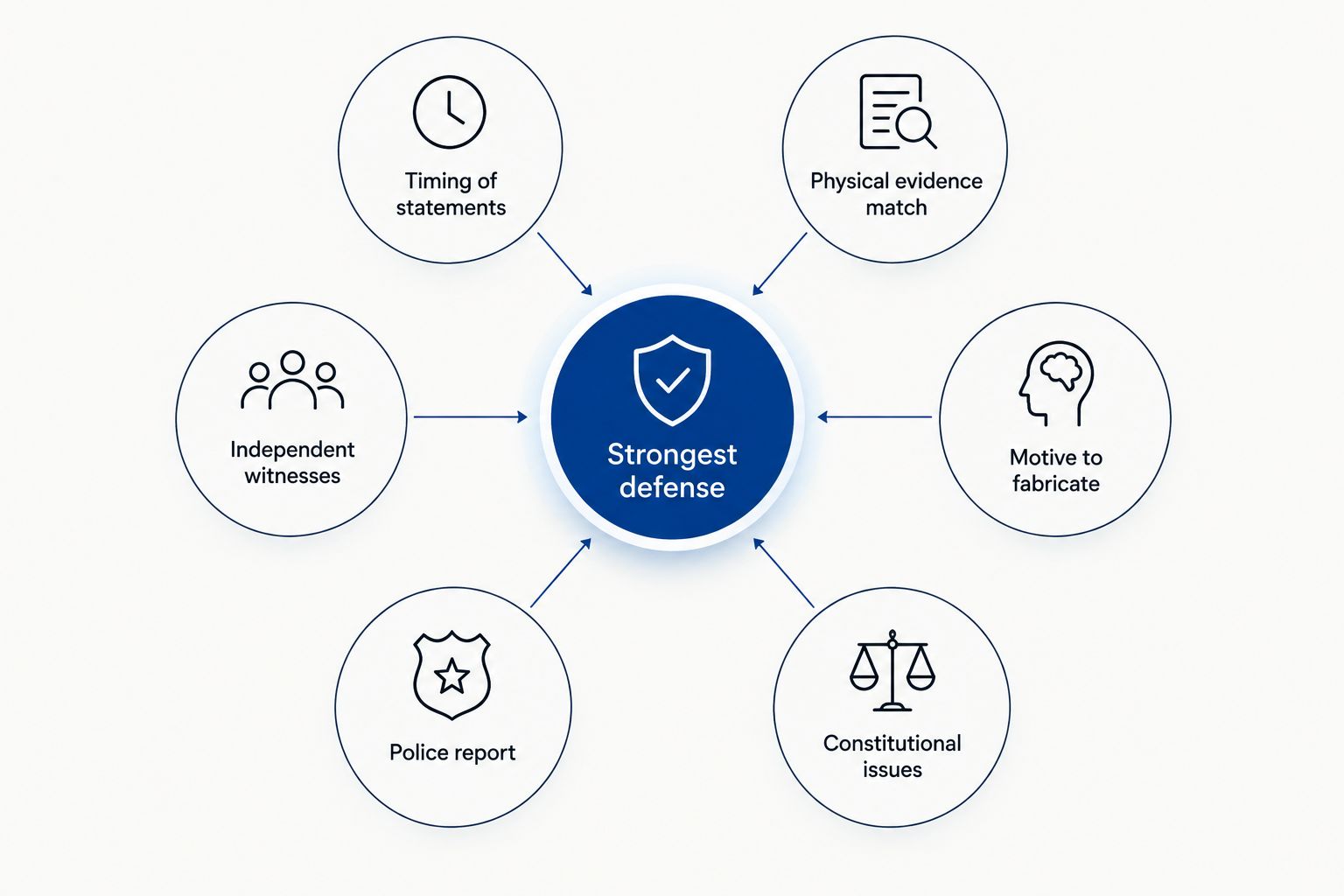
A defense is only as strong as the admissible evidence behind it. Use these criteria to judge whether a theory can survive prosecutor review, a motion hearing, and trial in 2026:
- Timing of statements: Compare the 911 call, body-camera statements, police report, follow-up interview, and testimony.
- Physical evidence match: Check whether photographs, medical records, damaged property, or clothing support the alleged conduct.
- Independent witnesses: Identify people who observed the incident, its immediate aftermath, or relevant communications.
- Motive to fabricate: Look for documented custody, divorce, housing, financial, or relationship disputes.
- Police report quality: Determine whether officers recorded both accounts and preserved potentially exculpatory evidence.
- Constitutional issues: Review the arrest, search, seizure, and any custodial interrogation.
A useful defense does more than suggest that the accusation might be false. It shows exactly where the prosecution’s evidence fails and supports that challenge with records, testimony, or a legal rule.
Defense strategies at a glance
| Rank | Defense strategy | Best for | Standout strength | Key limitation |
|---|---|---|---|---|
| 1 | Material inconsistent statements | An accusation that changed over time | Directly attacks credibility | Minor differences rarely prove fabrication |
| 2 | Contradicted or missing evidence | Specific claims that should have corroboration | Tests the allegation against objective facts | Some assaults leave no visible injury |
| 3 | Documented motive to fabricate | Custody, divorce, breakup, or housing disputes | Explains why the accusation arose | Motive alone does not disprove conduct |
| 4 | Independent witnesses and records | Incidents with observers or digital evidence | Adds evidence beyond either party’s account | Evidence can disappear or witnesses can resist involvement |
| 5 | Self-defense | Cases involving an initiated attack by the accuser | Can legally justify necessary force | Concedes that some physical contact occurred |
| 6 | Constitutional and evidentiary challenges | Flawed searches, interviews, or hearsay proof | Can exclude prosecution evidence | Suppression may not eliminate the entire case |
1. Material inconsistent statements: best overall defense
A material inconsistency concerns a fact that changes whether an assault occurred, who initiated contact, what force was used, or when the event happened. Differences about an unimportant detail carry less weight.
The defense should compare every recorded version rather than rely on memory. That includes dispatch audio, body-camera footage, written statements, messages, and sworn testimony. A contradiction becomes stronger when objective evidence proves which version cannot be true.
Material inconsistent statements pros:
- Tests the reliability of the accusation using the accuser’s own words
- Can support cross-examination without requiring the accused to testify
- Becomes stronger when video, timestamps, or witnesses confirm the conflict
Material inconsistent statements cons:
- Stress and imperfect memory can explain minor differences
- Statements must be obtained and used under Michigan evidence rules
Best for: cases where the central story changed between the initial report and later testimony.
Verdict: Prioritize when the inconsistency concerns a decisive fact.
2. Contradicted or missing evidence: best for unsupported claims
This strategy compares the alleged act with the evidence that should reasonably exist. If the accusation describes damaged property, torn clothing, repeated calls, or a specific injury, the defense checks whether photographs, records, and recordings confirm that detail.
An absence of visible injury does not automatically defeat a domestic assault charge. Michigan law does not require a serious injury for every charge. The better argument is that a specific claim conflicts with the available evidence, not that every assault must leave a mark.
Contradicted or missing evidence pros:
- Focuses the case on records a jury can examine directly
- Can expose exaggeration about the force, sequence, or location
- Supports reasonable doubt without depending entirely on either party’s credibility
Contradicted or missing evidence cons:
- Some alleged conduct produces no physical evidence
- A delayed report can explain why certain evidence was not preserved
Best for: allegations containing testable details that photographs, video, records, or property condition contradict.
Verdict: Prioritize when the accusation makes a factual claim the evidence disproves.
3. Documented motive to fabricate: best for overlapping disputes
A custody fight, divorce, breakup, eviction dispute, or conflict over shared property can provide context for a false allegation. Context is not proof. The defense needs messages, filings, witness testimony, or a documented timeline connecting the dispute to the accusation.
The strongest version of this strategy answers two questions: what benefit did the accuser seek, and what evidence shows that goal existed before the police report? A theory created after arrest carries less force than a message or filing that predates it.
Motive to fabricate pros:
- Gives the fact-finder a concrete reason to question the allegation
- Can connect family-court records and communications to the criminal case
- Works well with inconsistent statements or contradicted evidence
Motive to fabricate cons:
- A hostile relationship does not prove an accusation is false
- Aggressive attacks on the accuser can backfire without documentation
Best for: cases where a separate dispute and supporting paper trail existed before the accusation.
Verdict: Use as a supporting strategy, not a substitute for evidence.
4. Independent witnesses and records: best for objective corroboration
Independent proof can break a credibility tie. Relevant evidence can include a neighbor’s observations, home-security footage, building access records, call logs, location data, photographs, or messages sent immediately before and after the alleged incident.
Preservation is the first problem. Video can be overwritten, messages can be deleted, and witnesses can forget details. The defense should identify the source, record what it proves, and pursue lawful preservation before the evidence disappears.
Independent evidence pros:
- Adds proof beyond the accused person’s denial
- Can establish location, timing, demeanor, or sequence
- Makes other defenses easier to verify
Independent evidence cons:
- A witness may be biased, unavailable, or unwilling to testify
- Digital records need authentication and context
Best for: incidents that occurred near witnesses, cameras, connected devices, or documented communications.
Verdict: Prioritize immediately because preservation delays can destroy the defense.
5. Self-defense: best when the accuser initiated force
Self-defense is different from claiming that no physical contact occurred. It argues that the accused used lawful force because the other person presented an imminent threat and the response was necessary and proportionate under the circumstances.
This strategy requires careful factual analysis. Injuries, relative position, witness accounts, prior messages, and the sequence of contact can matter. An unsupported claim that the other person started it is not enough.
Self-defense pros:
- Directly addresses cases in which the accused responded to aggression
- Can explain defensive injuries or limited physical contact
- Gives the jury a lawful reason for conduct that occurred
Self-defense cons:
- Concedes some form of force or contact
- Becomes weaker if the response continued after the threat ended
- Can conflict with an earlier statement denying all contact
Best for: cases with credible evidence that the accuser initiated or threatened imminent force.
Verdict: Use only when the facts and earlier statements remain consistent.
6. Constitutional and evidentiary challenges: best for flawed proof
Police and prosecutors must follow constitutional rules even when an accusation is serious. A defense lawyer should examine whether officers lawfully entered or searched a home, seized a device, conducted a custodial interrogation, and preserved evidence.
Miranda applies to custodial interrogation, not every conversation with police. A successful challenge can suppress an unlawfully obtained statement, but it will not automatically exclude independent photographs, witness testimony, or other admissible evidence.
Hearsay analysis also matters when the prosecution wants to use an accuser’s out-of-court statements. Some statements can fall within an exception, and confrontation rights can limit others. The answer depends on how, why, and when the statement was made.
Constitutional and evidentiary challenge pros:
- Can prevent improperly obtained evidence from reaching the jury
- Forces the prosecution to identify admissible proof
- Applies even when credibility arguments are limited
Constitutional and evidentiary challenge cons:
- Excluding one statement may leave enough evidence to continue
- Technical arguments require a complete record and precise motion practice
Best for: cases involving a home entry, device search, custodial questioning, unavailable witness, or disputed 911 statement.
Verdict: Review in every case; prioritize when challenged evidence is essential to the prosecution.
How the defenses were ranked
The 2026 ranking places direct attacks on the allegation first, independent corroboration next, and technical legal challenges last. That order does not make the lower-ranked defenses weak. It reflects the need to answer both the accusation and the admissibility of the prosecution’s proof.
A case can require several defenses at once. For example, a material contradiction becomes more useful when a timestamp disproves one version, while a fabrication motive becomes more persuasive when pre-accusation messages document the dispute.
The ranking also accounts for risk. Self-defense can be powerful, but it conflicts with a claim that no contact occurred. A procedural motion can suppress a statement, but it cannot erase independent evidence. Kevin Bessant Law’s domestic violence defense should select one consistent case theory and test every argument against it.
Which defense should you choose?
Start with the evidence, not the accusation’s emotional history. If the story changed on a decisive fact, prioritize inconsistent statements. If the allegation contains a detail that records disprove, lead with objective contradiction. If a custody or divorce dispute supplies a documented motive, use it to explain why the false report occurred.
Self-defense belongs in cases where contact occurred and the evidence supports a necessary response to imminent force. Constitutional and hearsay challenges belong in every complete review, but they are most valuable when the disputed evidence is central to the prosecution.
Do not contact the accuser to demand a recantation, argue about the report, or recover property if a bond condition or personal protection order bars contact. A new message can become prosecution evidence, and a violation can create another charge. Review the separate guide to Michigan PPO violation defenses if an order is already in place.
Kevin Bessant Law can evaluate the police report, bond terms, recorded statements, and available evidence during a free case evaluation. That review should begin immediately in 2026, before records disappear or avoidable contact creates another problem.
Protect your defense now
Request a free case evaluation for a domestic violence charge in metro Detroit.
FAQ
What is the best defense to a false domestic violence accusation in Michigan?
The best defense attacks material inconsistencies and supports that attack with independent evidence. Records, video, messages, photographs, or credible witnesses carry more weight than an unsupported denial.
Can an accuser drop a Michigan domestic violence charge?
No, the accuser cannot personally drop a criminal charge after the prosecutor takes control of the case. A prosecutor can continue using other admissible evidence even if the accuser recants or refuses to cooperate.
Will a domestic violence case be dismissed if there are no injuries?
No, the absence of injuries does not automatically require dismissal in Michigan. It becomes useful when the allegation describes force that conflicts with photographs, medical records, video, or other evidence.
Can text messages prove a domestic violence accusation is false?
Text messages can support a false-accusation defense when they contradict the timeline, show a fabrication motive, or document what happened before and after the report. The complete conversation matters because isolated screenshots can lack context.
Is self-defense allowed in a Michigan domestic violence case?
Yes, self-defense can apply when the accused reasonably responded to an imminent threat with necessary and proportionate force. The evidence must support that account, and it must remain consistent with earlier statements.
What should I preserve after a false domestic violence accusation?
Preserve messages, call logs, photographs, videos, receipts, location records, witness contact details, bond documents, and PPO paperwork. Do not alter files or access another person’s account without authorization.
Should I contact the accuser if the allegation is false?
No, do not contact the accuser if a bond condition or personal protection order prohibits it. Even without an order, messages demanding a recantation can be portrayed as pressure or intimidation.
When should I contact Kevin Bessant Law about a false accusation?
Contact Kevin Bessant Law immediately after an arrest, police request, or notice of charges. Early review in 2026 protects evidence and helps prevent statements or prohibited contact from damaging the defense.
One last thing
Preserve first and explain later. Save the complete message thread, original photographs, call logs, video files, and witness information without editing or posting them publicly. Ask counsel about sending preservation requests for dispatch audio, body-camera footage, surveillance video, and other records held by third parties.
Do not give police a detailed statement simply because you want to clear up the accusation. A partial explanation can lock the defense into a timeline before counsel reviews the report and recordings. In 2026, the safest immediate steps are to remain silent, obey every release condition, preserve evidence, and get legal advice tailored to the exact charge.