

A Michigan witness tampering charge under MCL 750.122 can stack a second felony on top of whatever case you're already fighting, and picking the wrong defense strategy wastes the narrow window you have before charges harden. This guide ranks the defense strategies that actually move a witness tampering charge Michigan defense case in 2026, from attacking the intent element to suppressing the recording the prosecutor built the case around.
- Challenging the specific-intent element is the strongest starting point for most witness tampering charge Michigan defense cases in 2026.
- MCL 750.122 ties penalty exposure to the severity of the underlying case, so context matters as much as the conversation itself.
- Witness credibility attacks work best when the case rests on one recanting or inconsistent accuser.
- Suppressing texts, calls, or recordings gathered without proper authority can remove the state’s main exhibit.
- A free case evaluation with a Detroit criminal defense lawyer is the fastest way to match a defense to your specific charge.
Why this matters
A witness tampering charge rarely shows up alone. It usually rides alongside a domestic violence case, a felony drug charge, or a pending PPO matter, and prosecutors in Wayne, Macomb, Oakland, Washtenaw, and Monroe counties treat it as proof you're trying to obstruct their case.
That makes the charge look worse to a judge than the underlying case itself, even when the conversation was ambiguous or the witness misread your intent. Kevin Bessant has spent 20+ years in Michigan courtrooms building the fact record these cases turn on, and Michigan Super Lawyers recognition doesn't come from filing generic motions.
The strategy that fits your case in 2026 depends on what was actually said, who said it, and how the state got its evidence.
What makes the best defense strategy for a witness tampering charge
- Strength of the intent evidence – did you actually threaten, bribe, or coerce, or just talk to someone?
- Witness consistency – has the accuser's story already changed once?
- How the evidence was gathered – warrant, consent, or an illegal wiretap?
- Connection to a separate case – is the tampering charge tied to a weaker underlying case?
- Timing – can the defense be raised before the felony exam or only at trial?
- Statutory fit – does the conduct actually match what MCL 750.122 covers?
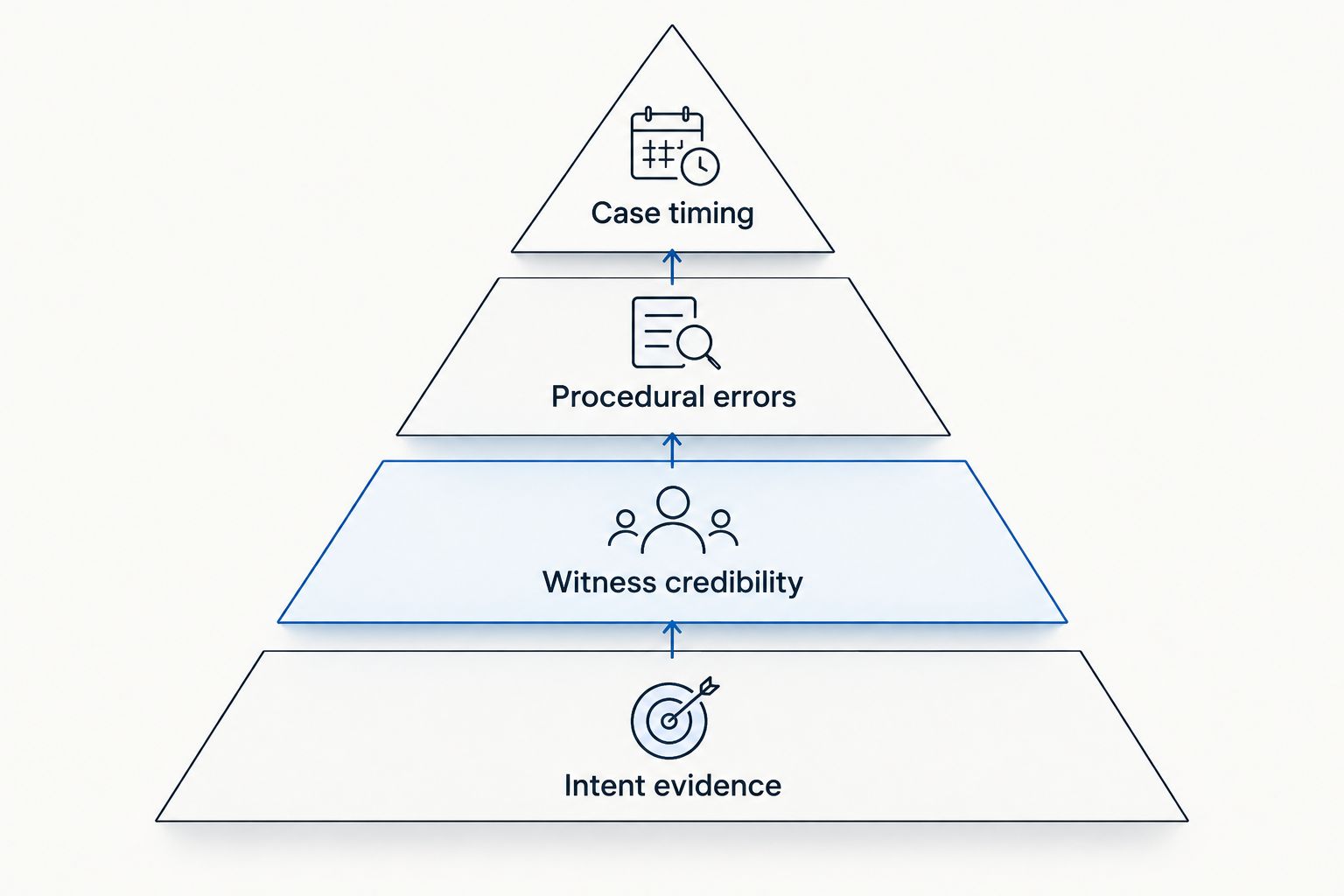
Witness tampering defense strategies at a glance
| Strategy | Best for | Standout feature | Key limitation |
|---|---|---|---|
| Challenging intent | No clear threat or bribe in the record | Attacks an element the prosecutor must prove | Needs a detailed factual investigation |
| Witness credibility attack | Cases resting on one accuser | Uses inconsistencies already on record | Weaker when other evidence corroborates |
| Suppressing digital evidence | Cases built on texts, calls, recordings | Can remove the state's core exhibit | Only works if collection was improper |
| Lawful-advice / free speech defense | Advising a witness on legal rights | Grounded in constitutional protection | Doesn't cover threats or payment |
| Negotiated resolution with underlying case | Tampering tied to a weak separate case | Addresses both charges together | Depends on strength of the other case |
| Statute misapplication challenge | Conduct that isn't really tampering | Targets overbroad charging | Needs strong case-law argument |
1. Challenging the specific-intent element: best defense for cases without a clear threat or bribe
MCL 750.122 requires the prosecutor prove you intended to influence, discourage, or prevent testimony – a conversation alone doesn't satisfy that. Building this defense means pulling every text, call log, and witness statement apart to show ambiguous or protected conduct instead of coercion.
Challenging intent pros:
- Targets an element the prosecutor carries the full burden on
- Can be raised as early as the felony exam, not just at trial
- Applies no matter what the underlying charge is
Challenging intent cons:
- Requires a documented factual record, not just argument
- Judges give prosecutors room once a witness testifies about feeling pressured
Best for: defendants who spoke to a witness but never threatened, paid, or coerced them.
Verdict: pursue this first – request discovery on any recorded statements immediately.
2. Attacking witness credibility and consistency: best defense for cases resting on one accuser
This strategy cross-examines the accuser's changed story, motive to fabricate, and prior inconsistent statements rather than the tampering conversation itself.
Credibility attack pros:
- Effective when the tampering allegation comes from one person's account
- Can expose motive tied to a divorce, custody dispute, or PPO matter
- Undermines the same witness's credibility on the underlying charge too
Credibility attack cons:
- Weaker when texts or recordings independently corroborate the witness
- Needs a documented history of inconsistency, not speculation
Best for: cases where the accuser has already changed their account once.
Verdict: strong paired with another defense – rarely enough standing alone.
3. Suppressing illegally obtained digital evidence: best defense for cases built on texts, calls, or recordings
When the entire tampering case is one text thread or a recorded jail call, the question becomes how that evidence was collected. The same Fourth Amendment and wiretap analysis used in a computer crime charge applies here.
Suppression pros:
- Can remove the prosecution's central exhibit entirely
- Applies to jailhouse calls, seized phones, and wiretaps alike
Suppression cons:
- Only works if collection actually violated the Fourth Amendment or Michigan's wiretap statute
- Motion practice takes months with no guarantee of a ruling in your favor
Best for: charges where the whole case is one recorded conversation.
Verdict: file the suppression motion before assuming the recording is admissible.
4. Lawful-advice and free speech defense: best defense for advising a witness on legal rights
Telling someone "you don't have to talk to police" is protected speech, not tampering, as long as nothing coercive rides along with it.
Lawful-advice pros:
- Grounded in constitutional protection for lawful advice
- Doesn't require attacking the witness's honesty
Lawful-advice cons:
- Narrow – one coercive line in the same conversation defeats it
- Doesn't help if money or property changed hands
Best for: family or friends charged for giving legal advice, not threats.
Verdict: raise this immediately, but only if the record has no coercive language.
5. Negotiating a resolution tied to the underlying case: best defense when tampering is linked to a weak separate case
A witness tampering charge tied to a shaky PPO violation charge or domestic case gets addressed as one problem, not two separate fights.
Negotiated resolution pros:
- Handles the tampering charge and the underlying case together
- Can reduce total exposure across both charges
- Uses weaknesses in the underlying case as leverage
Negotiated resolution cons:
- Depends entirely on how strong or weak the underlying case is
- Not available once the underlying case is already resolved
Best for: defendants facing both a tampering charge and a pending domestic violence or PPO matter.
Verdict: discuss both charges together at the first case evaluation, not separately.
6. Challenging overbroad application of MCL 750.122: best defense for charges stretching the statute too far
Prosecutors sometimes charge tampering for ordinary contact with a witness – a phone call, a text asking someone to "just tell the truth." This strategy argues the statute wasn't written to cover that conduct.
Statute-fit pros:
- Targets charging decisions that stretch the statute past its intent
- Can produce a pretrial motion to dismiss
- Builds an appellate record even if the trial court denies it
Statute-fit cons:
- Requires case-law research most defendants can't do alone
- Judges are cautious about narrowing a statute at the trial level
Best for: charges based on ordinary witness contact, not threats or payment.
Verdict: raise this early – waiting until trial weakens the argument.
How we ranked these strategies
Each strategy is ranked against the same six criteria: intent evidence, witness consistency, how evidence was gathered, ties to an underlying case, timing, and statutory fit. Strategies that work at the earliest stage of a witness tampering charge Michigan defense case rank higher because Michigan courts give more room to argue before a felony exam than after a jury is seated in 2026.
Which defense should you choose?
If your case hinges on a single ambiguous conversation, start with the intent challenge – it puts the burden back on the prosecutor. If the accuser has already changed their story, pair the credibility attack with it. If the whole case is a recording, get a suppression motion filed before the felony exam, not after.
Defendants facing a tampering charge tied to a weaker case should also look at how to get a Michigan criminal charge dismissed – dismissal strategy and tampering defense often overlap when both charges come from the same set of facts. None of this replaces a case-specific review; a witness tampering charge in 2026 turns on details a checklist can't capture.
Charged with witness tampering in Michigan?
Free case evaluation and payment plans available for qualifying cases.
FAQ
What is witness tampering under Michigan law?
Witness tampering in Michigan is charged under MCL 750.122, which covers threatening, bribing, or otherwise trying to influence, discourage, or prevent someone from testifying or reporting a crime. It applies to attempts, not just conduct that actually changes a witness’s testimony.
How much prison time does a Michigan witness tampering charge carry?
Penalty exposure under MCL 750.122 scales with the severity of the case the tampering is tied to – a charge connected to a serious felony carries far higher stakes than one connected to a misdemeanor. A Detroit criminal defense lawyer reviewing your specific file can tell you where your charge lands.
Can you be charged with witness tampering just for talking to a witness?
Yes, ordinary contact can trigger a charge if a prosecutor characterizes it as an attempt to influence testimony, even without a direct threat. That’s exactly why a statute misapplication or lawful-advice defense matters in 2026.
Is witness tampering a felony in Michigan?
It can be charged as either a felony or misdemeanor depending on the underlying case it relates to. Cases tied to serious felonies are treated far more seriously than those tied to minor offenses.
What’s the best defense against a Michigan witness tampering charge in 2026?
For most cases, challenging the intent element the prosecutor must prove is the strongest starting point in 2026. Cases built on a recorded conversation or a single inconsistent accuser call for a suppression motion or credibility attack instead.
Can a witness tampering charge be dismissed?
Dismissal is possible when the intent element can’t be proven, when evidence gets suppressed, or when the underlying case it’s tied to falls apart. Whether dismissal is realistic depends entirely on the specific facts of the case.
Does a witness tampering charge affect bond or bail conditions?
Yes, tampering charges often trigger no-contact orders and stricter bond conditions because a judge sees it as an attempt to interfere with the court process. Violating those conditions creates a separate problem on top of the tampering charge itself.
Should you talk to police about a witness tampering accusation?
No. Say nothing to police and contact a criminal defense lawyer immediately – anything said before charges are even filed can become the intent evidence the prosecutor needs.
One last thing
MCL 750.122 punishes the attempt, not just the result – you can be charged even if the witness never actually changed their testimony or refused to appear. That single fact surprises most people facing this charge for the first time in 2026, and it's exactly why the intent element deserves the first look, not the last.
Related guides