

Your life changed the second those sirens appeared in the rearview mirror. Now, you’re standing against a legal system designed to convict, not to understand. A first-offense OWI in Michigan isn’t a simple traffic ticket; it’s a high-stakes crisis that can derail your career and strip away your freedom. You’re likely feeling the weight of the unknown, wondering if a single mistake will result in a permanent criminal record or months behind bars. It’s natural to feel anxious about the OWI penalties Michigan first offense charges carry, especially when you’re trying to distinguish between standard intoxication and “Superdrunk” BAC levels defined under MCL 257.625.
You deserve a defense that acts as a shield against these aggressive prosecutions. This guide reveals the exact legal consequences you face in 2026 and how a battle-ready strategy can protect your driver’s license. We’ll break down the mandatory jail times, the crushing fines, and how Michigan Court Rules like MCR 6.610 govern your proceedings. We also examine critical caselaw, such as People v. Wood, to show how evidence can be challenged. Don’t let the system dictate your future. Learn how to fight back and regain control of your life today.
Key Takeaways
- Michigan legally classifies drunk driving as OWI (Operating While Intoxicated), a serious criminal offense that demands a proactive defense strategy.
- Understand how OWI penalties Michigan first offense cases can lead to 93 days in jail and $500 in fines under the strict guidelines of MCL 257.625.
- Learn why a BAC of .17 or higher triggers “Superdrunk” penalties, doubling your potential jail time and adding mandatory alcohol treatment requirements.
- Prepare for the 30-day “hard suspension” where you’re prohibited from driving, followed by a 150-day restricted license period.
- Discover how attacking technical errors, such as faulty breathalyzer calibration or illegal police stops, can help you fight for a dismissed or reduced charge.
OWI vs. DUI in Michigan: Understanding Your First Offense Charge
Michigan doesn’t care about the term “DUI.” If you’re arrested for drunk driving in Detroit or the surrounding metro area, the charge on your paperwork will read OWI: Operating While Intoxicated. This distinction isn’t just semantics; it’s a reflection of Michigan’s broad and aggressive reach into your private life. While many people discuss Drunk driving in the United States using the DUI acronym, Michigan Compiled Laws (MCL) 257.625 establishes OWI as the primary hammer the state uses to prosecute you. You must realize that the system is built to secure a conviction, not to give you a pass for a first mistake.
Do not mistake this for a minor slip-up. A conviction under MCL 257.625 is a permanent criminal misdemeanor. This means it shows up on background checks for employment, housing, and professional licensing. The system is designed to label you a criminal from the moment of your first arrest. You can be charged for more than just alcohol. Michigan law allows for prosecution based on:
- Alcohol intoxication (.08 BAC or higher).
- Controlled substances, including valid prescriptions or illegal drugs.
- Any amount of a Schedule 1 drug in your system, regardless of whether you appear impaired.
Confronting the potential OWI penalties Michigan first offense cases carry requires knowing exactly what the state must prove. Standing alone against this machinery is a recipe for disaster. You need an advocate who understands how to dismantle the prosecution’s narrative before it cements your future.
The Legal BAC Limits for Michigan Drivers
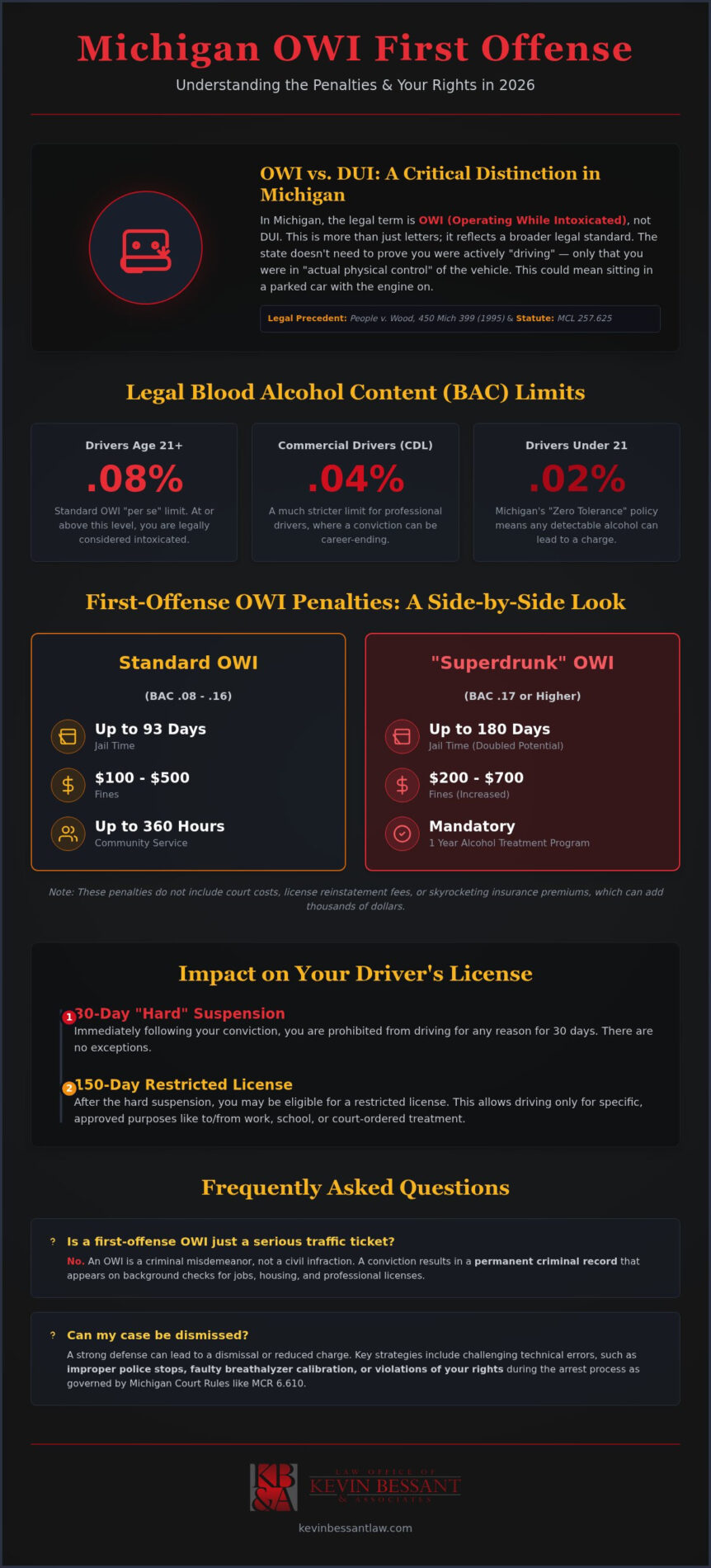
Michigan sets strict thresholds for intoxication. For most drivers age 21 and over, the “per se” limit is .08. However, the state’s zero-tolerance policy for those under 21 means a BAC of just .02 can trigger a life-altering arrest. Commercial drivers face even higher stakes; a .04 BAC for CDL holders can end a career instantly. These numbers are the baseline the prosecution uses to build their case against you. If you’re over these limits, the law presumes you are intoxicated, regardless of how well you think you were driving.
Why ‘Operating’ Matters More Than ‘Driving’
The most dangerous trap in Michigan law is the definition of “operating.” The prosecution doesn’t have to prove you were weaving between lanes on the Lodge Freeway. They only need to prove you had “actual physical control” of the vehicle. In Detroit, we see people arrested while sleeping in their cars with the heater on. The Michigan Supreme Court in People v. Wood, 450 Mich 399 (1995), clarified that “operating” requires the person to have actually operated the vehicle as a motor vehicle, but police still push the boundaries of this definition every day. According to MCL 257.625, operating means “being in actual physical control of a vehicle.” This definition is a weapon used by the state to secure convictions even when no movement occurred. You need a shield that can challenge the validity of these arrests and protect your future from the harsh OWI penalties Michigan first offense statutes impose.
Summary of OWI Penalties Michigan First Offense: Freedom at Risk
A first-offense arrest feels like a nightmare, but the legal reality is even harsher. Under MCL 257.625, the state has the power to upend your life completely. You’re looking at a maximum of 93 days in jail, fines ranging from $100 to $500, and up to 360 hours of mandatory community service. This isn’t just a fine you pay at a window. It’s a criminal conviction that creates a permanent stain on your record. Michigan judges often use the full weight of these statutes to set an example, especially in busy metro Detroit courts. You need to understand that the system isn’t looking to be fair; it’s looking to punish.
The OWI penalties Michigan first offense cases trigger go far beyond the courtroom. You’ll face non-negotiable costs that drain your bank account. These include a $75 Crime Victim’s Rights fee, court costs that can reach $1,500, and a $125 license reinstatement fee. Your insurance premiums will likely skyrocket by an average of $1,500 per year. When you add up the potential for vehicle impoundment and the loss of income from a jail stay, the financial hit is devastating. This is why standing alone against the prosecution is a risk you cannot afford to take.
Jail Time and Probation: The Threat to Your Liberty
Never walk into a courtroom assuming you’ll get a slap on the wrist. While 93 days is the maximum, even a weekend in jail can cost you your job and strain your family ties. If you avoid immediate incarceration, you’ll likely face sober probation. This is a high-pressure environment where random alcohol and drug testing becomes your new normal. In Detroit-area courts, the intensity of this monitoring is relentless. Missing a single test or failing to report can lead to a probation violation, which often results in the jail time you were trying to avoid. You need a defense that fights to keep you out of this cycle entirely.
The Financial Burden of an OWI Conviction
The hidden costs of an OWI often outweigh the initial fines. Beyond the court-ordered payments, you’ll be forced to carry high-risk insurance. This isn’t just a small increase; it’s a long-term financial anchor. When you consider the thousands of dollars at stake, the ROI of a professional defense becomes clear. Investing in an aggressive advocate now is the only way to shield yourself from these cascading expenses. If you’re ready to protect your livelihood, it’s time to speak with a battle-ready advocate about your specific situation.
The ‘Superdrunk’ Threshold: Enhanced Penalties for BAC .17 or Higher
Michigan law doesn’t treat all intoxication equally. If your blood alcohol content (BAC) is .17 or higher, you aren’t just facing a standard charge. You’re facing the “Superdrunk” law, technically known as Operating with a High BAC under MCL 257.625(1)(c). This is a calculated escalation by the state to crush offenders with doubled penalties. The system sees that .17 number and immediately shifts from punitive to predatory. Understanding how OWI penalties Michigan first offense statutes apply differently here is the first step in building your shield.
The state uses this threshold to justify significantly harsher restrictions on your life. A Superdrunk conviction isn’t just a more expensive mistake; it’s a deeper legal hole. You face a mandatory one-year license suspension. For the first 45 days, you have no driving privileges whatsoever. No work, no school, no emergencies. Only after that “hard suspension” can you apply for a restricted license, and even then, it comes with strings attached that the state uses to pull you back into the system.
Standard OWI vs. High-BAC (Superdrunk) Comparison
The difference between a .16 and a .17 BAC is massive in the eyes of a Michigan judge. The state isn’t just asking for higher fines. They’re coming for your liberty. Consider these statutory differences:
- Jail Time: A standard OWI carries up to 93 days. A Superdrunk conviction doubles that maximum to 180 days.
- Fines: Standard fines stop at $500. High-BAC fines jump to a maximum of $700 plus additional court costs.
- Rehabilitation: High-BAC convictions carry a mandatory requirement to complete a one-year alcohol treatment program.
The Mandatory Ignition Interlock Requirement
If you’re convicted of a High-BAC offense, the state forces you to turn your car into a mobile breathalyzer. An Ignition Interlock Device (IID) isn’t just a tool; it’s a constant, expensive reminder of your conviction. You’ll pay between $100 and $200 for installation and up to $100 every month for rental fees. Every time you start your car, you must blow into the device. If it detects even a trace of alcohol, your car won’t start. The device reports every failure directly to the court or the Secretary of State.
This device carries a heavy social stigma and technical traps that can lead to further probation violations. The state expects you to fail these tests. This is exactly why securing a DUI defense lawyer Detroit who isn’t intimidated by high BAC numbers is vital. We don’t just accept the lab results. We challenge the calibration of the machines and the procedures used during your arrest to fight for a reduction or dismissal. Don’t let a .17 reading define the rest of your life.
Driver’s License Sanctions: Keeping Your Right to Drive
Lose your license, lose your life. In a city like Detroit or a suburb like Southfield, your car is your lifeline. The OWI penalties Michigan first offense convictions trigger include an immediate strike against your driving privileges. Under MCL 257.625, a standard conviction results in a 30-day “hard suspension.” During these 30 days, you are legally prohibited from touching a steering wheel. There are no exceptions for work, child care, or emergencies. If you’re caught driving during this window, you face additional criminal charges and a likely extension of the suspension.
After those 30 days, you enter a 150-day restricted license period. This isn’t freedom; it’s a leash. You are only permitted to drive to specific locations: your place of employment, school, court-ordered programs, or for necessary medical treatment. Deviating from these routes is a violation. Additionally, the Secretary of State will slap 6 points onto your Michigan Master Driving Record. These points stay for two years. They drive your insurance rates into the stratosphere and make you a permanent target for police every time your plates are scanned.
The Impact on Professional and Commercial Licenses
Protect your livelihood at all costs. For CDL holders or healthcare professionals, a conviction is often a career-ender. Commercial drivers face a one-year disqualification of their CDL for a first-offense OWI. The state doesn’t care if you’ve spent decades building your career. Nurses and doctors may face immediate investigations from professional licensing boards. You must challenge the underlying arrest to prevent these automatic sanctions from destroying your professional standing. In cases like People v. Green, 260 Mich App 392; 677 NW2d 363 (2004), the court reminds us that the legality of the initial stop is everything. If the stop was bad, the license sanctions shouldn’t stand.
Navigating the Michigan Secretary of State (SOS) Sanctions
The Michigan Secretary of State (SOS) operates as a separate machine from the criminal courts. License sanctions are often automatic upon conviction. Navigating this administrative labyrinth is nearly impossible without an aggressive driver’s license shield. Appealing an SOS decision requires precise legal maneuvering and an understanding of specific administrative rules. Don’t wait for the plastic to be taken from your wallet. If you want to keep your right to drive, you need to speak with a battle-ready advocate immediately to start building your defense.
Defending Your Future: Why an Aggressive Shield is Mandatory
The prosecution is already building its case against you. They have the police report, the lab results, and the momentum of a system designed to convict. You cannot afford to be passive. An aggressive defense isn’t just about showing up in court; it’s a proactive strike designed to dismantle the state’s evidence before it destroys your life. We look for the cracks in their foundation. Was the traffic stop constitutional? Was the breathalyzer machine calibrated according to the strict requirements of Michigan Compiled Laws? If the police violated your rights or cut corners, that evidence must be suppressed.
Sometimes the best shield is a strategic pivot. By negotiating an OWI down to Operating While Visibly Impaired (OWVI) under MCL 257.625(3), we can often bypass the most devastating OWI penalties Michigan first offense convictions carry. An OWVI charge typically results in fewer points on your record and more lenient license restrictions, allowing you to maintain your livelihood. Kevin Bessant understands the complex inner workings of the Michigan legal system and knows exactly how to pressure the prosecution to secure these vital reductions. We don’t back down from a fight when your freedom is on the line.
Challenging the Evidence: From Traffic Stop to Blood Draw
Police reports are often treated as gospel, but they are frequently riddled with errors and subjective observations. We scrutinize every second of dashcam and bodycam footage to find the truth. Field Sobriety Tests (FSTs) are notoriously unreliable and often administered in conditions that make failure inevitable. If the officer failed to follow standardized training or ignored environmental factors, those results are compromised. You need an aggressive criminal defense attorney Detroit from the very start of your case to ensure these flaws are exposed and used as leverage for your freedom.
Securing Your Freedom: Contact Kevin Bessant & Associates
The state of Michigan has unlimited resources to prosecute you. Do not stand alone against this machinery. You need a dedicated protector who has spent over 20 years in high-stakes litigation across Detroit, Southfield, and the surrounding metro areas. We are not intimidated by the system; we are the shield that stands between you and a life-altering criminal record. Take the first step toward reclaiming your future and protecting your driver’s license. Contact Kevin Bessant now to secure the battle-tested representation your case demands.
Secure Your Future with a Battle-Ready Defense
A first-offense arrest doesn’t have to define your life. MCL 257.625 gives the state power to strip away your freedom and your right to drive. Between the 93-day jail maximum and the aggressive license sanctions, the stakes couldn’t be higher. Understanding the OWI penalties Michigan first offense cases trigger is vital, but knowledge alone isn’t a shield. You need a dedicated advocate who knows the inner workings of Detroit and Metro Michigan courts to dismantle the prosecution’s case.
With over 20 years of aggressive criminal defense experience, Kevin Bessant & Associates stands in the gap for you. We are fierce advocates for driver’s license restoration and long-term freedom. Don’t let a single mistake become a permanent criminal record. Take the proactive step to protect your livelihood and your family today. Contact the Law Office of Kevin Bessant & Associates for an Aggressive DUI Shield. You have the power to fight back, and we have the battle-tested experience to lead the way.
Legal Authority: Statute and Case Law
Michigan’s OWI statute is codified at MCL 257.625, with the "operating" requirement defined at MCL 257.35a.
- People v Wood, 450 Mich 399, 404-405; 538 NW2d 351 (1995) — the Michigan Supreme Court held that once a person has put a vehicle in motion, or in a position posing a significant risk of collision, that person continues to “operate” it under MCL 257.625 until the vehicle is returned to a position posing no such risk. In Wood, a driver found unconscious with the engine running and the transmission in drive, foot on the brake, was found to be operating the vehicle.
- People v Green, 260 Mich App 392; 677 NW2d 363 (2004) — addressed the legality of the underlying stop and search in an OUIL case, underscoring that suppressed evidence from an unlawful stop can undercut the prosecution’s proof.
For the current statutory text and published opinions, see the Michigan Legislature’s MCL database and the Michigan Courts case search.
Frequently Asked Questions
Will I go to jail for my first OWI offense in Michigan?
Jail is a very real possibility for any drunk driving conviction. Under MCL 257.625, a first-timer faces up to 93 days in jail. In Detroit and Southfield courts, judges often use this time to send a stern message to the community. Don’t assume you’ll get a pass just because it’s your first mistake. While many offenders receive probation, the threat of incarceration is always present. You need an aggressive advocate to fight these OWI penalties Michigan first offense charges.
Can a first-offense OWI be reduced to a lesser charge like reckless driving?
You can often have your charge reduced through aggressive plea bargaining. While a reduction to reckless driving is rare, we frequently negotiate OWI charges down to Operating While Visibly Impaired (OWVI). This reduction saves your driver’s license from a 30-day hard suspension and lowers the points on your record. Each case in metro Detroit is unique. We must analyze the police report for errors to create the leverage needed for a successful reduction.
How long does an OWI stay on my criminal record in Michigan?
An OWI conviction stays on your criminal record permanently unless you successfully petition the court for an expungement. Unlike a simple speeding ticket, this is a criminal misdemeanor that will appear on every background check for jobs or housing. It doesn’t just fall off after a few years. Because the stakes are so high, you must treat this arrest with the utmost seriousness from the very first day you appear in a Michigan court.
Can I get a first-offense OWI expunged in Michigan?
You can now apply to expunge a first-offense OWI under Michigan’s Clean Slate laws, specifically MCL 780.621c. This was a major legal shift in 2021, allowing people to clear their records after a five-year waiting period. However, this process isn’t automatic. It requires a formal application and a hearing before a judge. If you’re tired of a past mistake holding you back, our firm specializes in navigating these complex expungement proceedings to restore your reputation.
What is the difference between OWI and OWVI?
The primary difference lies in the level of proof the state must present. OWI (Operating While Intoxicated) usually requires a BAC of .08 or higher. OWVI (Operating While Visibly Impaired) only requires the prosecution to prove your ability to drive was visibly weakened. While OWVI carries lighter license sanctions, it is still a criminal conviction. Understanding these nuances is vital when facing the OWI penalties Michigan first offense statutes impose on drivers.
What happens if I refused the chemical test during my OWI arrest?
Refusing a breath or blood test triggers Michigan’s Implied Consent law under MCL 257.625c. This results in an automatic one-year suspension of your driver’s license and six points on your record, separate from the OWI charge. You only have 14 days to appeal this suspension through the Michigan Secretary of State. If you miss this window, you lose your right to a hearing. We act quickly to protect your license during these high-stakes appeals.
Do I need a lawyer for a first-offense OWI if I plan to plead guilty?
Pleading guilty without a lawyer is a dangerous gamble. Even if you plan to admit fault, an attorney ensures the court follows MCR 6.610 and that your rights were protected during the arrest. We often find procedural errors that lead to better sentencing terms or reduced charges you would miss on your own. Don’t walk into a Detroit courtroom alone. You need an expert shield to minimize the damage and protect your future.
How will an OWI affect my car insurance rates in Michigan?
Your insurance rates will likely skyrocket, often doubling or tripling after a conviction. Michigan insurance companies view OWI offenders as high-risk, frequently requiring an SR-22 certificate. You can expect to pay thousands of dollars in additional premiums over several years. This financial burden is one of the most persistent consequences of an arrest. Fighting the charge is the only way to avoid these long-term costs and keep your monthly expenses from becoming unmanageable.
What does “operating” a vehicle actually mean under Michigan’s OWI law?
Under People v Wood, 450 Mich 399 (1995), a driver “operates” a vehicle for OWI purposes once they’ve put it in motion or in a position posing a risk of collision, and continues to operate it until that risk is gone — meaning you can be found guilty even if the car never moved while police were present.
Can a bad traffic stop get my OWI evidence thrown out?
Yes. Cases like People v Green, 260 Mich App 392 (2004), confirm that if the initial stop lacked a lawful basis, evidence gathered afterward, including chemical test results, can be suppressed and the related license sanctions challenged.