

In a Michigan drug trafficking case, the evidence sitting on the prosecutor’s desk isn’t your verdict; it’s simply the opening move in a high-stakes game they expect you to lose. You likely feel the crushing weight of the system and the “guilty until proven innocent” atmosphere that follows a major drug bust. It’s natural to feel paralyzed when facing the prospect of life in prison or the million-dollar fines associated with large-scale narcotics charges. You need a shield. Retaining a battle-ready drug trafficking defense attorney Michigan is the only way to shift the momentum back in your favor.
We understand the fear of losing decades to a cell and the confusion surrounding the 2026 federal sentencing amendments. This article explains how an aggressive legal strategy can challenge the legality of every search to fight for a dismissal or a reduction to simple possession. You’ll discover how to protect your freedom from mandatory minimum prison sentences by attacking the prosecution’s foundation. We will examine the specific tactics used to expose government overreach and the methodical path to reclaiming your future.
Key Takeaways
- Understand why Michigan treats trafficking as a high-stakes felony and how substance weight dictates mandatory minimum prison terms.
- Learn how a drug trafficking defense attorney Michigan can challenge illegal searches to potentially have your charges dismissed or reduced.
- Navigate the complex differences between state and federal sentencing guidelines to understand the specific threats posed by federal agencies.
- Discover the power of a Motion to Suppress and how it acts as a vital shield against unconstitutional police tactics.
- Leverage over 20 years of aggressive local experience in Metro Detroit courts to stand firm against intimidating prosecutors and protect your future.
Facing Drug Trafficking Charges in Michigan: The High Stakes of Your Freedom
The moment the handcuffs click, the state of Michigan begins building a case designed to strip away your liberty. Under the Michigan Public Health Code (MCL 333.7401), drug trafficking is a high-stakes felony that carries far more weight than a simple possession charge. While possession suggests personal use, trafficking implies you’re a cog in the global drug trade, exposing you to aggressive prosecution and life-altering prison sentences. You aren’t just a defendant; you’re a target in a system that assumes your guilt from the first interrogation. Retaining an aggressive drug trafficking defense attorney Michigan is your only viable path to challenge the government’s narrative.
The emotional impact of a trafficking arrest is immediate and paralyzing. You’re suddenly facing a machine that has unlimited resources to ensure you never see your family again. You don’t have time to wait and see what happens. The system is already moving against you, and you need a shield to stand in the gap before your first court date arrives.
Possession vs. Intent to Distribute: The Legal Threshold
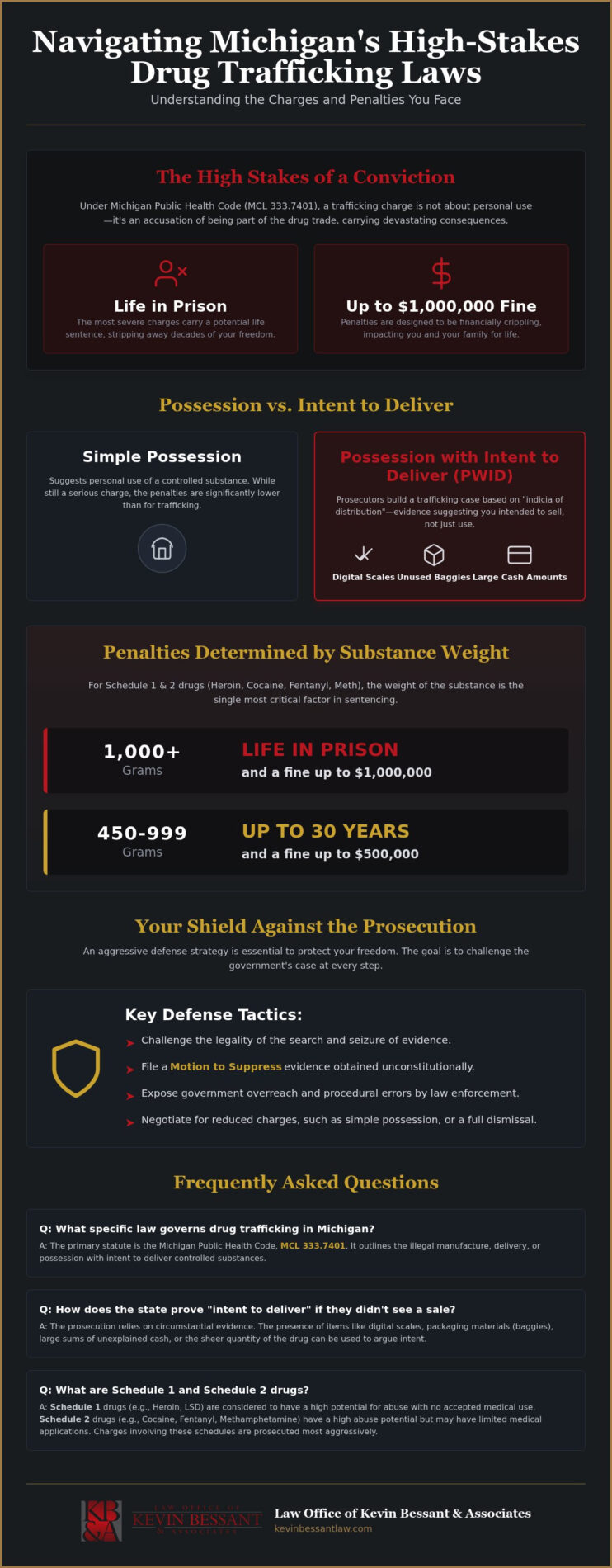
Prosecutors don’t need to witness a hand-to-hand sale to charge you with a major felony. They look for “indicia of distribution” to escalate the charges. If the police find digital scales, unused baggies, or large amounts of cash, they’ll upgrade a possession charge to “Possession with Intent to Deliver” (PWID). They also rely on “constructive possession,” a legal theory where you’re charged for drugs found in your proximity, even if they aren’t in your pockets. Michigan prosecutors frequently over-charge these cases to create leverage, hoping the sheer weight of a potential 20-year sentence will force you into a desperate plea deal. You need an advocate who knows how to dismantle these assumptions.
The Reality of a Felony Conviction in 2026
A trafficking conviction in 2026 does more than just lock you away; it creates a permanent barrier to your existence. It destroys your professional licensing prospects, disqualifies you from most housing, and strips you of your civil rights. Drug trafficking is defined as the movement, manufacture, or sale of controlled substances with intent to distribute. The system is engineered to convict you, treating every piece of evidence as a foregone conclusion. You are standing in the middle of a legal crisis that could cost you decades of your life. If you don’t act now, the state will decide your future for you. Reach out to Kevin Bessant & Associates immediately to start building your defense.
Understanding Michigan Drug Classifications and Mandatory Minimums
Michigan law categorizes controlled substances into “Schedules” based on their perceived danger and medical utility. This classification system isn’t just a list; it’s a roadmap for the prosecution to seek the harshest possible penalties. When you’re facing a trafficking charge, the state isn’t looking at your intent alone. They’re looking at the Schedule and the weight. These two factors combine to create a legal trap that can result in decades behind bars. You need a drug trafficking defense attorney Michigan who understands how to dismantle the state’s classification arguments before they solidify into a conviction.
Schedule 1 and 2 Narcotics: The Prosecutor’s Target
Schedule 1 substances are those the state deems to have a high potential for abuse and no accepted medical use, such as Heroin or LSD. Schedule 2 drugs, including Cocaine, Methamphetamine, and Fentanyl, have high abuse potential but limited medical applications. In 2026, Michigan courts have placed a massive target on Fentanyl distribution. Prosecutors treat these cases with maximum severity, often seeking the highest possible charges regardless of the circumstances. If you’ve been swept up in a narcotics investigation, a Detroit Drug Lawyer is your first line of defense against these overzealous tactics.
Weight-Based Penalties and Mandatory Sentencing
The weight of the substance is the primary weapon used to determine your prison sentence. Michigan law establishes strict thresholds that dictate your potential exposure:
- 1,000 grams or more: Up to life in prison and a fine of up to $1,000,000.
- 450 to 999 grams: Up to 30 years in prison and a $500,000 fine.
- 50 to 449 grams: Up to 20 years in prison and a $250,000 fine.
- Less than 50 grams (Delivery): Up to 20 years in prison and a $25,000 fine.
These weights are critical because they often trigger mandatory minimums. Mandatory sentencing takes the power away from the judge and gives it directly to the prosecutor. It doesn’t matter if you’re a first-time offender or a pillar of the community; if the weight is there, the judge’s hands are often tied. An aggressive drug trafficking defense attorney Michigan fights these numbers by challenging the lab’s testing methods, the accuracy of the scales used, and the chain of custody for the evidence.
Don’t be misled by talk of “7411” sentencing. While MCL 333.7411 allows for deferred sentences and eventual expungement, it almost never applies to trafficking or delivery offenses. It’s a tool for simple possession, not for high-stakes felony litigation. For major quantities, Life Without Parole is a very real possibility. The system is designed to bury you under the weight of these numbers. You must act now to secure a shield for your future before the prosecution locks in their strategy.
State vs. Federal Drug Trafficking: Navigating the Complex Legal Landscape
A drug arrest in Michigan can take two distinct paths, and one is significantly more treacherous than the other. If federal agencies like the DEA, FBI, or ATF were involved in your investigation, your case will likely move to federal court. This shift isn’t just a change of venue; it’s a total transformation of the rules. Federal prosecutors often rely on 21 U.S.C. § 846, the conspiracy statute, which allows them to charge you for the actions of every person in an alleged drug ring. You could face decades in prison for narcotics you never even touched. To survive this, you need a drug trafficking defense attorney Michigan who understands how to fight in both court systems.
The sentencing structures differ wildly. While Michigan uses its own sentencing guidelines, federal courts follow the United States Sentencing Guidelines (USSG). These are notoriously rigid. As of November 1, 2026, new amendments to the federal guidelines are set to take effect, potentially increasing the average sentence for certain methamphetamine offenses from 87 months to 128 months. Federal authorities don’t just want a conviction; they want a total victory. You must secure an advocate who isn’t intimidated by the federal government’s massive resources.
The Eastern District of Michigan: Federal Court Realities
If your case is in the Eastern District of Michigan, you’re facing one of the most aggressive federal jurisdictions in the country. Conviction rates here are staggering. Prosecutors often push for “Proffer” meetings, where they ask you to provide information in exchange for a potential sentence reduction. This is a minefield. One wrong word can be used against you or lead to additional charges. Never enter a federal building without a battle-ready defense. The dynamics in Detroit and Southfield federal courts require a proactive strategy that attacks the government’s evidence before it reaches a grand jury.
Why State Charges Can Be Just as Dangerous
Don’t assume state court is a safe haven. Michigan’s habitual offender laws allow prosecutors to enhance your penalties if you have prior felony convictions. A second or third drug offense can double or even triple your potential prison time. The state is looking for any reason to keep you behind bars for the rest of your life. We know how to navigate these local court habits to protect your freedom. Discover why us is the choice for those who refuse to be another statistic in the Michigan legal system. You’re fighting for your life. Don’t stand alone against a system designed to crush you.
How an Aggressive Defense Attorney Fights Michigan Drug Trafficking Charges
The prosecution wants you to believe their evidence is insurmountable. It isn’t. Every drug bust starts with a police interaction, and if that interaction violated your constitutional rights, the entire case can collapse. A drug trafficking defense attorney Michigan doesn’t just look for excuses; we look for the government’s failures. We scrutinize every second of bodycam footage and every line of the police report to find the cracks in their foundation. If the police cut corners, we ensure they pay for it in court.
Challenging the Fourth Amendment: Illegal Search and Seizure
Probable Cause is the most common battleground in high-stakes narcotics cases. Police often use “fishing expeditions” during routine traffic stops, extending the detention illegally to wait for a K-9 unit to arrive. If a drug dog “alerts” without proper training records or under questionable circumstances, that search is legally vulnerable. A Motion to Suppress is a legal request to exclude evidence obtained illegally. When this motion is successful, the evidence is barred from trial, often leaving the prosecutor with no choice but to dismiss the charges entirely.
Attacking the Prosecution’s Evidence
The state relies heavily on Confidential Informants (CIs) who are typically paid or working off their own serious criminal charges. Their testimony is inherently biased and frequently manufactured to satisfy detectives. We aggressively cross-examine these witnesses to expose their hidden motives and history of dishonesty. Beyond the witnesses, we investigate the Chain of Custody. If the seized substances were handled improperly or stored insecurely between the scene and the laboratory, the integrity of the evidence is compromised. We demand to see the logs.
We also challenge the lab results and the accuracy of the testing equipment itself. Gas chromatography-mass spectrometry machines must be calibrated with surgical precision; if maintenance logs are missing or out of date, the results are unreliable. Finally, we employ the “Mere Presence” defense. Simply being in a house or a vehicle where drugs are discovered is not proof of trafficking or intent. You are not responsible for the actions of others just because you were in the vicinity. You need a battle-ready advocate to stand in the gap. If you’re ready to challenge the system, contact Kevin Bessant & Associates now to secure your shield.
Why Kevin Bessant is the Shield You Need in Metro Detroit
When you’re facing decades in prison, you don’t need a consultant; you need a combatant. Kevin Bessant brings over 20 years of aggressive litigation experience to the table, specifically focused on high-stakes felony defense. He has built a reputation as the premier drug trafficking defense attorney Michigan by refusing to be intimidated by the government’s tactics. While other firms might push for a quick plea to clear their calendar, our philosophy is rooted in a battle-ready defense. We fight for your freedom because we know exactly what’s at stake: your life, your family, and your future.
The first few hours after an arrest are the most critical. The initial bond hearing sets the tone for the entire case. If you’re stuck behind bars, you can’t effectively assist in your defense, and the pressure to take a bad deal increases. We move immediately to secure your release, challenging the prosecution’s request for high cash bonds. You need a shield that starts working the moment the state tries to lock you away. We don’t just wait for the trial; we start the rescue mission at the very first hearing.
Local Expertise in Detroit, Southfield, and Beyond
The legal landscape in Metro Detroit is not uniform. Each jurisdiction has its own procedural nuances that can make or break a case. Kevin Bessant & Associates has deep roots in the 36th District Court in Detroit, the 46th District Court in Southfield, and the Warren district courts. We know the judges and we know the prosecutors. This local presence allows us to anticipate the opposition’s moves and negotiate from a position of strength. Whether we’re arguing for a case dismissal due to illegal police conduct or seeking a reduction in charges, our familiarity with these specific courtrooms is a decisive advantage. If you or a loved one is currently in custody, you need a Bond Hearing Lawyer Detroit who can stand before a judge and fight for your immediate release.
Take Action: Your Defense Starts with a Phone Call
The state of Michigan is already working to build a case against you. Every minute you wait is a minute the prosecution spends solidifying their evidence. Do not wait for the system to crush you. We offer a focused path forward that prioritizes your liberty and your rights. You can’t afford to stand alone against a federal or state task force. We provide a free initial consultation to discuss the specifics of your drug trafficking charges and outline an aggressive strategy to protect you. Take the next necessary step. Contact Kevin Bessant today and secure the shield you need to fight back.
Legal Authority: Statute and Case Law
Michigan’s delivery and possession-with-intent statute is codified at MCL 333.7401.
- People v Wolfe, 440 Mich 508, 524; 489 NW2d 748 (1992) — the Michigan Supreme Court held that intent to deliver may be proven entirely by circumstantial evidence, and can be inferred from the quantity of drugs possessed or the way the substance was packaged; an actual delivery is not required.
- People v Hardiman, 466 Mich 417, 428; 646 NW2d 158 (2002) — confirms that circumstantial evidence and the reasonable inferences arising from it can establish the elements of a crime beyond a reasonable doubt, the standard courts apply when weighing indicia of distribution like scales or packaging.
For the current statutory text and published opinions, see the Michigan Legislature’s MCL database and the Michigan Courts case search.
Take Control of Your Future Before the System Decides It for You
The state of Michigan and federal authorities have already begun their assault on your freedom. You’ve seen how mandatory minimums and rigid sentencing guidelines are used as weapons to force desperate pleas. You’ve also learned that the Fourth Amendment remains your strongest ally when police overstep their bounds. Don’t let the weight of the evidence paralyze you. A drug trafficking defense attorney Michigan can expose the cracks in the prosecution’s case by attacking illegal searches and discrediting biased informants.
Kevin Bessant brings over 20 years of criminal defense experience as a high-stakes felony specialist. As a local Detroit and Southfield expert, he understands the specific dynamics of the 36th and 46th District courts. You don’t have to stand alone against a system that assumes your guilt. Take the first step toward reclaiming your life and protecting your rights today. Our firm is ready to stand in the gap and fight for the best possible outcome in your case.
Secure Your Aggressive Shield: Contact Kevin Bessant Now
Frequently Asked Questions
What is the mandatory minimum for drug trafficking in Michigan?
Mandatory minimums in Michigan are primarily determined by the weight of the controlled substance. For quantities of 1,000 grams or more of Schedule 1 or 2 narcotics, you face up to life in prison and a $1,000,000 fine. Amounts between 450 and 999 grams carry up to 30 years. These laws strip power from judges and give it to prosecutors. An aggressive drug trafficking defense attorney Michigan fights to challenge the weight or classification to avoid these devastating sentences.
Can a drug trafficking charge be dropped if the search was illegal?
A drug trafficking charge can be dismissed if the evidence was obtained through an illegal search or seizure. We use a Motion to Suppress to challenge Fourth Amendment violations, such as warrantless searches or illegal traffic stops. If the judge agrees that the police acted unconstitutionally, the evidence is barred from trial. Without the physical drugs as evidence, the prosecution’s case often collapses, leading to a full dismissal of all charges against you.
What is the difference between drug possession and drug trafficking?
The primary difference lies in the quantity of the substance and the perceived intent of the individual. Possession typically involves a small amount intended for personal use. Trafficking, or “Possession with Intent to Deliver,” is charged when police find large quantities, scales, packaging materials, or excessive cash. Michigan law treats trafficking as a major felony because it implies participation in a distribution network. The penalties for trafficking are significantly more severe than simple possession convictions.
How much does a drug trafficking defense lawyer cost in Michigan?
The cost of a defense lawyer varies based on the complexity of the case and whether it is in state or federal court. High-stakes felony litigation requires extensive investigation, expert witnesses, and aggressive motion practice. While we don’t provide flat rates here, you should view legal fees as an investment in your freedom. A specialized attorney provides the shield necessary to navigate a system designed to convict you. Contact our office for a specific, confidential case evaluation.
What happens at a bond hearing for a drug trafficking charge?
At a bond hearing, a judge determines if you can be released from jail while your case is pending. For trafficking charges, prosecutors in Detroit and Southfield often argue for high cash bonds, labeling you a flight risk or a danger to the community. We fight these characterizations by highlighting your local ties and lack of prior record. Securing a reasonable bond is vital so you can assist in building your defense from outside a jail cell.
Can I go to prison for a first-time drug trafficking offense in Michigan?
Yes, you can go to prison for a first-time drug trafficking offense in Michigan. Unlike minor crimes, trafficking is a high-stakes felony where the state often seeks mandatory prison time regardless of your criminal history. The weight of the drugs involved dictates the potential sentence, not just your past behavior. You must secure a drug trafficking defense attorney Michigan immediately to fight for a reduction of charges or a sentencing agreement that avoids lengthy incarceration.
Is trafficking a federal or state crime in Detroit?
Trafficking can be either a federal or state crime in Detroit, depending on which agency conducted the investigation. If the DEA or FBI was involved, your case will likely proceed in the Eastern District of Michigan federal court. State charges are handled in local district courts like the 36th District. Federal penalties are often more rigid and carry higher conviction rates. We have the battle-ready expertise to defend your rights in both legal systems effectively.
What should I do immediately after being arrested for drug trafficking?
You must remain silent and request an attorney immediately. Do not attempt to explain your situation to the police or try to “make a deal” on your own. Anything you say will be used to solidify the prosecution’s case against you. Contact Kevin Bessant & Associates to protect your rights from the very first interrogation. Proactive legal intervention is the only way to prevent the state from building an insurmountable narrative during the early stages of the investigation.
Does the prosecution have to prove an actual sale happened to convict me of intent to deliver?
No. People v Wolfe, 440 Mich 508 (1992), holds that intent to deliver can be proven entirely through circumstantial evidence — the amount of the substance or how it was packaged — and an actual completed delivery is not required for a conviction.