

A single mistake shouldn’t have the power to dismantle your child’s entire future, but the Michigan legal system is often unforgiving. You’re likely paralyzed by the fear that a drug charge will strip away college scholarships and leave a permanent stain on a public record before your child even reaches adulthood. The confusion between juvenile and adult court, combined with the pressure of the Detroit police process, creates a high-stakes crisis that no parent should handle alone. You need a shield to stand between your family and a system that can be devastatingly efficient at branding young people as criminals.
Securing an aggressive juvenile drug possession defense Detroit is the most critical step you can take right now to protect your child’s path forward. You have options, and there is a clear way to fight for a dismissal or entry into a diversion program like the Consent Calendar. This article explains how to navigate Michigan’s “Raise the Age” legislation and the specific tactics used to keep your child’s record clean. We will preview the differences between the formal and consent calendars, the impact of recent legal reforms, and the immediate actions necessary to secure a favorable outcome in the Detroit court system.
Key Takeaways
- Learn how Michigan’s “Raise the Age” legislation protects 17-year-olds from automatic adult prosecution and ensures their cases stay within the juvenile system.
- Discover the “Consent Calendar” pathway, a vital diversionary tool that can lead to a case being closed and records destroyed without a formal adjudication.
- Secure an aggressive juvenile drug possession defense Detroit to challenge illegal searches and seizures that violate your child’s Fourth Amendment rights.
- Understand the concept of “Constructive Possession” and how to prove that your child was not legally responsible for substances found in their vicinity.
- Identify the immediate steps required to protect college scholarships and future career prospects by prioritizing rehabilitation over a permanent criminal record.
Facing Juvenile Drug Possession Charges in Detroit: What’s at Stake?
A juvenile drug arrest in Detroit is not just a minor detour. It’s a high-stakes legal crisis that can derail a young life before it truly begins. When the police knock or a school search leads to a precinct visit, the clock starts ticking on your child’s future. You aren’t just fighting a charge; you’re fighting a system that is designed to process cases efficiently, often at the expense of a child’s potential. A passive approach is a dangerous mistake. You need an aggressive juvenile drug possession defense Detroit to act as a shield, stopping the momentum of the prosecution before it becomes an immovable obstacle.
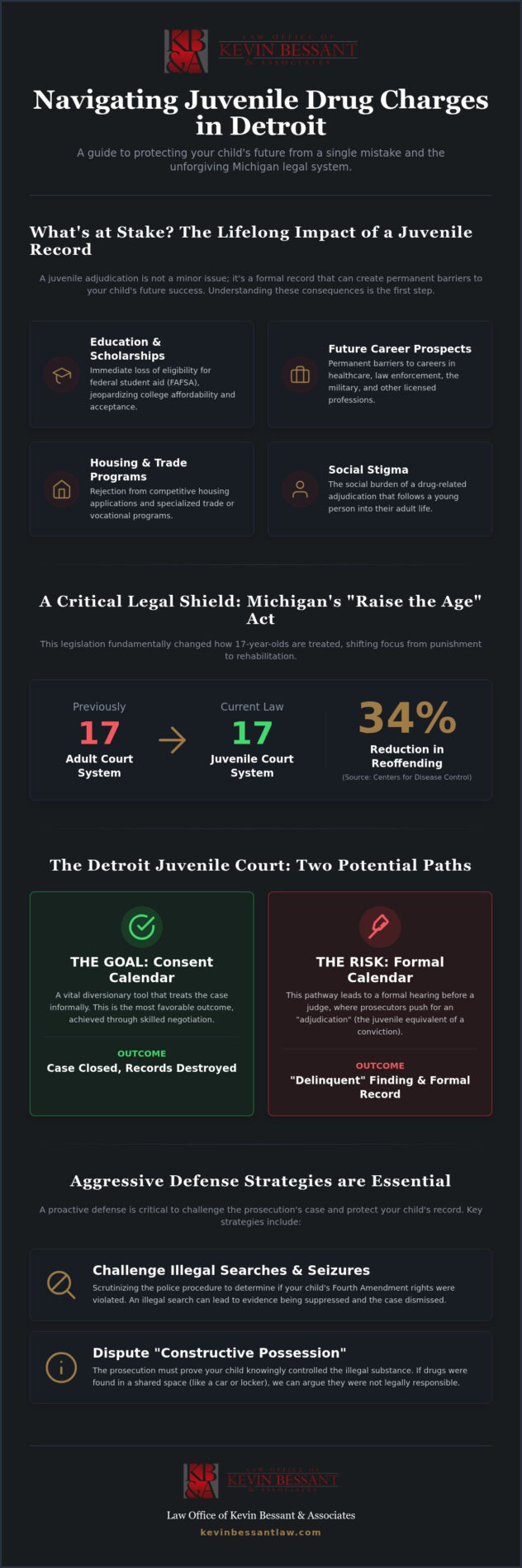
The immediate impact is felt through intense anxiety and the weight of the Detroit court process, but the secondary consequences are often more destructive. A formal record can trigger a cascade of failures:
- Immediate loss of eligibility for federal student aid (FAFSA), making college unaffordable.
- Rejection from competitive housing applications and specialized trade programs.
- Permanent barriers to careers in healthcare, law enforcement, or the military.
- The social stigma of a drug-related adjudication that follows them into adulthood.
The Reality of Juvenile Adjudication in Wayne County
In the juvenile system, you’ll hear the term “adjudication” instead of “conviction.” While this sounds less severe, the legal reality is nearly identical. An adjudication means the court has found your child “delinquent,” which gives the state significant power over their freedom. The Detroit Juvenile Court Process operates within the Family Division of the Third Circuit Court, where judges have broad discretion. Don’t be misled; Detroit prosecutors often push for adult-level penalties or restrictive probations that set kids up to fail. Your child needs a juvenile drug possession defense Detroit that understands how to leverage this discretion in your favor.
Why 2026 is a Critical Year for Michigan Juvenile Law
Recent legislative shifts have fundamentally changed how local Detroit precincts handle young offenders. Since the “Raise the Age” legislation took full effect, 17-year-olds are no longer automatically thrown into the adult system for drug offenses. This change, which remains a cornerstone of the 2026 legal landscape, ensures that 17-year-olds are treated as minors who deserve rehabilitation rather than strictly punishment. In Michigan, the juvenile court maintains jurisdiction over individuals who are under the age of 18 at the time of the alleged offense. This shift provides a vital window for intervention; in fact, including 17-year-olds in the juvenile system has been shown to reduce reoffending by 34%, according to data from the Centers for Disease Control.
Michigan Drug Laws: Schedules, Penalties, and the ‘Raise the Age’ Act
Michigan’s legal system classifies controlled substances into five distinct schedules based on their potential for abuse and recognized medical utility. Don’t underestimate the severity of these classifications. Under Michigan Drug Laws, Schedule 1 substances like heroin, LSD, or ecstasy carry the highest level of felony scrutiny. Even possession of Schedule 2 drugs, such as cocaine or prescription stimulants like Adderall and OxyContin, can trigger aggressive prosecution that treats a teenager like a hardened criminal. When your child is caught in this net, an aggressive juvenile drug possession defense Detroit is the only way to challenge the state’s narrative.
Understanding Drug Schedules (1-5) in Detroit
In Detroit juvenile cases, we most frequently see charges involving prescription pills, marijuana, and cocaine. The quantity of the substance is the primary trigger for felony-level scrutiny. For instance, possession of less than 50 grams of cocaine can result in up to 4 years of incarceration, while larger amounts can lead to life imprisonment. Prosecutors often use the presence of scales or multiple small bags to escalate a simple possession charge to “Possession with Intent to Deliver.” In the juvenile system, this charge can result in long-term placement in high-security residential facilities, stripping your child of their freedom and education.
Marijuana laws for minors remain a trap for the unwary. While Michigan has legalized recreational use for adults over 21, the rules for juveniles are strict. If your child is under 18 and found with marijuana, the case is handled in juvenile court where detention is a real possibility. For those aged 18 to 20, possession of 2.5 ounces or less is typically a civil infraction, but a third offense escalates to a misdemeanor. Michigan law currently handles all individuals under the age of 18 within the juvenile justice system rather than as adults.
The Holmes Youthful Trainee Act (HYTA) for Young Adults
For young adults between the ages of 18 and 26, the Holmes Youthful Trainee Act (HYTA) serves as a vital shield. If your child is facing drug charges in Detroit, Southfield, or Warren, HYTA eligibility allows them to complete a term of probation without a public criminal conviction ever appearing on their record. It’s a high-stakes second chance that requires a battle-ready advocate to secure. You can find more detail on how we fight these specific charges at our Detroit drug lawyer resource page. This protection is only available if the defense proactively demands it and proves the individual is a candidate for rehabilitation.
Don’t let a single mistake define your child’s legacy. If the police are already involved and you need a juvenile drug possession defense Detroit, reach out to us immediately to begin building your defense. The system won’t wait, and neither should you.
The Detroit Juvenile Court Process: Consent Calendar vs. Formal Charges
The moments following a juvenile arrest are a blur of confusion and high-pressure decisions. In Wayne County, the system moves with calculated speed, and if you aren’t prepared, your child can be swept into a cycle of court dates and detention before you’ve even processed the charges. You need to understand that the path your case takes is often decided in the very first meeting. A passive defense waits for the court to act; an aggressive juvenile drug possession defense Detroit dictates the terms from the start to ensure the system doesn’t swallow your child’s future.
The Preliminary Inquiry: Your First Opportunity for Defense
The first 24 to 48 hours after an arrest are the most critical. This period culminates in the preliminary inquiry, where a judge or referee determines if there is enough evidence to move forward and, more importantly, whether your child stays in custody or comes home. This is where a bond hearing lawyer Detroit becomes your child’s most vital asset. We fight to keep your child out of detention centers, as being at home allows for a much more effective defense strategy. During this inquiry, your attorney must immediately begin negotiating with the juvenile probation officer. In Detroit, these officers hold significant influence over whether a case is recommended for the “Consent Calendar” or the “Formal Calendar.”
The Consent Calendar is the ultimate goal for most first-time offenders. It’s an informal process where the child follows a court-ordered plan. If they succeed, the case is dismissed, and the records are destroyed. There is no formal adjudication and no public record. The Formal Calendar, however, is a trial-like process that leads to a permanent record. You cannot leave this choice to chance. We intervene early to prove your child belongs on the Consent Calendar.
Formal Adjudication and the Risk of Adult Designation
When drug charges involve large quantities or “Intent to Deliver,” the stakes escalate to a dangerous level. Prosecutors may file a “Waiver” motion to move the case out of the Family Division and into the adult criminal system. There are two types of waivers you must fear:
- Automatic Waiver: Triggered by specific high-level felonies where the prosecutor can choose to file directly in adult court.
- Prosecutorial Waiver: Where the state argues that the juvenile system’s rehabilitative nature isn’t enough for the alleged crime.
If your child is “waived,” they face adult prison and a permanent felony record. Our juvenile drug possession defense Detroit uses aggressive tactics to fight these motions. We challenge the state’s criteria, emphasizing the child’s potential for rehabilitation and the lack of prior history. We don’t just ask for leniency; we demand it by highlighting every procedural error the police made during the arrest.
Aggressive Defense Strategies for Juvenile Drug Possession
Don’t wait for the prosecution to show leniency; they won’t. The system is built to process cases, not protect your child’s future. An effective juvenile drug possession defense Detroit requires an immediate, vigorous attack on the state’s evidence. We don’t just “handle” cases; we dismantle them by identifying constitutional violations and procedural failures that the Detroit police often hope you’ll ignore. Your child’s shield must be proactive, not reactive.
One of the most powerful tools in our arsenal is challenging “Constructive Possession.” Often, a juvenile is charged simply because drugs were found in a vehicle they were riding in or a room they shared. Under Michigan law, proximity is not enough. The prosecutor must prove your child had both knowledge of the substance and the intent to control it. If we can prove a “Lack of Knowledge,” the state’s case collapses. We investigate every detail of the arrest to find evidence that the drugs belonged to someone else.
Challenging Searches in Schools and Vehicles
Searches in Detroit schools are a legal minefield. Administrators only need “reasonable suspicion” to search a locker or backpack, which is a much lower bar than the “probable cause” required for police on the street. However, this doesn’t give them a license to ignore your child’s rights. We scrutinize school searches and vehicle stops in Southfield or Warren for any sign of overreach. If the police or school officials crossed the line, we invoke the Exclusionary Rule. This rule is a simple but vital protection: it forces the court to throw out any evidence that was obtained through an illegal or unconstitutional search. If the evidence is suppressed, the charges often follow.
Negotiating Diversion and Rehabilitation
When the evidence can’t be suppressed, we pivot to an aggressive rehabilitative defense. We present your child as a promising student and community member, not a criminal statistic. By securing independent drug evaluations, we provide the court with a professional perspective that counters the prosecutor’s harsh narrative. This strategy is essential for securing entry into diversion programs that lead to a “Clean Slate.” Michigan’s expungement laws offer a path to a clear record, but you must fight for that path from the very first day. Contact our Detroit office immediately to start building an aggressive shield for your child’s future.
Why Kevin Bessant is the Shield Your Child Needs in Detroit
The legal system doesn’t see your child’s potential. It sees a file number and a set of charges. When the state moves to adjudicate a minor, they aren’t looking for excuses; they’re looking for a result. You need a juvenile drug possession defense Detroit that refuses to let your child become another statistic in a crowded court docket. At the Law Office of Kevin Bessant & Associates, we don’t just provide counsel. We act as a vital shield, standing in the gap between your family and a system that can be devastatingly efficient at dismantling futures. With 20+ years of high-stakes litigation experience, we know how to stop the prosecution’s momentum before it destroys your child’s life.
Our firm is deeply rooted in the local legal landscape. We don’t just practice in Detroit; we have a formidable presence in the courts of Southfield, Warren, and Royal Oak. This local specialization is critical. Every jurisdiction has its own nuances, and knowing the specific tendencies of Wayne County judges and prosecutors allows us to build a more precise, effective defense. We understand the inner workings of the system, and we use that knowledge to navigate treacherous territory that would overwhelm a less experienced advocate.
A Track Record of Protecting Detroit’s Youth
We specialize in the high-stakes cases that define a young person’s future, from felony drug offenses to complex gun charges. Your child deserves an aggressive juvenile crime attorney Detroit who treats their case with the urgency it demands. At our firm, your child is never just a case number. We take every situation with the utmost seriousness, providing a battle-ready defense that is formidable toward the opposition yet accessible and supportive toward your family. We are dedicated protectors who understand that the outcome of this case will alter the entire trajectory of your child’s life.
Immediate Action: Contact the Law Office of Kevin Bessant & Associates
Don’t make the mistake of waiting for the first court date to hire an attorney. The most effective work often happens in the hours and days immediately following an arrest. Early intervention allows us to negotiate for the Consent Calendar, challenge the legality of searches, and secure bond before the system hardens its stance. Waiting only gives the prosecutor more time to build their case. You must be proactive. The system is relentless, but we are more so. Contact us today to protect your child’s future and secure the aggressive shield they need to stay out of the criminal justice system.
Legal Authority: Statute and Case Law
Michigan juvenile court jurisdiction is codified at MCL 712A.2, with waiver procedures at MCL 712A.4.
- New Jersey v TLO, 469 US 325, 341-342; 105 S Ct 733; 83 L Ed 2d 720 (1985) — the U.S. Supreme Court held that school officials need only “reasonable suspicion,” not the probable cause required of police, to search a student’s belongings, but the search must still be reasonable in scope for the circumstances.
- People v Konrad, 449 Mich 263, 271; 536 NW2d 517 (1995) — the Michigan Supreme Court held that constructive possession requires the prosecutor to prove dominion or control over the substance; mere proximity, such as riding in a car or sharing a room where drugs are found, is not enough on its own.
For the current statutory text and published opinions, see the Michigan Legislature’s MCL database and the Michigan Courts case search.
Take Decisive Action to Shield Your Child’s Future Today
The Michigan legal system doesn’t pause for your child to find their footing. It’s a relentless machine that often prioritizes processing over rehabilitation. You’ve learned that the path to a clean record depends on immediate intervention, whether that means negotiating for the Consent Calendar or aggressively challenging an illegal search and seizure. A passive defense is a surrender; you need an assertive juvenile drug possession defense Detroit that stands in the gap between the prosecutor and your child’s potential.
With 20+ years of aggressive criminal defense experience, Attorney Kevin Bessant provides the specialized focus required to win in Detroit’s juvenile and drug courts. Our firm offers battle-ready advocacy across Wayne, Oakland, and Macomb Counties, ensuring that a single mistake doesn’t define the rest of your child’s life. Don’t let the system dictate the outcome of your family’s crisis. Early action is the only way to ensure their scholarships and career goals remain intact.
Secure Your Child’s Future with an Aggressive Detroit Defense Lawyer. You can protect their path forward, and we are ready to fight alongside you every step of the way.
Frequently Asked Questions
Can a juvenile be charged with a felony for drug possession in Michigan?
Yes, juveniles face felony charges if the substance and quantity trigger high-level scrutiny under Michigan’s Controlled Substance Act. Possession of Schedule 1 or 2 drugs like heroin or cocaine often leads to felony-level adjudication. You need a juvenile drug possession defense Detroit that challenges the legality of the search before these charges become a permanent barrier. The state treats these cases with extreme severity regardless of the offender’s age.
What is the ‘Consent Calendar’ in Detroit juvenile court?
The Consent Calendar is a confidential diversion program within the Wayne County Family Division for first-time or non-violent offenders. It’s an informal process where your child follows a court-approved plan instead of facing a formal trial. If they successfully complete the plan, the case is closed and all records are destroyed. This keeps their public record entirely clean, but it requires an aggressive attorney to negotiate this placement immediately.
Will my child have a permanent criminal record after a drug arrest?
Your child won’t automatically have a permanent record if you take proactive steps to secure an aggressive defense. While a formal adjudication can follow them into adulthood, programs like the Consent Calendar or HYTA for older teens are designed to keep records private. We focus on these outcomes to ensure college scholarships and career paths remain open, shielding your child from the long-term consequences of a drug-related arrest.
Can my child be tried as an adult for drug trafficking in Detroit?
Yes, Detroit prosecutors can use “Prosecutorial Waivers” to move serious drug felonies into the adult criminal system. If the state argues that the juvenile system cannot provide adequate rehabilitation for trafficking offenses, your child could face adult prison and a permanent felony record. This is a high-stakes crisis where you need a battle-ready advocate to fight the waiver motion and keep the case in the Family Division where rehabilitation is prioritized.
What should I do immediately after my child is arrested for drugs in Southfield?
Instruct your child to remain silent and refuse to answer any questions from the Southfield police without an attorney present. Contact the Law Office of Kevin Bessant & Associates immediately to prepare for the preliminary inquiry. Early intervention is the only way to secure a favorable bond and begin negotiating for a diversion program. Don’t wait for the first court date; the most critical defense work happens in the first 24 hours.
How does the ‘Raise the Age’ law affect 17-year-olds in Michigan?
Michigan’s “Raise the Age” legislation ensures that 17-year-olds are no longer automatically prosecuted as adults. They are now handled within the juvenile justice system by default, which focuses on rehabilitation rather than just punishment. This shift has been shown to reduce reoffending by 34 percent according to the CDC. However, an aggressive juvenile drug possession defense Detroit is still necessary because prosecutors can still request waivers for serious drug-related felonies.
What is the difference between juvenile drug use and possession with intent to deliver?
Simple use or possession is typically treated as a lower-level offense, whereas possession with intent to deliver is a high-level felony. Prosecutors look for “indicia of distribution,” such as scales, large amounts of cash, or individual packaging, to escalate the charges. We aggressively challenge these assumptions to prove the substance was for personal use or that your child had no knowledge of its presence, preventing the state from branding them as a dealer.
Can a juvenile drug conviction be expunged later in life?
Yes, Michigan’s “Clean Slate” laws allow for the expungement of juvenile adjudications, but relying on future expungement is a risky strategy. A record can still destroy scholarship opportunities and housing options in the years before it is cleared. It’s far more effective to fight for a dismissal or entry into a diversion program today. Our firm handles both immediate criminal defense and the complex process of clearing records through expungement.
How much suspicion does a school need to search my child’s locker or backpack?
New Jersey v TLO, 469 US 325 (1985), holds that school officials only need “reasonable suspicion,” a lower standard than the probable cause police need, but the search still has to be reasonable in scope given the circumstances — an overly invasive search can still be challenged.
Is being in a car or room with drugs enough to convict my child?
No. People v Konrad, 449 Mich 263 (1995), holds that constructive possession requires proof of dominion or control over the substance; mere proximity, like riding in a vehicle or sharing a bedroom where drugs are found, is not enough by itself.