

You made a split-second decision to survive, yet you’re the one facing a high-stakes courtroom battle for your freedom. In this state, the law doesn’t automatically take your side just because you were protecting yourself. Success depends entirely on proving self defense in Michigan through a tactical assault on the prosecution’s narrative. They’re already building a case to cast you as the aggressor. Without a strategic shield, you risk falling victim to mandatory minimum sentences and the crushing weight of a felony conviction.
You shouldn’t have to apologize for staying alive. We understand the gut-wrenching anxiety of being misidentified by a complex legal system. This article provides the legal blueprint you need to assert your rights and secure a dismissal of charges. You’ll learn the precise “reasonable belief” standard juries use to judge your actions and the critical distinctions between Stand Your Ground and the Castle Doctrine. We’ll show you how to secure an aggressive advocate who can flip the script on the prosecution. Don’t let a moment of survival turn into a lifetime of regret. Stand your ground in court with the same resolve you used to protect your life.
Key Takeaways
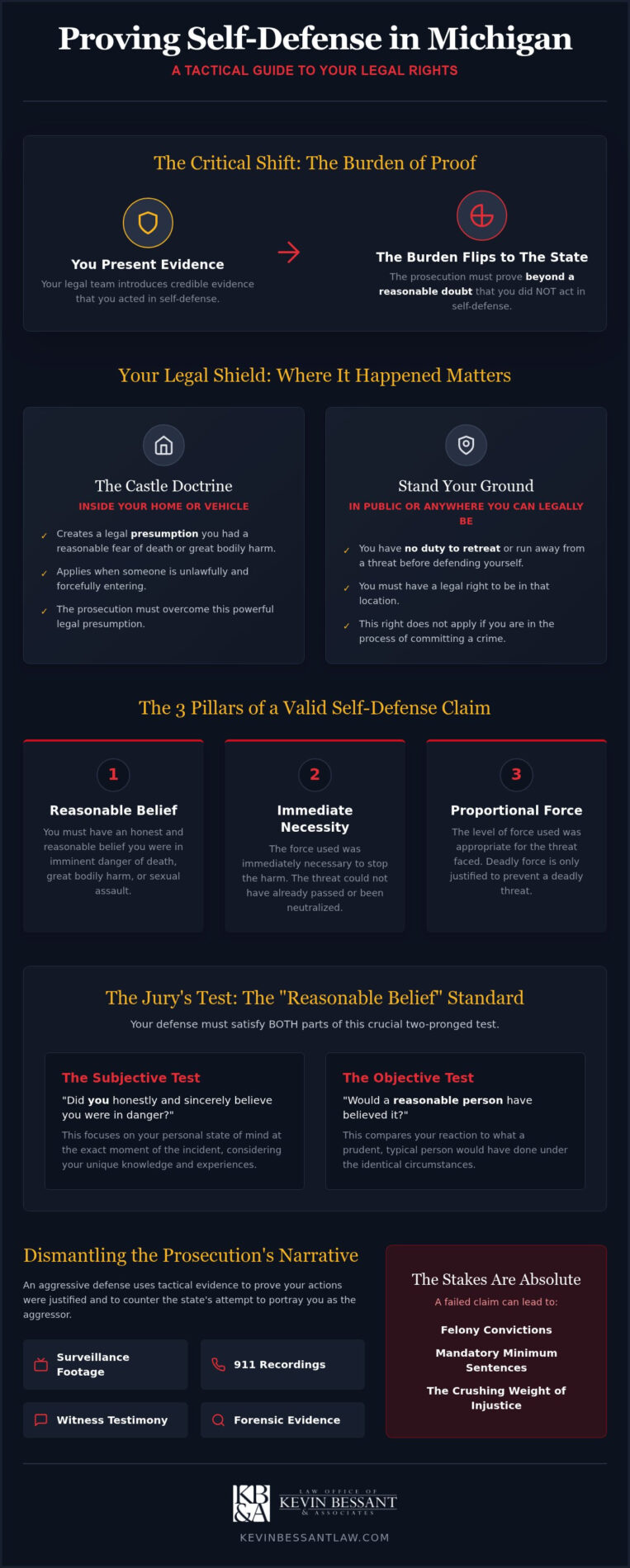
- Understand how the legal burden shifts to the state once you present evidence of proving self defense in Michigan.
- Learn why you have no duty to retreat under Stand Your Ground laws and how the Castle Doctrine protects you inside your home.
- Discover the subjective and objective tests that make up the “Reasonable Belief” standard used in Michigan courts.
- Identify the tactical evidence, such as surveillance footage and 911 recordings, that can dismantle the prosecution’s narrative.
- Don’t let the prosecution control the story. Learn why securing an aggressive legal shield is vital to avoiding mandatory minimum sentences.
The Legal Foundation: Proving Self Defense in Michigan (MCL 780.972)
Michigan law doesn’t grant a free pass just because you felt scared. To survive a courtroom, you must understand that self-defense is an “affirmative defense.” This means you’re acknowledging the physical act occurred, but you’re asserting that the law authorized your conduct under the specific circumstances. Success in proving self defense in Michigan depends on your ability to meet the strict requirements of MCL 780.972, the statute that defines when force is legally justified. The stakes are absolute. If you fail to meet the legal threshold, you’re not a survivor in the eyes of the court; you’re a criminal. You need to act decisively to ensure the law works for you, not against you.
One of the most powerful tools in your arsenal is the burden of proof. Once your defense team introduces evidence of self-defense, the legal weight shifts entirely. The prosecution must disprove your claim beyond a reasonable doubt. They have to convince a jury that you were the aggressor or that your fear was fabricated. This is where the battle for your freedom is won or lost. Understanding the nuances of Michigan Gun Laws is essential, as the distinction between non-deadly and deadly force determines the level of scrutiny your actions will face. Deadly force is only permitted when you reasonably believe it’s necessary to prevent imminent death or great bodily harm.
The Three Pillars of a Self-Defense Claim
To successfully prevail when proving self defense in Michigan, your actions must stand on three legal legs. First, you must have an honest and reasonable belief that you were in imminent danger of death, great bodily harm, or sexual assault. This isn’t just about how you felt. The law asks if a reasonable person in your situation would’ve felt the same way. Second, the use of force must have been immediately necessary to prevent that harm. You can’t claim self-defense if the threat had already retreated or was no longer immediate. Finally, the force you used must be proportional to the threat you faced. If any of these pillars crumble under cross-examination, your entire defense collapses.
Why Proving Self-Defense is a High-Stakes Battle
In the high-pressure courts of Detroit, Southfield, and Warren, the prosecution is not your friend. They’ll scrutinize every second of your interaction to find a reason to charge you with a felony. A failed self-defense claim often leads to mandatory minimum sentences for gun charges, which can steal years of your life. This is the danger-then-rescue reality of criminal litigation. You face the danger of the system, and you need a rescue that’s calculated and fierce. You need an aggressive criminal defense attorney Detroit from the Law Office of Kevin Bessant & Associates who knows how to seize the narrative from the start. We don’t just react to the state’s evidence; we proactively build a case that forces the jury to see the world through your eyes at the moment of the threat.
Stand Your Ground vs. The Castle Doctrine in Michigan
Michigan law provides a powerful shield for those forced to defend themselves, but the strength of that shield depends heavily on where the confrontation occurs. The Stand Your Ground and Castle Doctrine laws are distinct legal tools that every gun owner must understand. The Castle Doctrine, codified in MCL 780.951, creates a legal presumption that you acted with an honest and reasonable belief of imminent death or great bodily harm if someone is in the process of breaking into your dwelling or occupied vehicle. In these specific environments, the law shifts the starting point in your favor. You don’t have to prove your fear; the law assumes it exists because of the intruder’s illegal entry.
When a confrontation moves to a public space, the strategy for proving self defense in Michigan shifts to the Stand Your Ground statute. This law removes the “duty to retreat” that existed under old common law. You aren’t required to turn your back on a threat or attempt to flee before defending yourself, provided you are not engaged in a crime and are in a place you have a legal right to be. A gun charge lawyer Detroit must aggressively document your legal right to be in that space to prevent the prosecution from claiming you had an obligation to run away. The distinction between a private dwelling, a place of business, and a public sidewalk is a critical battleground in your defense.
No Duty to Retreat: When You Can Stand Your Ground
Standing your ground is only a viable defense if you are “clean.” If you’re committing a crime, even a minor one, the prosecution will argue you had a duty to retreat. This is a common trap in high-pressure public confrontations in Detroit or Warren. Prosecutors often try to find a “duty to retreat” where none exists by questioning your right to be in a specific location or by scrutinizing your behavior leading up to the event. You need a defense that forcefully establishes your legal standing from the moment the threat emerged.
The First Aggressor Trap: Why You Can’t Start the Fight
Michigan law generally denies the right of self-defense to the person who started the incident. If the prosecution can cast you as the “first aggressor,” your Stand Your Ground protections vanish. This is why the police narrative is so dangerous. They often mischaracterize assertive or protective behavior as “aggressive” to justify an arrest. We fight this by securing evidence that proves you were the victim of an unprovoked attack. Don’t let the state twist your survival instincts into criminal intent. If you’re being questioned after a defensive encounter, contact our office immediately to ensure your side of the story is the one that sticks.
The ‘Reasonable Belief’ Standard: The Core of Your Defense
The “reasonable belief” standard is the engine of your defense. It’s not enough to simply tell a jury you were scared for your life. You must win two distinct legal battles: the subjective test and the objective test. First, you must demonstrate that you honestly believed you were in imminent danger. Second, you must prove that any sensible person in your exact position would have reached the same conclusion. Proving self defense in Michigan hinges on this dual-layer scrutiny. If the jury decides your fear was genuine but “unreasonable,” your shield vanishes.
Juries don’t judge your actions in a vacuum. They must consider the totality of the circumstances. Your past experiences, such as being a previous victim of a violent crime, color the jury’s perception of your fear. The environment plays a massive role too. A confrontation in a high-crime area of Detroit at 2 AM carries a different “reasonableness” threshold than a verbal dispute in a quiet suburban park. Finally, you must prove “imminence.” The threat must be happening right now. You cannot use force to prevent a future “maybe” or to retaliate for a past insult. It must be a now-or-never moment of survival.
Proportionality: Why Force Must Match the Threat
Force must be a mirror to the threat you face. Using a firearm against an unarmed person is a massive legal hurdle, but it isn’t an impossible one. Michigan courts look at specific disparities to determine if lethal force was “reasonable” against a non-armed attacker:
- Physical Disparity: Significant differences in size, weight, or strength between you and the aggressor.
- Multiple Attackers: Being outnumbered creates a reasonable fear of “great bodily harm” even if no weapons are visible.
- Age and Ability: Your health or age compared to a younger, more capable assailant.
The danger of “excessive force” is the prosecution’s favorite weapon. If you continue to use force after the threat is neutralized—such as shooting an attacker who is already down or fleeing—you become the aggressor in the eyes of the law. You must stop the moment the danger ends.
Proving Fear in Homicide and Felony Assault Cases
In high-stakes homicide or felony assault cases, the prosecution will try to characterize your survival instinct as an “intent to kill.” A michigan felony assault attorney works to humanize your reaction and refocus the jury on your state of mind. We often use expert witnesses to explain the biological reality of the “fight or flight” response. This high-pressure physiological state can impair fine motor skills and tunnel vision, explaining why a survivor might fire multiple shots in a matter of seconds. We shift the narrative from criminal intent to a desperate, justified intent to survive.
Tactical Evidence: How to Prove Self Defense in Court
The moment the smoke clears, the clock starts ticking against you. Proving self defense in Michigan is an evidence-driven race where the first few hours are often the most critical. When the police arrive, they’ll try to get you to “tell your side of the story.” Do not fall for this trap. Your words, even if spoken in a state of trauma, can be twisted into a confession or used to highlight inconsistencies later. The golden rule is absolute: remain silent and do not speak to any law enforcement officer without your lawyer present. While you remain silent, we act to preserve the facts.
We immediately begin securing surveillance footage from Detroit businesses and residential Ring cameras before the data is overwritten or deleted. This visual record is often the only objective witness to the onset of the confrontation. We also secure 911 call recordings to establish the timeline. Were you the one who called for help? If you sought police intervention immediately, it strongly supports the narrative that you were a victim acting in fear, not a criminal looking for trouble. Our team also canvasses the area for neutral witnesses; individuals with no stake in the outcome who can verify you were not the aggressor.
Digital Evidence and Social Media
Your phone is a vital tool for proving self defense in Michigan. Text messages, direct messages, or social media threats from the “victim” can prove their violent intent long before the physical encounter began. We also use GPS data to establish your movements. This often shows that you were trying to leave the situation or avoid the encounter entirely, which reinforces your lack of criminal intent. Be warned: the prosecution will scour your social media too. Any posts celebrating gun culture or “toughness” will be used to paint you as someone looking for a fight. We manage this digital battlefield to ensure only the truth reaches the jury.
The Role of Forensic Experts
We don’t just rely on testimony; we rely on hard science to build your shield. Forensic experts play a critical role in high-stakes felony cases. Ballistics and blood spatter analysis can prove the distance and angle of a threat, verifying that your use of force was a direct response to an immediate physical danger. Medical records documenting your own injuries prove you were being assaulted. Finally, psychological evaluations establish the impact of the threat on your decision-making, explaining why you reacted the way you did. This scientific evidence leaves the prosecution with no room to speculate. If you’ve been forced to defend yourself, call Kevin Bessant & Associates now to start securing the evidence that will save your freedom.
Why Kevin Bessant is Your Vital Shield in Self-Defense Cases
Facing a prosecutor who wants to turn your act of survival into a felony is a high-stakes crisis. You don’t need a lawyer who sits back and waits for the state to act. You need a vital shield who takes the initiative from day one. Kevin Bessant & Associates provides the aggressive advocacy required for proving self defense in Michigan. We’ve spent over 20 years in the courtrooms of Detroit, Warren, and Southfield, building a reputation for fierce, unwavering defense. Our battle-ready approach to homicide and felony assault charges is designed to protect your 2nd Amendment rights and your long-term freedom. We understand that the system is designed to prosecute, and we are designed to stop them.
Standing in the Gap for the Accused
Our “danger-then-rescue” philosophy is more than just a strategy; it’s our mission. We stand in the gap for individuals who’ve been misidentified as aggressors by a complex and often biased legal system. Navigating the Wayne County courts requires a seasoned guide who knows the inner workings of the prosecution’s tactics. We don’t just review evidence; we challenge it. We turn the tide of police investigations by asserting your rights and framing the narrative before the state can cement its case. We focus entirely on the next necessary step to secure your freedom, ensuring you’re never intimidated by a system that lacks your perspective.
Take Immediate Action to Protect Your Future
A felony conviction in Michigan is a life-altering event that you can’t afford to risk. It means the permanent loss of your civil liberties and a future defined by a criminal record. The prosecution has already started their work. They’re gathering statements and building a narrative to cast you as a criminal. You must act now to counter their efforts. Proving self defense in Michigan is a strategic battle that demands an expert who isn’t afraid of a fight. Don’t stand alone against the weight of the state. Contact the Law Office of Kevin Bessant & Associates today for a confidential consultation. Your freedom is our priority, and we’re ready to fight for it.
Legal Authority: Statute and Case Law
Michigan’s Self-Defense Act is codified at MCL 780.972 (use of deadly force) and MCL 780.951 (the Castle Doctrine presumption), with civil immunity addressed separately at MCL 600.2922b.
- People v Riddle, 467 Mich 116, 119; 649 NW2d 30 (2002) — the Michigan Supreme Court clarified the common-law duty to retreat, holding that a person is never required to retreat from a sudden, fierce, and violent attack, nor from an attacker reasonably believed to be about to use a deadly weapon, as long as the belief in the necessity of deadly force is honest and reasonable.
For the current statutory text and published opinions, see the Michigan Legislature’s MCL database and the Michigan Courts case search.
Secure Your Freedom with an Unwavering Legal Shield
The legal system doesn’t reward survival; it scrutinizes it through a lens of strict statutes and objective tests. Successfully proving self defense in Michigan requires more than just telling your story. It demands a tactical mastery of the laws we’ve discussed, from the Castle Doctrine to the “reasonable belief” standard. You now have the blueprint for your defense, but you shouldn’t have to carry the burden of the system’s pressure alone. Don’t let the prosecution dictate your future by failing to secure the right advocate.
With 20+ years of criminal defense experience, the Law Office of Kevin Bessant & Associates provides the aggressive representation necessary to dismantle the prosecution’s narrative. We specialize in high-stakes homicide and gun offenses, acting as a vital shield in the courts of Detroit and throughout Southeast Michigan. You fought to survive the initial threat; now, let us fight to protect your long-term freedom from a system that often lacks your perspective. We are battle-ready and prepared to stand in the gap for you.
Secure Your Vital Shield—Contact Kevin Bessant for an Aggressive Defense Evaluation. You stood your ground then; we’ll stand ours now.
Frequently Asked Questions
Can I claim self-defense if I was carrying a gun illegally in Michigan?
You can still raise a self-defense claim, but carrying illegally complicates your case significantly. Michigan’s Stand Your Ground law requires that you aren’t engaged in a crime at the time of the incident. If you possess a firearm without a CPL or in a prohibited zone, the prosecution will argue you had a duty to retreat. You need an aggressive lawyer to fight for your rights despite any underlying weapons charges.
Do I have to retreat if someone attacks me in a public place in Detroit?
No, you don’t have a duty to retreat in a public place in Detroit if you aren’t committing a crime and have a legal right to be there. This is the core of Michigan’s Stand Your Ground statute. While the prosecution may try to claim you could’ve fled, the law allows you to use force, including deadly force, if you honestly and reasonably believe it’s necessary.
What is the ‘Castle Doctrine’ and does it apply to my car?
The Castle Doctrine provides a legal presumption of fear when an intruder enters your home, business, or occupied vehicle. In Michigan, this means you don’t have to prove you were afraid if someone is forcibly entering your car while you’re inside. The law assumes your fear of death or bodily harm is reasonable. This presumption is a vital shield when proving self defense in Michigan after a carjacking.
How much force is considered ‘proportional’ in a self-defense situation?
Proportional force means the level of force you use must match the threat you face. You cannot use deadly force to stop a minor physical altercation or a simple slap. However, if an attacker is significantly larger, younger, or if there are multiple assailants, using a weapon against an unarmed person may be deemed proportional. The jury will evaluate the “reasonable person” standard to decide if your choice was justified.
Can I use deadly force to protect my property or home from a thief?
No, you cannot use deadly force solely to protect property in Michigan. The law only justifies deadly force to prevent imminent death, great bodily harm, or sexual assault. If a thief is stealing your car while it’s empty or taking items from your porch, you aren’t legally permitted to shoot. However, if the thief enters your occupied home or vehicle, the Castle Doctrine may apply because the threat shifts to personal safety.
What happens if I accidentally hurt a bystander while acting in self-defense?
If your use of force against an aggressor was legally justified, you may not be held criminally liable for accidentally injuring a bystander. This often falls under the doctrine of “transferred intent.” However, the prosecution may still charge you with reckless discharge of a firearm if they believe your actions were grossly negligent. Proving self defense in Michigan in these scenarios requires a battle-ready advocate to demonstrate that your reaction was reasonable.
Can I be sued in civil court if I am found not guilty by reason of self-defense?
A criminal acquittal alone does not automatically bar a civil lawsuit. Michigan’s civil immunity statute, MCL 600.2922b, can shield a justified defender from civil liability for damages, but that immunity isn’t automatic — it must be affirmatively raised and established, often through a pre-suit immunity motion, because civil courts use a lower “preponderance of the evidence” standard than the criminal system’s “beyond a reasonable doubt.”