

A drug trafficking charge in Michigan is not a simple legal misunderstanding; it is a coordinated attempt by state or federal prosecutors to strip away your freedom for decades. When you face the possibility of life in prison and million dollar fines, the government’s power feels absolute. You need a drug trafficking lawyer Michigan residents trust to stand as an aggressive shield between you and a system built to convict. The prosecution has likely spent months building their case using wiretaps, confidential informants, and surveillance, but their narrative is not the final word. You have rights, and you have the power to fight back.
It’s natural to feel overwhelmed by the threat of mandatory minimum sentences and the evidence stacked against you. You’re facing a high-stakes battle where the opposition is already miles ahead. This guide reveals the strategies used to dismantle the prosecution’s case, from challenging the legality of searches to exposing the unreliability of informants. Discover how to aggressively challenge the state’s evidence, fight for a dismissal or a reduction to simple possession, and navigate the 2026 sentencing guidelines to protect your future. Your life is on the line, and the next steps you take will determine your freedom.
Key Takeaways
- Michigan’s drug laws are among the nation’s harshest; learn how the 2026 sentencing guidelines for Schedule 1 and 2 substances can dictate the rest of your life.
- Federal agencies like the DEA and FBI often escalate local cases. Understand why jurisdiction matters and how to defend against federal mandatory minimums.
- An experienced drug trafficking lawyer Michigan residents trust can use the Fourth Amendment as a shield to suppress evidence from illegal searches and seizures.
- Not every large quantity of a controlled substance proves “intent to deliver.” Discover the strategies used to reduce high-stakes trafficking charges to simple possession.
- Learn how to expose the unreliability of confidential informants and dismantle the prosecution’s conspiracy narrative through aggressive procedural warfare.
Michigan Drug Trafficking Charges: The Stakes in 2026
In Michigan, drug trafficking isn’t just a crime; it’s a life-altering felony that the state pursues with relentless vigor. Whether it’s manufacturing, distributing, or possessing with the intent to deliver, the charges are designed to bury you under decades of prison time. As part of the global drug trade, Michigan’s ports and highways are under constant surveillance by task forces that don’t distinguish between a simple mistake and a career criminal. If you’ve been swept up in a sting, you need a drug trafficking lawyer Michigan can rely on to halt the prosecution’s momentum. Don’t wait for the system to decide your fate. You need an aggressive shield now.
Trafficking vs. Possession with Intent to Deliver (PWID)
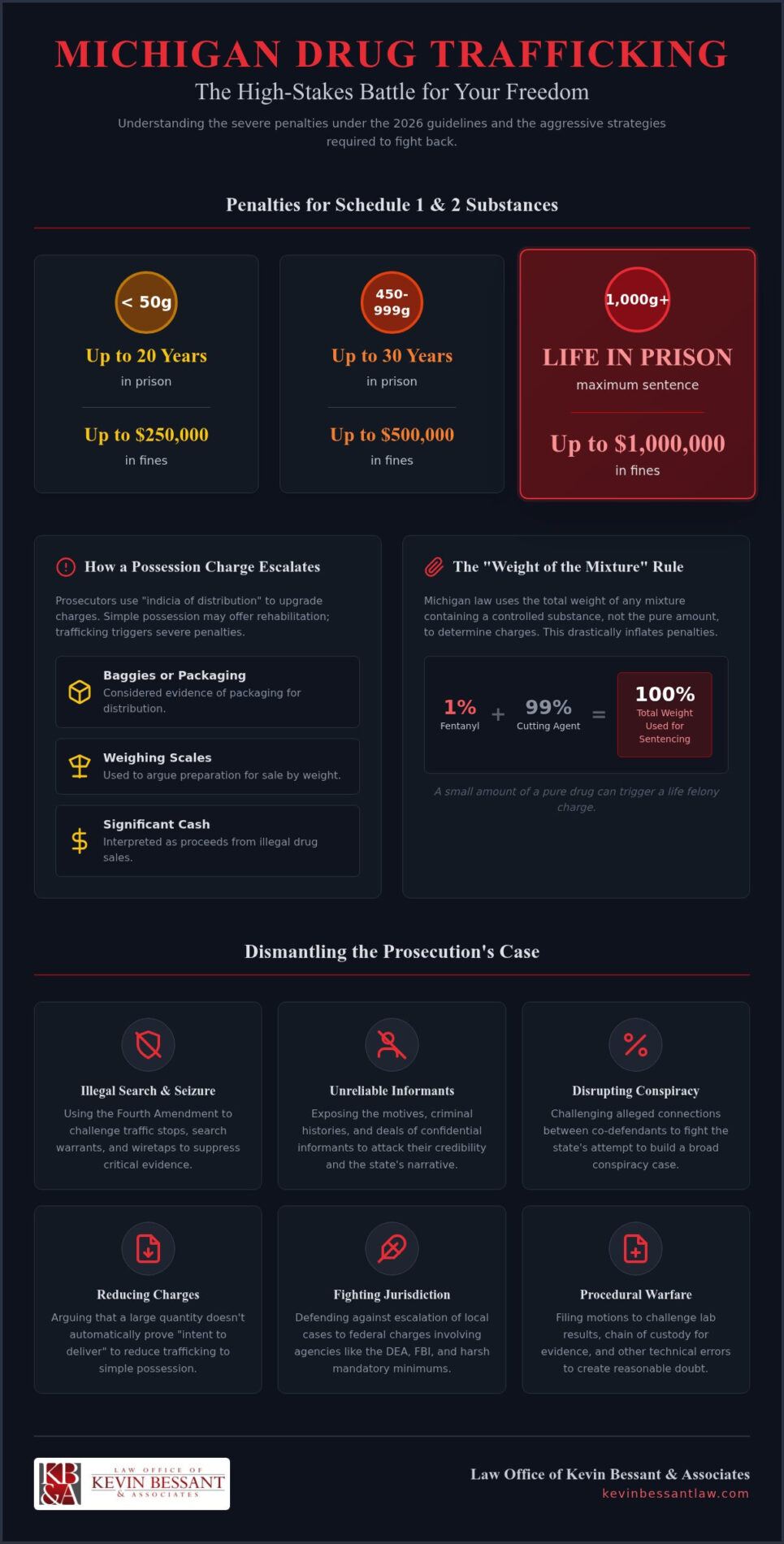
Prosecutors often use “indicia of distribution” to upgrade a simple possession charge to a high-stakes felony. If police find scales, baggies, or significant cash alongside a controlled substance, they’ll argue you weren’t just using; you were selling. This shift is critical. A simple possession charge might offer rehabilitation options, but trafficking triggers the full weight of the Michigan penal code. Securing a drug trafficking lawyer Michigan trusts is the only way to challenge the “intent” narrative. You aren’t just fighting a case; you’re fighting for your future against a system that assumes your guilt based on the tools in your pocket.
Mandatory Minimums and Life Offenses
Michigan’s history with drug laws is brutal. While the infamous “650-Lifer” law has evolved, the current sentencing guidelines for 2026 remain severe. As of July 16, 2026, several bills like SB 430 and HB 5157 are pending in the legislature, but they haven’t yet changed the harsh reality for Schedule 1 or 2 substances. For drugs like heroin, cocaine, or fentanyl, the penalties are tied directly to weight. The system is a steamroller, and without a fighter, you’ll be crushed.
- Less than 50 grams: Punishable by up to 20 years in prison and a fine of up to $250,000.
- 450 to 999 grams: Punishable by up to 30 years in prison and a fine of up to $500,000.
- 1,000 grams or more: Punishable by up to life in prison and a fine of up to $1,000,000.
These aren’t just numbers; they’re years of your life. The system wants a conviction to justify its budget and its statistics. You need an aggressive shield to stop them before they take everything. Discover why us is the right choice for those facing the toughest courtrooms in Detroit, Southfield, and Warren. We understand the inner workings of these local court systems and won’t let you be steamrolled by overzealous prosecutors.
Michigan Drug Schedules and Quantity Thresholds
Michigan’s legal system categorizes controlled substances into “Schedules” based on their perceived danger and medical utility. Schedule 1 and 2 drugs, such as Heroin, Cocaine, Methamphetamine, and Fentanyl, carry the most severe penalties. Prosecutors don’t just look at the drug itself; they also target “analogues” or synthetic versions designed to mimic prohibited substances. If you’re caught in the crosshairs of these classifications, a drug trafficking lawyer Michigan can trust is your only hope of navigating the technicalities the state uses to secure convictions. Aggressive defense starts with a precise understanding of how these substances are classified and how the state intends to use them against you.
One of the most dangerous aspects of Michigan law is the “weight of the mixture” rule. Prosecutors don’t care if the substance you possessed was 99% filler. If a controlled substance is present in a mixture, the total weight of that entire mixture determines your charges. This means a small amount of a drug can suddenly trigger a 20-year or 30-year felony. You need an aggressive shield to challenge how these weights were calculated and whether the laboratory testing was actually accurate. We fight to ensure the prosecution doesn’t inflate your charges through questionable math or faulty lab results.
Heroin and Fentanyl: The Prosecution’s Primary Targets
Trafficking charges involving opioids carry a massive social and legal stigma in Metro Detroit courtrooms. Prosecutors in Southfield, Warren, and Detroit treat these cases as high-profile victories. Charges escalate rapidly based on specific weight thresholds. For Schedule 1 or 2 substances like heroin, possessing 450 to 999 grams can lead to 30 years in prison. If the amount exceeds 1,000 grams, you face life in prison. Kevin Bessant fights back against the “overzealous prosecutor” narrative by humanizing the client and attacking the state’s evidence. We don’t let the prosecution use public sentiment as a tool to steamroll your constitutional rights.
The Felony Firearm Multiplier
The stakes get even higher if a weapon is involved. Michigan’s “Felony Firearm” statute creates a mandatory two-year prison sentence that must be served consecutively to any other sentence. If you are convicted of trafficking and had a gun nearby, you’ll spend two extra years in prison before your trafficking sentence even begins. This multiplier is a favorite tool for prosecutors looking to force a plea deal. You need a Gun Charge Lawyer Detroit can rely on to fight these stacked charges. Don’t let the system trap you with technicalities and mandatory add-ons. If you’re facing these high-stakes charges, it’s time to reach out for a professional evaluation of your case.
State vs. Federal Drug Trafficking: Why Jurisdiction Matters
If the DEA or FBI knocks on your door in Metro Detroit, your legal situation has shifted from a local crisis to a national battle. Federal drug trafficking investigations often involve months of wiretaps, surveillance, and multi-state coordination. Unlike state cases handled by local police, federal charges are prosecuted by the U.S. Attorney’s Office and carry devastating mandatory minimum sentences. You need a drug trafficking lawyer Michigan residents trust to navigate the rigid procedures of the federal court system. The rules of engagement change the moment your case moves from a county courthouse to the federal building in Detroit.
One of the most immediate differences is the bond process. In Michigan state courts, judges often set a cash or surety bond. In the federal system, you face a detention hearing where the government frequently argues for “permanent detention.” They want you behind bars while your case proceeds. Without an aggressive shield to argue for your release, you could spend months or years in custody before your trial even begins. We understand the nuances of both state and federal courts in Southfield and Detroit, ensuring your rights are protected regardless of which agency is leading the charge.
Federal Sentencing Guidelines vs. Michigan Public Health Code
Federal sentencing is a cold, math-based system. It uses a “points” scale that factors in the drug weight, your criminal history, and whether a weapon was present. While Michigan’s Public Health Code is harsh, the federal guidelines are often far more restrictive. However, the “Safety Valve” provision is a critical tool we use for first-time federal offenders. If you meet specific criteria, this provision allows a judge to sentence you below the mandatory minimum. Strategic advocacy is often the difference between a decade in prison and a significantly reduced sentence. Our goal is always to keep the case in state court whenever possible, where we have more leverage to fight for your freedom.
Conspiracy Charges: The Prosecution’s Favorite Tool
You don’t have to touch a single gram of a controlled substance to be charged with federal drug trafficking. Prosecutors love the “conspiracy” charge because it only requires proof of an agreement to violate drug laws. If they can link you to a larger organization, you can be held legally responsible for every drug sale made by your “co-conspirators.” We dismantle these narratives by attacking the evidence of an “agreement” and exposing the lies of informants looking for their own deals. Discover why us is the right choice for dismantling complex conspiracy cases. Don’t let a “guilt by association” narrative ruin your life. If the federal government is targeting you, contact us immediately to begin your defense.
Dismantling the Prosecution’s Case: Aggressive Defense Strategies
The prosecution wants you to believe their evidence is bulletproof. It isn’t. A drug trafficking lawyer Michigan residents rely on understands that every piece of evidence has a history. If that history is tainted by police misconduct or procedural errors, it cannot be used to steal your freedom. We don’t just review the state’s case; we dismantle it. By examining the Fourth Amendment, we determine if the police had a legal right to stop your vehicle or enter your property. If they didn’t, we fight to have that evidence thrown out entirely. You need a battle-ready advocate who knows how to spot these cracks before the system crushes you.
Suppression of Evidence: The ‘Fruit of the Poisonous Tree’
An illegal traffic stop in Detroit or a search warrant based on stale, anonymous tips can be the key to your freedom. If the initial search was unconstitutional, every piece of evidence found afterward is considered “fruit of the poisonous tree.” We aggressively litigate “Motions to Suppress” to gut the prosecution’s evidence. When the drugs are suppressed, the case often collapses. Don’t assume the police followed the rules. They often cut corners to secure a high-profile trafficking arrest, and we’re here to hold them accountable for every violation of your rights.
Entrapment and Undercover Stings
Police overreach is common in high-stakes drug investigations. Undercover stings and “controlled buys” often cross the line into illegal entrapment. If the government induced you to commit a crime you weren’t otherwise predisposed to commit, your case may be eligible for dismissal. We use an “Aggressive Shield” approach to put the police on trial. We scrutinize the reliability of confidential informants, many of whom are “snitches” lying to save themselves. We expose their motives and dismantle their credibility in front of the jury. It’s time to stop reacting to the prosecution and start attacking their narrative.
Securing Your Release: The Bond Hearing
The first 24 hours after your arrest are the most critical for your future. If you are stuck behind bars, you can’t help build your defense. You need a Bond Hearing Lawyer Detroit can trust to fight for your immediate release. We present you to the judge as a human being with ties to the community, not just another “trafficker” on a docket. Our goal is to secure a fair bond so you can fight your case from home. If you or a loved one is currently in custody, speak with an aggressive advocate today to start the process of bringing you home.
Why Kevin Bessant is the Aggressive Shield You Need in Michigan
When you’re staring down a felony trafficking charge, you aren’t just fighting a legal case; you’re fighting for your life. The prosecution has the entire weight of the government behind them. You need a drug trafficking lawyer Michigan can trust to stand in the gap. With over 20 years of battle-tested experience, the Law Office of Kevin Bessant & Associates serves as your aggressive shield. We aren’t intimidated by overzealous prosecutors or the high-pressure tactics they use to force quick pleas. We understand the system from the inside out. We don’t let you be treated like a statistic. Our personality is formidable toward the opposition but supportive and accessible to you. You deserve a battle-ready advocate who won’t flinch when the stakes are at their highest.
We frame the legal process as a struggle where you should never stand alone. This “advocate-versus-system” dynamic is at the core of everything we do. While the government focuses on convictions, we focus on your future. We act as a seasoned guide who knows exactly how to navigate treacherous territory, projecting a persona that is both experienced and intensely focused on achieving favorable outcomes. It’s the voice of someone who’s not intimidated by the system and encourages you to feel the same level of confidence.
Local Knowledge in Detroit, Southfield, and Warren
Every courtroom in Metro Detroit has its own unique rhythm. A drug trafficking lawyer Michigan depends on must understand the specific tendencies of judges and prosecutors in Detroit, Southfield, and Warren. Some judges prioritize rehabilitation for first-time offenders, while others strictly follow the most severe sentencing guidelines for Schedule 1 substances. We know these courtrooms. We know how local prosecutors build their cases. This regional expertise is the difference between a generic defense and a targeted strategy that wins. Our local presence builds a wall of credibility that prosecutors respect. Learn more about our background and Why Us is the right choice for high-stakes felony advocacy.
Take Immediate Action: Your Defense Starts Now
The cost of waiting is too high. Every hour you delay is an hour the prosecution uses to solidify their narrative or pressure witnesses. If the police are asking questions, “I want my lawyer” is your only response. Stop talking. Anything you say will be twisted to fit their conspiracy narrative. Your defense starts the moment you decide to fight back. We provide the vigorous, proactive representation required to navigate treacherous legal territory. Don’t let the system steamroll your rights or your future. You need a dedicated protector who is not intimidated by the system. Contact the Law Office of Kevin Bessant & Associates today to secure the aggressive advocacy you need to protect your freedom.
Legal Authority: Statute and Case Law
Michigan’s delivery and manufacture statute is codified at MCL 333.7401.
- People v Wolfe, 440 Mich 508, 524; 489 NW2d 748 (1992) — the Michigan Supreme Court held that intent to deliver may be proven entirely by circumstantial evidence, such as the quantity possessed or how the substance was packaged, without requiring proof of an actual completed sale.
- Wong Sun v United States, 371 US 471; 83 S Ct 407; 9 L Ed 2d 441 (1963) — the U.S. Supreme Court established the “fruit of the poisonous tree” doctrine, holding that evidence derived from an initial illegal search or seizure must be excluded, not just the evidence directly seized during that unlawful act.
For the current statutory text and published opinions, see the Michigan Legislature’s MCL database and the Michigan Courts case search.
Reclaim Your Future Against High-Stakes Charges
You’re facing the most aggressive prosecution of your life. The 2026 Michigan sentencing guidelines for Schedule 1 and 2 trafficking are designed to take your freedom for decades. You’ve learned how illegal searches can be suppressed and how conspiracy charges often rely on unreliable informants. These are high-stakes felony charges that require more than just a consultation; they require a battle-ready advocate who knows the Detroit and Southfield court systems. Don’t let the government’s narrative become your reality.
You need a drug trafficking lawyer Michigan residents trust to act as an aggressive shield. With 20+ years of criminal defense experience, the Law Office of Kevin Bessant & Associates provides the specialized high-stakes felony representation you need to dismantle the prosecution’s case. We provide aggressive advocacy in Detroit and Metro courts to ensure you never stand alone against the system. The time to act is now. Every hour you wait allows the state to build a stronger case. Take the first step toward protecting your rights and your future today.
Secure Your Aggressive Shield—Call Kevin Bessant Now
Your situation is serious, but it is not hopeless. With the right fighter in your corner, you can navigate this crisis and reclaim your life.
Frequently Asked Questions
What is the difference between drug possession and drug trafficking in Michigan?
Possession is simple ownership for personal use, while trafficking involves manufacturing, distributing, or possessing with the intent to deliver. In Michigan, the line is often drawn by the quantity of the substance or the presence of “indicia of distribution” like scales and packaging. If you’re caught with a large amount, prosecutors assume you’re selling. You need a drug trafficking lawyer Michigan can count on to challenge this assumption and fight for a reclassification.
Can I go to prison for a first-time drug trafficking offense in Michigan?
Yes, first-time offenders face serious prison time for trafficking. Unlike minor misdemeanors, trafficking is a major felony where Michigan’s sentencing guidelines prioritize punishment over rehabilitation. Even without a criminal history, the weight of the drugs can trigger decades behind bars. You cannot rely on the court’s mercy in these high-stakes cases. You need an aggressive shield to fight for a deviation from the guidelines before the judge reaches for the gavel.
How do mandatory minimum sentences work for drug trafficking in 2026?
In 2026, mandatory minimums serve as the absolute floor for your incarceration based on the substance’s weight. For Schedule 1 or 2 drugs like fentanyl or cocaine, the system is rigged to trigger automatic prison time once specific thresholds are met. A drug trafficking lawyer Michigan residents trust will aggressively seek “substantial and compelling” reasons for a judge to depart from these guidelines. We fight to ensure the court sees you as a person, not just a weight.
What should I do if the police want to question me about a drug investigation?
Do not answer any questions without your attorney present. The police aren’t looking for the truth; they’re looking for a confession to close their investigation. Even “innocent” statements can be twisted into evidence of a conspiracy. Assert your Fourth and Fifth Amendment rights immediately. Tell the officers, “I am exercising my right to remain silent and I want my lawyer.” Once you say those words, all questioning must stop until your advocate arrives at your side.
Is it possible to get a drug trafficking charge reduced to a misdemeanor?
Reducing trafficking to a misdemeanor is extremely difficult, but fighting for a reduction to simple possession is a common goal. This shift is critical because it removes the “intent to deliver” element, which carries the heaviest penalties and no mandatory minimums. We achieve this by attacking the prosecution’s evidence of distribution. If we can prove the search was illegal, we may even be able to have the entire case dismissed before it ever reaches a jury.
How does a ‘conspiracy’ charge work in a drug trafficking case?
A conspiracy charge only requires proof of an agreement between two or more people to violate drug laws. You don’t have to possess, sell, or even see the controlled substances to be convicted. If the government can link you to a “plan,” you are legally responsible for every action taken by your co-conspirators. We dismantle these cases by exposing the lack of a real agreement and challenging the testimony of informants who are lying for deals.
Can a lawyer help me get a lower bond for a trafficking charge in Detroit?
Yes, a skilled advocate is vital for securing a reasonable bond in Detroit’s busy courtrooms. Judges often set high bonds for trafficking because they view the defendant as a flight risk. We counter this by presenting your employment history, family ties, and community involvement. Our goal is to get you out of jail immediately so you can participate in building your defense. We ensure the judge treats you as a human being, not a flight risk.
What happens if the police didn’t have a warrant to search my car or home?
If the police searched your property without a warrant and no legal exception applied, the evidence is likely inadmissible. This is known as the “Fruit of the Poisonous Tree” doctrine. We file motions to suppress evidence to prevent the jury from ever seeing the drugs or cash found during an illegal search. When the primary evidence is thrown out, the prosecution usually has no choice but to dismiss the case. We hold the police accountable for their mistakes.
Does the state have to prove an actual sale to convict me of intent to deliver?
No. People v Wolfe, 440 Mich 508 (1992), holds that intent to deliver can be proven entirely through circumstantial evidence, the amount of the substance or how it was packaged, without requiring proof of a completed transaction.