

A single mistake or a misunderstanding over property valued at $1,000 shouldn’t cost you five years of your life, but Michigan prosecutors are already working to ensure it does. You’re likely feeling blindsided that a retail incident has escalated into a high-stakes felony threat that could haunt your career forever. It’s a terrifying position to be in, and the anxiety you’re feeling about your freedom is entirely justified. The legal system isn’t designed to be fair; it’s designed to secure convictions against you.
This guide will pull back the curtain on the severe first degree retail fraud penalties Michigan judges can impose and, more importantly, how an aggressive defense acts as a shield for your future. You’ll discover the specific legal thresholds for 2026, the long-term impact of a permanent felony record, and the strategic maneuvers used to pursue a misdemeanor reduction or an expungement-eligible outcome. Don’t let the system dictate your story. Learn how to fight back and secure the second chance you deserve by understanding the battle ahead.
Key Takeaways
- Understand the $1,000 threshold that transforms a shoplifting incident into a high-stakes felony charge under Michigan law.
- Discover how first degree retail fraud penalties Michigan judges impose can include up to five years in prison and devastating financial fines.
- Learn about the “enhancement rule” and how a prior record can turn a minor theft into a severe felony prosecution.
- Explore aggressive defense tactics that challenge the prosecution’s evidence regarding criminal intent and the actual market value of the property.
- Find out why immediate legal intervention is critical to securing bond and protecting your career in Detroit, Southfield, and Warren courts.
What is First-Degree Retail Fraud Under Michigan Law?
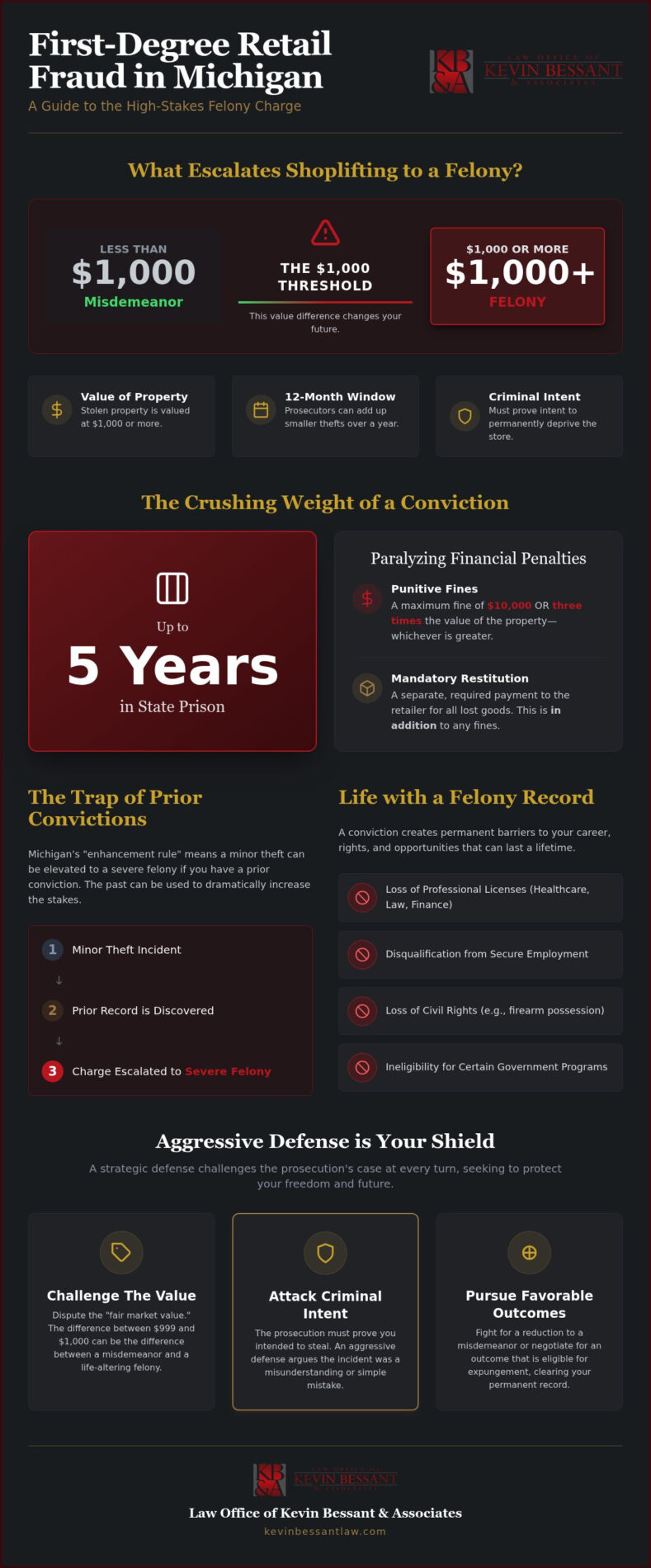
Michigan law doesn’t treat shoplifting as a minor lapse in judgment. Under MCL 750.356c, you’re facing a high-stakes felony that can dismantle your future in an instant. To truly grasp What is Retail Fraud?, you must understand that the state is looking for any reason to escalate your case. First-degree retail fraud is triggered when the value of the property stolen, or the value involved in a fraudulent return, reaches $1,000.00 or more. This isn’t limited to one bad day; the prosecution can add up smaller incidents over a 12-month window to reach that felony level.
One specific requirement often overlooked is the “open for business” rule. The alleged theft must occur while the establishment is open to the general public. If the store was closed, the legal landscape shifts toward even more severe charges like Breaking and Entering. Because the state classifies this as a serious felony, the first degree retail fraud penalties Michigan judges enforce are meant to be crushing. You’re looking at a maximum of five years in a state prison. You need a shield that stands between you and a system designed to lock you away.
The Legal Elements the Prosecution Must Prove
The prosecution’s burden is heavy, but they’re experienced at carrying it. They must prove you had the specific intent to permanently deprive the store of its property. This isn’t just about physical theft. It includes price-switching, altering barcodes, or attempting to return items you never bought. We aggressively attack the “value” element of the charge. The difference between $999 and $1,000 is the difference between a misdemeanor and a life-altering felony. We demand the state prove the fair market value, not just an arbitrary retail price they’ve slapped on a tag.
Retail Fraud vs. Ordinary Larceny
You might wonder why this isn’t just a simple larceny charge. Michigan created specific statutes for retail environments to protect businesses during business hours. Shoplifting from a store is legally distinct from stealing property from a private home. The location changes the entire legal strategy. While a minor theft might result in a 93-day misdemeanor, the moment that $1,000 threshold is crossed, you’re in felony territory. This distinction is why you can’t treat this like a simple ticket; it’s a direct assault on your freedom.
Severe Penalties: Prison Time and Fines for a Felony Conviction
A conviction for first-degree retail fraud isn’t just a mark on your record; it’s a direct threat to your physical freedom. Michigan law empowers judges to sentence you to up to five years in a state prison. This isn’t a “slap on the wrist” offense. The prosecution often views these cases through the lens of the state’s Organized Retail Crime Unit, which means they’re looking to make an example out of you. Beyond the cell block, the financial weight of these charges can be paralyzing.
The first degree retail fraud penalties Michigan courts impose are designed to be punitive and financially draining. You face a maximum fine of $10,000.00 or three times the value of the stolen property, whichever is greater. If the state alleges you took $5,000 worth of merchandise, the court could demand $15,000 in fines alone. This doesn’t include court costs, oversight fees, or the potential for years of restrictive felony probation that dictates where you live and who you see.
Mandatory Fines and Restitution
Michigan judges don’t have much leniency when it comes to the financial side of a felony. You’ll be ordered to pay full restitution to the retailer for any damaged or lost goods. This is a separate obligation from the punitive fines mentioned above. If you’re struggling to keep your head above water, these court-ordered payments can lead to a cycle of debt and technical probation violations. It’s vital to have an advocate who can challenge the prosecution’s valuation of the property before these numbers are set in stone.
Life with a Felony Record in Michigan
The consequences of a conviction follow you long after you’ve left the courtroom. A felony record in Michigan triggers an immediate loss of specific civil rights, including your right to possess a firearm and your eligibility for certain government programs. Your professional future is also at stake. Many employers in Michigan conduct deep background checks, and a felony retail fraud conviction is a massive red flag. You may find yourself disqualified from:
- Professional licenses in healthcare, law, or finance.
- Secure employment in the automotive or manufacturing sectors.
- Eligibility for student loans or specialized educational grants.
- Safe, affordable housing options that exclude felony offenders.
The system is rigged to keep you down once you’re in it. Your best defense is preventing that conviction from ever reaching your permanent record. Don’t wait for the court to decide your fate; take action to protect your rights immediately.
The Trap of Prior Convictions: How Your Past Elevates the Charge
The Michigan legal system is designed to punish repeat behavior with extreme prejudice. You might think that taking an item worth $250 is a minor misdemeanor, but if you have a prior conviction for retail fraud on your record, the prosecution will immediately elevate that charge to a high-stakes felony. This is the enhancement trap. Under Michigan law, a single prior conviction for second-degree retail fraud can turn a relatively small incident into a five-year prison threat. The prosecution uses your past as a blunt instrument to ensure the most severe first degree retail fraud penalties Michigan law allows are on the table.
When the prosecution sees a prior conviction, they stop seeing a person and start seeing a statistic they can exploit. They’ll use your history to argue for higher bond amounts, stricter travel restrictions, and longer jail sentences. This aggressive “stacking” of charges is a favorite tactic for prosecutors in Detroit and Southfield who want to force a quick plea. You need a shield that understands how to dismantle these prior allegations before they’re used to crush your future.
Understanding the Habitual Offender Laws
The danger increases exponentially if you have other unrelated felonies on your record. Michigan’s Habitual Offender laws allow the state to increase the maximum prison time for a first-degree retail fraud conviction well beyond the standard five years. The prosecutor has the sole discretion to file a “Habitual Offender Notice” within 21 days of your arraignment. This notice is often used as a bargaining chip to scare you into a bad deal. We know how the system works and we don’t let the state use these procedural threats to bully our clients. You can learn more about our battle-ready approach by seeing why clients trust our firm to stand in the gap.
Breaking the Cycle of Recidivism Allegations
We look for cracks in the prosecution’s foundation by challenging the validity of your prior convictions. If the court failed to follow proper procedures during your previous case, or if you weren’t properly represented by counsel, that prior might be invalid for enhancement purposes. We also focus on humanizing you to the judge. By presenting evidence of proactive rehabilitation or addressing the underlying circumstances of the incident, we can often dismantle the recidivist narrative the state is trying to build. Our goal is to prevent the stacking of misdemeanor priors and protect you from the full weight of the first degree retail fraud penalties Michigan courts typically hand out to repeat offenders.
Aggressive Defense Strategies to Fight Michigan Shoplifting Felonies
A felony charge is an accusation, not a final judgment. To avoid the crushing first degree retail fraud penalties Michigan prosecutors seek, we must dismantle their case piece by piece. One of the strongest shields in our arsenal is challenging “intent.” Shoplifting requires a specific intent to steal; a simple mistake, like leaving an item in the bottom of a shopping cart or a self-checkout scanning error, is not a crime. We also aggressively attack the $1,000 valuation. If we can prove the fair market value is even one dollar under that threshold, the felony charge collapses into a misdemeanor, instantly reducing your potential prison exposure.
Constitutional violations are another vital area of focus. If the police or store security conducted an illegal search of your person or vehicle, or if they failed to read your Miranda rights during a custodial interrogation, we fight to have that evidence suppressed. Mistaken identity also plays a significant role in high-traffic retail environments. Surveillance systems are often grainy and unreliable, leading to false accusations that we challenge through forensic video analysis and witness cross-examination.
Dissecting Surveillance and Loss Prevention Tactics
Store security footage is rarely the “smoking gun” the prosecution claims it is. We expose the “gaps” where the camera misses critical context or where loss prevention officers violate their own internal store protocols. These officers often act with excessive aggression, but we cross-examine them on their training and the chain of custody for the allegedly stolen items. If the evidence was handled improperly, the entire case against you may be tainted. We don’t let the state rely on sloppy work to secure a conviction.
Negotiating for Reduced Charges or Dismissal
Not every victory happens in a jury trial; many are won through strategic, high-pressure negotiation. Many local Michigan courts offer “Retail Fraud Diversion” programs that allow for a full dismissal if specific requirements are met. For younger defendants between the ages of 17 and 26, we leverage the Holmes Youthful Trainee Act (HYTA) to ensure a conviction never appears on a public record. Securing an expungement-eligible outcome is always a top priority when fighting to preserve your future career prospects.
Why Immediate Action is Mandatory
The first 24 to 48 hours after an arrest are the most critical. You need a battle-ready advocate to secure a favorable bond at your initial hearing so you can fight this case from home rather than a jail cell. Why choosing the right advocate matters is simple: we act immediately to preserve store evidence and witness statements before they are overwritten or lost forever. Don’t let the prosecution build their case while you sit idle. Contact our firm today to begin building your defense shield.
Protect Your Future: Why You Need an Assertive Retail Fraud Shield
Facing a felony charge in Michigan is a direct assault on your livelihood, your reputation, and your freedom. When the state brings its full weight against you, the Law Office of Kevin Bessant & Associates stands as your vital shield. We don’t just manage cases; we dismantle the prosecution’s narrative through relentless trial preparation and aggressive advocacy. The first degree retail fraud penalties Michigan judges hand down are designed to be life-altering, but those penalties only apply if the state can secure a conviction. We make sure that doesn’t happen without a fierce, battle-ready struggle.
Our approach is proactive rather than reactive. We don’t wait for the prosecution to hand over evidence; we go out and secure it. From the moment you retain our firm, we’re working to preserve surveillance footage, identify defense witnesses, and prepare for the high-stakes environment of a felony trial. You shouldn’t stand alone against a system that’s already biased toward your guilt. You need an advocate who isn’t intimidated by the badges or the bench and who knows exactly how to navigate treacherous legal territory.
Local Expertise in Michigan District and Circuit Courts
Navigating the legal landscape in Detroit, Southfield, and Warren requires more than just a law degree; it requires specialized local knowledge. We understand the specific tendencies of judges in Royal Oak and Troy. We know how local prosecutors approach retail fraud cases and where they’re likely to overreach in their valuation of property. This deep familiarity allows us to anticipate the state’s next move and position your case for a reduction or dismissal. Our results in high-stakes felony litigation are built on 20 years of experience in these specific courtrooms.
Your Next Steps Toward Freedom
The clock is ticking. Your first court appearance will set the tone for the entire case, and securing a favorable bond is the first step toward winning. Don’t leave your freedom to chance or wait until it’s too late to preserve evidence that could prove your innocence. Prepare for your arraignment with the confidence that only an experienced defender can provide. Protect your future-Contact Kevin Bessant now to schedule your consultation and begin building your defense. We’re ready to stand in the gap for you and fight for the second chance you deserve.
Legal Authority: Statute and Case Law
Michigan’s first-degree retail fraud statute is codified at MCL 750.356c, with the $1,000 threshold, prior-conviction enhancement, and the “open for business” requirement set out directly in the statute.
- People v Reddick, 187 Mich App 547, 551; 468 NW2d 278 (1991) — the Michigan Court of Appeals addressed the sufficiency of evidence for a first-degree retail fraud conviction, confirming that concealment combined with conduct suggesting intent to avoid payment can support a conviction, but the prosecution must still prove every element, including value.
- People v Kenny, Mich App (2016) — relying on the pattern jury instruction M Crim JI 23.13(3), held that a person can “steal” property under the retail fraud statutes by concealing it with intent to keep it, even without ever leaving the store.
For the current statutory text and published opinions, see the Michigan Legislature’s MCL database and the Michigan Courts case search.
Take Command of Your Future Today
The state of Michigan is already building a case to take your freedom. You’ve seen how a $1,000 threshold or a single prior conviction can escalate a retail incident into a life-altering felony. The first degree retail fraud penalties Michigan courts impose are meant to be permanent, but they aren’t inevitable. By aggressively challenging the prosecution’s evidence and attacking the valuation of the property, you can fight for a misdemeanor reduction or an expungement-eligible outcome. Don’t let a single mistake define the rest of your life.
You don’t have to face this overwhelming legal system alone. With over 20 years of criminal defense experience and deep expertise in the Detroit and Southfield court systems, our firm provides the aggressive advocacy required for high-stakes felonies. We act as your vital shield, standing in the gap to protect your career, your reputation, and your rights. The path to a second chance starts with a decisive choice to fight back against the system.
Secure Your Aggressive Defense-Contact the Law Office of Kevin Bessant & Associates Today
Your future is worth the fight. Take the first step toward reclaiming your freedom right now.
Frequently Asked Questions
Is first-degree retail fraud a felony in Michigan?
Yes, first-degree retail fraud is a serious felony offense under Michigan law. It carries a maximum penalty of five years in state prison and a permanent criminal record that can never be hidden from employers. This charge represents the most severe classification of retail theft in the state, signaling that the prosecution is seeking maximum punishment against you.
Can I go to jail for a first-time shoplifting offense in Michigan?
Yes, you can go to jail for a first-time offense if the prosecution charges you with a felony. While some judges may consider probation, the law allows for immediate incarceration for any first-degree conviction. You need an assertive advocate to fight for a misdemeanor reduction or a diversion program to ensure you stay out of a cell and protect your freedom.
What is the difference between 1st, 2nd, and 3rd-degree retail fraud?
The degree of the charge is determined by the value of the property and your prior criminal history. Third-degree is a 93-day misdemeanor for theft under $200, while second-degree is a one-year misdemeanor for values between $200 and $1,000. First-degree is a five-year felony triggered by theft over $1,000 or by having specific prior convictions that elevate a smaller theft into a felony strike.
How much property value triggers a first-degree retail fraud charge?
A property value of $1,000.00 or more triggers a first-degree charge in Michigan. Prosecutors also have the power to aggregate the total value of items stolen in separate incidents over a 12-month period to reach this threshold. If you’re facing the crushing first degree retail fraud penalties Michigan law allows, the state is already working to prove the value meets this life-altering felony level.
Can a retail fraud conviction be expunged in Michigan?
Yes, many retail fraud convictions are eligible for expungement under Michigan’s “Clean Slate” legislation. However, the process is not always automatic and often requires a formal petition to the court after a specific waiting period. Securing an expungement-eligible outcome during your initial trial is the most effective way to ensure your record eventually gets cleared.
Will I lose my job if I am charged with felony retail fraud?
You could lose your job, as many Michigan employers have zero-tolerance policies for felony arrests involving theft or dishonesty. A felony conviction is a massive red flag on background checks and can lead to the immediate revocation of professional licenses in healthcare, finance, or law. You must act immediately to prevent a permanent felony from dismantling your career prospects and financial stability.
What should I do if loss prevention detains me in a Michigan store?
Remain silent and demand to speak with a lawyer immediately. Don’t sign any documents, don’t apologize, and don’t try to explain the situation to store security, as they are trained to use your words as a confession. Anything you say in that room will be handed over to the police and used by the prosecution to secure a conviction against you in court.
How much does a retail fraud defense lawyer cost in Detroit?
Legal fees vary significantly based on the complexity of the felony charge and the experience of the attorney representing you. You should contact a specialized firm directly to discuss your specific case and receive a clear assessment of the costs involved. Investing in an assertive defense is a vital step toward avoiding the long-term financial devastation of a felony conviction and a five-year prison sentence.
Do I have to leave the store with the item to be convicted of retail fraud?
No. People v Kenny confirms that concealing an item with intent to keep it can support a conviction even if the item never made it past the registers or out the door.