

In Michigan, a single mistake from twenty years ago can collide with a new arrest to trigger a mandatory prison sentence. Under Heidi’s Law, the legal system ignores how long you’ve been sober or how hard you’ve worked to rebuild your life; it only sees a lifetime lookback that turns a standard arrest into a Class E felony. You’re likely feeling the crushing weight of a predatory system designed to strip away your license, your professional career, and your freedom. The anxiety of facing a felony DUI Michigan charge is paralyzing when you realize the prosecution is actively seeking years behind bars.
You don’t have to stand alone against these life-altering charges. We understand that your future depends on a battle-ready defense that refuses to back down. This guide reveals the critical legal strategies needed to dismantle the prosecutor’s case, challenge flawed chemical tests, and fight to protect your liberty. We’ll examine the reality of Michigan’s harsh sentencing guidelines, the specific tactics used to reduce felonies to misdemeanors, and how an aggressive defense shield can stop the system from destroying everything you’ve built.
Key Takeaways
- Identify the specific legal triggers that elevate a standard OWI to a felony DUI Michigan charge, including the critical differences between alcohol and drug-related offenses.
- Understand the severe financial and personal consequences of a conviction, ranging from thousands in mandatory fines to multi-year prison sentences.
- Learn how to dismantle the prosecution’s case by challenging the legality of the initial traffic stop and identifying Fourth Amendment violations.
- Discover technical defense strategies that target the reliability of BAC testing equipment and the accuracy of chemical evidence.
- Explore why immediate, aggressive intervention from an experienced advocate is your only effective shield against a predatory legal system.
What Is a Felony DUI in Michigan? Understanding the Stakes
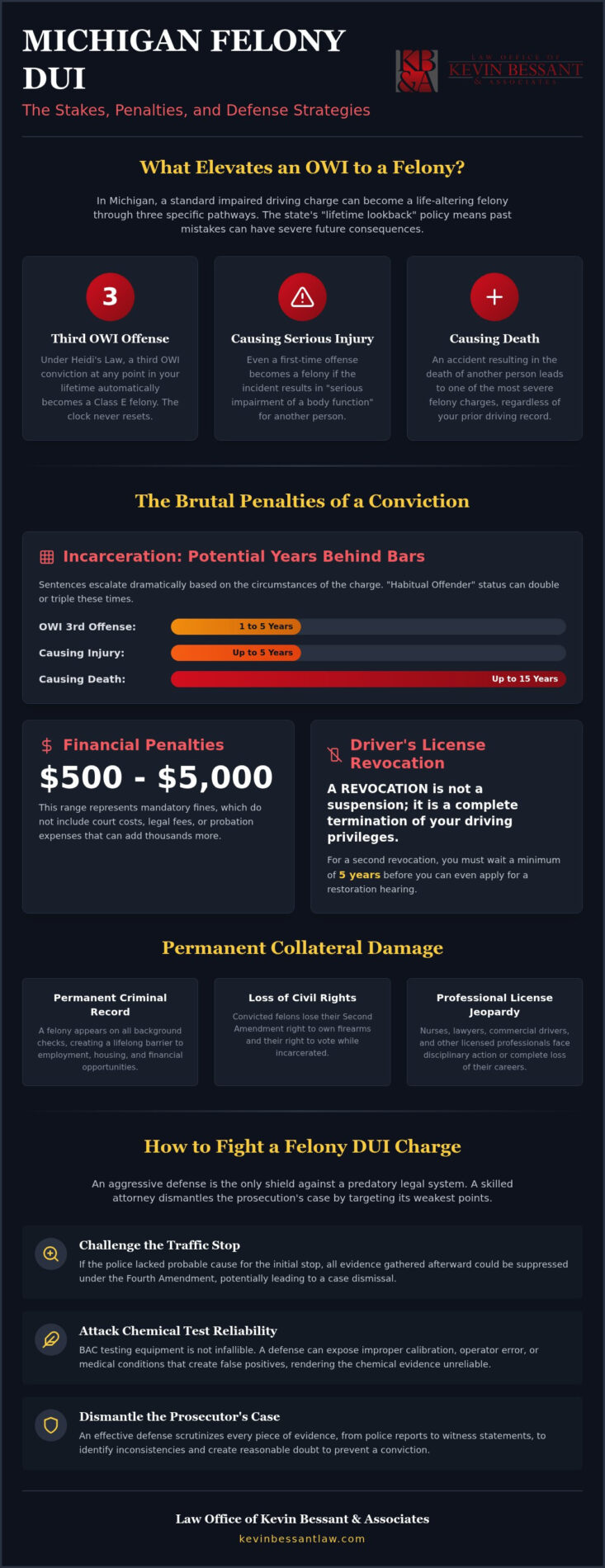
Michigan law classifies impaired driving under two primary umbrellas: Operating While Intoxicated (OWI) and Operating Under the Influence of Drugs (OUID). While many people associate a “DUI” strictly with alcohol, the state’s enforcement against narcotics and prescription medication is equally relentless. A felony DUI Michigan charge isn’t just a legal categorization; it’s an aggressive move by the prosecution to permanently label you a criminal. The state generally pursues these high-stakes charges through three specific avenues:
- A third OWI conviction at any point in your lifetime.
- An incident causing serious impairment of a body function.
- An accident resulting in the death of another person.
Unlike other states where laws might be more lenient over time, Michigan’s legal framework is built on a “danger-then-punishment” model that prioritizes state interests over individual recovery. While Drunk driving in the United States is governed by a variety of state-specific statutes, Michigan stands out for its uncompromising stance. Prosecutors in Wayne, Oakland, and Macomb counties treat these cases as political leverage. Judges and prosecutors often use these high-profile cases to signal their “tough on crime” credentials to voters, leaving the accused caught in a political crossfire. They aren’t looking to rehabilitate; they’re looking to convict. This aggressive posture is why you need a shield between you and a system that sees you only as a case number.
OWI 3rd Offense: The Lifetime Felony
Under Heidi’s Law, Michigan utilizes a “lifetime lookback” policy. This means if you had two prior convictions in 1995 and 2005, a new arrest in 2026 automatically triggers a Class E felony. The clock never resets. Even convictions from other states count toward this total, making it nearly impossible to escape your past without a sophisticated defense. A conviction here stays on your record forever, creating a permanent barrier to employment and housing. Don’t assume your old records are buried; the prosecution will find them and use them to threaten your freedom.
DUI Causing Serious Injury or Death
When an accident involves “serious impairment of a body function,” the prosecution doesn’t care about your driving history. This could be your first arrest, but the presence of an injury elevates the charge to a felony punishable by up to five years in prison. If a death occurs, you face up to 15 years. Navigating a felony DUI Michigan charge involving an injury requires an immediate, battle-ready response to counter the prosecution’s narrative. These cases carry intense emotional weight, often fueled by victim advocacy groups that pressure judges to impose the maximum possible sentences. You’re fighting the law and public sentiment simultaneously.
The Brutal Penalties of a Michigan Felony DUI Conviction
A felony DUI Michigan conviction is a life-altering event that the state uses to strip away your autonomy. It’s not a simple traffic matter. Under the Michigan Vehicle Code 257.625, an OWI 3rd offense carries a mandatory minimum of 30 days to one year in county jail or a prison sentence of one to five years. Fines are equally punishing, ranging from $500 to $5,000 plus court costs. If you have a prior felony record for unrelated crimes, the “Habitual Offender” sentencing enhancements can double or triple your potential time behind bars. Beyond the cell, you lose your Second Amendment right to own a firearm and your right to vote while serving your sentence. The state aims to isolate you.
Driver’s License Revocation: A Permanent Halt
Don’t confuse revocation with a suspension. A suspension has an end date; a revocation is a total termination of your driving privileges. For a second revocation, Michigan law requires a minimum five-year wait before you can even apply for a driver’s license restoration hearing. Even if you eventually win your hearing, you’ll be forced to install a Breath Alcohol Ignition Interlock Device (BAIID) and face strict monitoring. The Secretary of State is notoriously difficult to satisfy, and one minor technical error can reset your clock to zero.
Collateral Damage: Career and Reputation
The damage extends far beyond the courtroom. A felony conviction is a permanent red flag on background checks. If you hold a professional license as a nurse, attorney, or commercial driver, a conviction often triggers immediate suspension or permanent loss of your credentials. Employers in 2026 rarely overlook a felony record, often viewing it as a liability that outweighs your skills. A felony DUI Michigan record in 2026 acts as a permanent digital scar that limits your housing options and your ability to provide for your family. Securing the right representation early can be the difference between a prison cell and your living room. You should reach out to a defense specialist before the prosecution solidifies their case.
Why Michigan Courts Are Aggressive Toward Felony OWI
Michigan courts don’t operate in a vacuum. They are under immense pressure from the Secretary of State and political interest groups to maintain a zero-tolerance stance. While the Michigan Vehicle Code 257.625 sets the legal floor for penalties, local judges often set the ceiling much higher. In 2025, approximately 40.7% of traffic crash fatalities in Michigan involved alcohol or drugs, a statistic that fuels the aggressive posture of the judiciary. Unlike a first-time OWI where a judge might show some leniency, a felony DUI Michigan case is viewed strictly through the lens of public safety and political optics. Judges know that being “soft” on a repeat offender can end a career during the next election cycle.
Prosecutors frequently utilize “over-charging” as a psychological weapon to maintain control of the narrative. By stacking every possible enhancement and maximum penalty, they create a high-pressure environment designed to break your resolve. They want you to feel that a prison sentence is inevitable so you’ll accept an unfavorable plea deal just to escape the maximum. This isn’t justice; it’s a assembly-line approach to conviction. You’re not just fighting a charge; you’re fighting a system that prioritizes conviction rates over individual rights.
The Role of Wayne and Oakland County Prosecutors
Courts in Detroit and Southfield have carved out a reputation for uncompromising enforcement. In these jurisdictions, local court dynamics are heavily influenced by specific “no-tolerance” policies that affect everything from your initial appearance to final sentencing. These policies often dictate harsh bond conditions, including expensive GPS tethering and daily alcohol testing. If you are currently held, securing an aggressive Bond Hearing Lawyer Detroit is the only way to ensure your immediate release and give your defense team the time needed to build a shield against the state.
The Trap of the “Standard” Plea Deal
Never assume the first offer from a prosecutor is a “deal.” In a felony DUI Michigan case, the “standard” plea often still involves significant jail time and a permanent felony record that will haunt you for decades. Prosecutors rely on your fear to secure a quick win for their office. Managing a felony is not enough; you must fight it. A battle-ready advocate doesn’t just look at the plea; they look for the constitutional violations and technical errors that can get charges dismissed or reduced to a misdemeanor. Standing alone in a Michigan courtroom against these odds is a recipe for disaster.
How to Fight a Felony DUI Charge in Michigan: Defense Strategies
The prosecution wants you to believe their evidence is bulletproof. It’s not. A felony DUI Michigan charge often rests on flawed technology, procedural shortcuts, and the subjective observations of a single officer. We don’t accept the state’s narrative; we dismantle it piece by piece. Our defense strategy begins by positioning ourselves as a shield between you and a predatory legal system that is more interested in convictions than the truth. We utilize every available legal tool to challenge the evidence and protect your freedom.
Constitutional and Procedural Defenses
Every successful defense starts with the Fourth Amendment. Did the police officer have a valid, articulable “reasonable suspicion” to pull you over in Warren or Royal Oak? If the initial traffic stop was illegal, every piece of evidence gathered afterward—including breath tests and field sobriety results—becomes “fruit of the poisonous tree.” We aggressively move to suppress this evidence, which can lead to a total dismissal of charges. Additionally, we scrutinize whether the officer followed the mandatory 15-minute observation period before administering a breath test. Any failure to monitor you strictly for mouth alcohol or regurgitation can render the results inadmissible in court.
Scientific Challenges to BAC Evidence
The DataMaster DMT is a machine, and machines fail. We demand and analyze the calibration records, maintenance logs, and usage history of the specific device used in your case to expose mechanical errors. Blood draws are equally prone to failure; we look for chain-of-custody errors and improper storage techniques that lead to fermentation and inaccurate results. The “rising blood alcohol” defense is another powerful tool, as it demonstrates that because alcohol takes time to absorb into the bloodstream, your BAC may have been under the legal limit while driving even if it was over the limit by the time you reached the station. We use expert toxicologists to prove that the state’s timeline is scientifically impossible.
Immediate Actions After a Felony Arrest
What you do in the hours following an arrest determines the strength of your defense. Follow these steps immediately to protect yourself:
- Step 1: Exercise your right to remain silent. Don’t provide statements, explanations, or excuses to the police. They’re not looking to help you; they’re looking for admissions of guilt.
- Step 2: Document every detail of the arrest while it is fresh in your mind. Write down the weather conditions, what you ate, the officer’s behavior, and any witnesses present.
- Step 3: Secure an aggressive attorney before your first court appearance. You need a battle-ready DUI Defense Lawyer Detroit to take control of the situation immediately.
Don’t let the prosecution dictate your future with unchallenged evidence. You must take a proactive stance to secure your liberty. If you’re ready to fight back, you should contact our firm today to begin building your defense shield.
Why Kevin Bessant Is Your Essential Shield Against Felony Charges
The state of Michigan has already mobilized its resources against you. Prosecutors in Detroit and Southfield are preparing their case with one goal: a conviction that puts you in prison. When you face a felony DUI Michigan charge, you aren’t just looking for a consultant. You need a formidable shield. Kevin Bessant & Associates operates on a single, unwavering philosophy: we stand in the gap between the individual and the overwhelming power of the state. We don’t just “handle” cases. We fight them with a level of vigor and determination that forces the prosecution to earn every inch of their case. Your freedom is the only priority.
A Battle-Ready Advocate for Detroit and Beyond
Kevin Bessant brings over 20 years of high-stakes legal experience to your defense. This isn’t generic representation. It’s specialized advocacy from a lawyer who knows the specific tendencies of judges and prosecutors in Wayne, Oakland, and Macomb counties. We understand the local court dynamics that often dictate the outcome of a case before it even reaches trial. From the moment we are retained, we take a proactive approach toward bond hearings to secure your release and immediately begin filing motions for evidence suppression. You can learn more about our specific credentials and why clients trust us as their primary defense by visiting Why Us. We don’t wait for the prosecution to make the first move. We strike first. We challenge every procedural error and constitutional violation to protect your career and your reputation.
Take Control of Your Future Today
Time is your greatest enemy in a felony DUI Michigan case. The prosecution is already building their narrative, and every hour you wait is an hour they use to solidify their position. Early intervention is the only way to protect your professional licenses, your employment, and your freedom. You cannot afford to be passive when the legal system is actively working to dismantle your life. We offer a confidential case evaluation where we will listen to your situation and provide a clear, methodical path forward. Don’t let a predatory system dictate your future. Contact the Law Office of Kevin Bessant & Associates now to secure the aggressive representation you deserve. We are ready to stand as your shield and fight for the best possible outcome.
Legal Authority: Statute and Case Law
Michigan’s OWI statute, including the third-offense felony provision known as Heidi’s Law, is codified at MCL 257.625.
- People v Hammerlund, 504 Mich 442, 451; 939 NW2d 129 (2019) — the Michigan Supreme Court held that a warrantless OWI arrest made without probable cause requires suppression of the resulting breath-test results and statements, the controlling case for challenging a weak initial stop, which applies with equal force to a felony third-offense charge built on a questionable stop.
For the current statutory text and published opinions, see the Michigan Legislature’s MCL database and the Michigan Courts case search.
Secure Your Future Against Michigan’s Predatory Legal System
The state’s aggressive stance on a felony DUI Michigan charge is designed to break your spirit and strip away your freedom. We’ve explored how Michigan’s uncompromising lifetime lookback rules and the political pressures in local counties create a high-stakes environment where you are the target. However, you aren’t defenseless. By identifying Fourth Amendment violations and exposing the scientific failures of BAC testing, we can dismantle the prosecution’s narrative and protect your liberty.
Kevin Bessant & Associates provides the specialized high-stakes felony representation you need to survive this crisis. With over 20 years of criminal defense experience and a proven track record in Detroit and Southfield courts, we act as a battle-ready shield for our clients. Don’t leave your career and liberty to chance in a system that prioritizes conviction rates over your constitutional rights.
Take the first step toward reclaiming your life. You have the power to fight back, and we have the expertise to lead the charge toward a favorable outcome. We are ready to stand in the gap for you.
Frequently Asked Questions
Is a 3rd DUI always a felony in Michigan?
Yes, a third OWI offense in your lifetime is automatically classified as a Class E felony under Heidi’s Law. Michigan utilizes a lifetime lookback period, meaning prior convictions from decades ago still count toward this total. You face mandatory jail time and permanent revocation of your driving privileges regardless of how much time has passed since your last arrest. This is why immediate, aggressive defense is vital to your survival.
Can I go to prison for a first-offense DUI if someone was injured?
Yes, you can be sentenced to up to five years in state prison for a first offense if the accident caused serious impairment of a body function. The prosecution treats these cases with extreme aggression because of the physical harm involved. Your clean driving record won’t stop a judge from imposing a harsh sentence if you are convicted of this specific felony DUI Michigan charge. You need a shield.
How long does a felony DUI stay on your record in Michigan?
A felony DUI conviction remains on your criminal record permanently. Unlike some minor traffic offenses that may eventually be shielded from public view, a felony is a lasting mark that shows up on every background check. It affects your ability to secure housing, obtain loans, and find meaningful employment. Because it never expires, your only real option is to fight the charge before a conviction is entered by the court.
Can a felony DUI be expunged under the Clean Slate law?
No, felony DUI convictions are currently ineligible for expungement under Michigan’s Clean Slate laws. While recent legislation allows for the removal of a first-time misdemeanor OWI after five years, these protections do not extend to third offenses or cases involving serious injury or death. Once a felony is on your record, it’s there for life. This reality underscores the necessity of a battle-ready defense to prevent a conviction.
What happens if I refuse a chemical test in a felony DUI stop?
Refusing a chemical test triggers an automatic one-year driver’s license suspension under Michigan’s Implied Consent law. Additionally, the police will likely secure a search warrant to perform a forced blood draw anyway. While you have the right to refuse, the state uses that refusal as leverage to justify harsher administrative penalties. You need an advocate to challenge the legality of the stop and the subsequent warrant to protect your rights.
Will I lose my job if I am charged with a felony DUI?
You face a significant risk of termination, particularly if your career requires a professional license or a Commercial Driver’s License (CDL). Many employment contracts include clauses that trigger dismissal upon a felony charge or conviction. Even without a contract, the mandatory jail time associated with these charges often makes maintaining a job impossible. Securing an aggressive shield against these charges is the only way to preserve your professional future.
How much does a felony DUI defense attorney cost in Michigan?
The cost of a defense attorney varies based on the complexity of your case and the level of expert testimony required to dismantle the prosecution’s evidence. High-stakes felony DUI Michigan litigation involves extensive investigation, scientific analysis of BAC results, and aggressive motion practice. While you should check with individual firms for their specific structures, the true cost of a conviction—prison, lost wages, and permanent records—far outweighs the investment in a formidable defense.
Can a lawyer get my felony DUI reduced to a misdemeanor?
Yes, an experienced advocate can often negotiate a reduction to a misdemeanor by exposing procedural errors or constitutional violations. If the initial stop was illegal or the chemical testing equipment was improperly calibrated, the prosecution’s leverage vanishes. We focus on identifying the state’s weaknesses to force a more favorable outcome. A reduction is often the most effective way to avoid mandatory prison time and protect your future from a permanent felony record.
Can the whole case be thrown out if the initial stop was illegal?
Yes. People v Hammerlund, 504 Mich 442 (2019), holds that a warrantless OWI arrest made without probable cause requires suppression of the breath-test results and statements that followed, which applies with equal force to a felony third-offense case built on a weak stop.